Two forces are shaping the American crypto market on Thursday: a sharp repricing in the U.S. bond market and a political reset in Washington after the failure of the market-structure bill. Together, they show how much digital assets now depend on both macro conditions and regulatory direction.
Bond Market Shock Pulls Bitcoin Lower
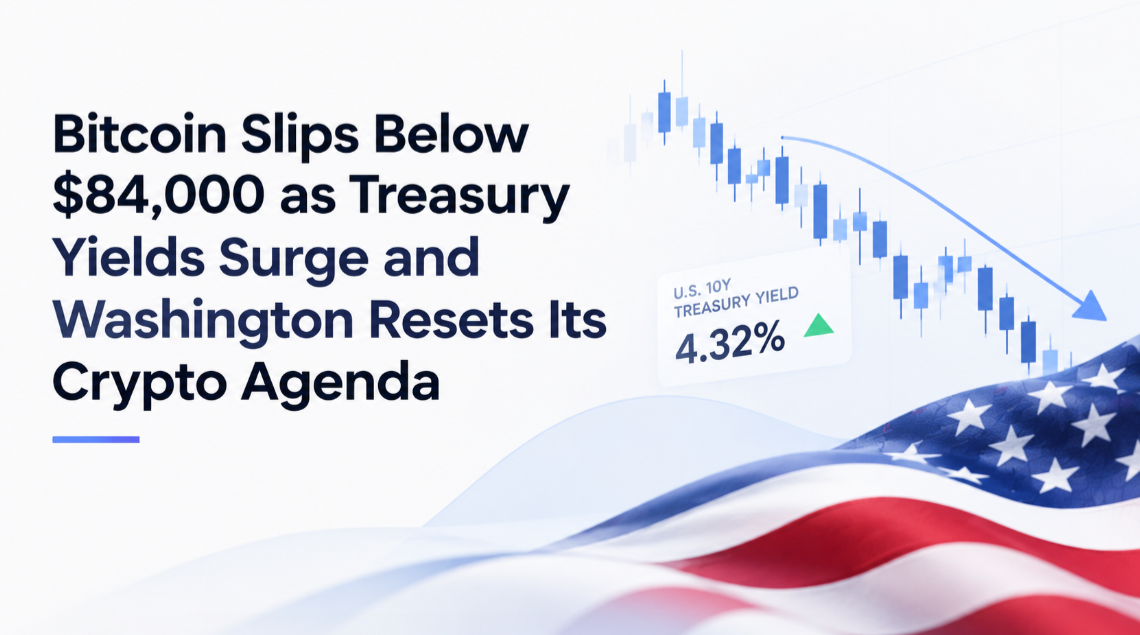
Bitcoin slipped below $84,000 during Asian trading hours on Thursday, touching roughly $83,200 after having climbed near $87,000 earlier this week. The trigger was the Treasury market. The 10-year yield closed Wednesday at 5.11%, up from 4.96% a day earlier, and reached 5.13% intraday, the highest level since 2007.
Stronger-than-expected economic data added fuel. The flash S&P Global U.S. composite PMI for September rose to 58.4, with services at 58.7 and manufacturing at 57, while input costs climbed at the fastest pace in four years. Oil also gained on the day. U.S. equities felt the pressure, with the Nasdaq down 1.15% and the S&P 500 down 0.7% on Wednesday.
Because bitcoin pays no yield, higher Treasury returns make it relatively less attractive, especially when traders fear tighter policy. The Federal Reserve raised rates on September 16, and some analysts now put the odds of another hike in October at around 70% or higher. The Treasury has also set a $6 billion ceiling for a buyback of bonds with 20 to 30 years remaining, a step traders are watching for signs of stabilization.
Not all the news was negative. Spot bitcoin ETFs took in more than $2 billion this week, and analysts point to support near $82,800 as the next level to watch.
White House Defends Trump's Crypto Ties
In Washington, Patrick Witt, the White House's crypto adviser, spoke at a Georgetown University conference on Wednesday to address criticism that President Trump's own crypto interests contributed to the CLARITY Act's failure to advance in the Senate on September 15.
Witt argued that Democrats turned the issue into a political fight and said the president had accepted two unprecedented ethics provisions during negotiations. The first would have required Trump to divest his crypto holdings or place them in a blind trust. The second would have allowed state attorneys general to act if federal authorities failed to police ethical violations.
Witt also blamed banking lobbyists, who oppose stablecoin rewards because they could compete with interest-bearing bank deposits. He signaled that the end-of-year lame-duck session is not a major focus and that the main work is shifting to federal regulators such as the Securities and Exchange Commission.
Why the Two Stories Connect
With the legislative route uncertain, regulators now carry more of the rulemaking load, and the market has fewer near-term catalysts of its own. In that environment, macro variables such as yields, inflation data and Fed expectations are likely to dominate short-term price action. This is analysis, not a forecast.
What to Watch Next
Traders will follow the U.S.-China summit in Washington this week, upcoming Fed communications and the final September PMI readings due October 1 and October 5. Any further rise in yields or the dollar could extend the pressure on risk assets, while softer data could ease rate-hike fears.