The U.S. crypto policy landscape shifted on two fronts this week, with one of the industry's most reliable regulatory allies announcing her exit and a federal court dealing a fresh blow to the prediction-markets sector.
Crypto Mom's Departure Thins Out the SEC's Digital-Asset Bench
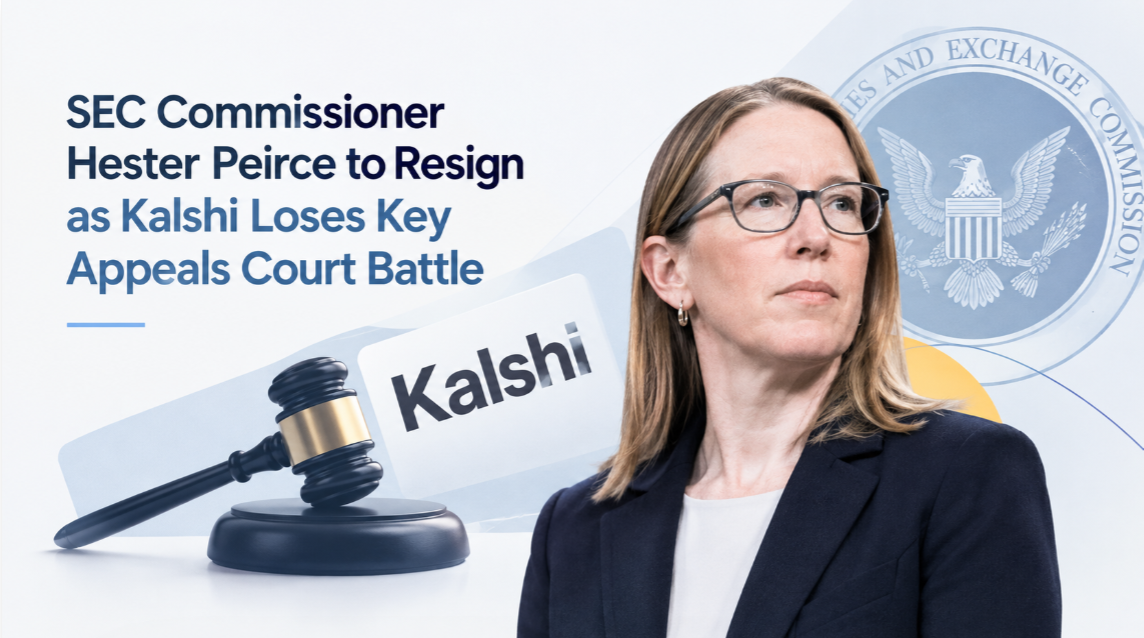
Securities and Exchange Commission Commissioner Hester Peirce, widely nicknamed "Crypto Mom" for her long-standing push for clear, rules-based digital asset policy, has formally announced her resignation, effective October 2. Peirce shared her decision in a letter posted to her personal social media account, thanking the administration for the opportunity to serve and noting she was leaving the agency in the hands of Chairman Paul Atkins and fellow commissioner Mark Uyeda.
Peirce joined the SEC in 2018 and spent nearly eight years shaping the agency's approach to crypto, including leading its Crypto Task Force since early 2025. Her tenure included guidance on mining, staking, and how various digital assets should be classified under securities law. She plans to join Regent University School of Law as an associate professor this November.
Her exit leaves the five-member commission with just two sitting commissioners, both Republicans — a thin bench that is still technically sufficient to form a quorum under SEC rules, but one that raises questions about the pace and direction of future rulemaking. The timing is notable: her resignation landed the same day the agency circulated additional crypto-related guidance addressing how token marketing, staking rewards, and secondary-market activity should be treated under existing securities rules, building on the SEC's broader "Regulation Crypto Assets" proposal introduced in August.
Kalshi Suffers a Second Major Appeals Court Defeat
Separately, the Sixth Circuit Court of Appeals ruled that prediction-market operator Kalshi's sports-related event contracts do not qualify as federally regulated "swaps," meaning they can instead be subject to state gambling laws rather than falling under the Commodity Futures Trading Commission's exclusive jurisdiction.
The unanimous three-judge panel addressed two cases brought by Kalshi against regulators in Ohio and Tennessee. The court upheld Ohio's denial of an injunction shielding the platform from state oversight, while vacating an injunction that had previously been granted in Kalshi's favor in Tennessee. The judges reasoned that Kalshi's sports contracts are not tied to outcomes with a direct financial, economic, or commercial consequence in the way the law defines a swap — despite Kalshi's argument that the products should qualify given their structure and listing on a CFTC-registered exchange.
A company spokesperson pushed back on the decision, arguing that a state-by-state patchwork of conflicting rulings shows exactly why Congress created a single federal regulator for these markets in the first place. The ruling marks the second significant appellate loss for the prediction-markets industry in roughly a month, following a similar decision favoring Nevada's position, while courts in New Jersey and the Third Circuit have reached the opposite conclusion — setting up a circuit split that increases the odds the U.S. Supreme Court will eventually take up the issue.
What It Means for the Market
Together, the two developments underscore how unsettled U.S. crypto-adjacent regulation remains even as the industry pushes for clarity. The SEC's commissioner shortage arrives at a moment when the agency is actively finalizing new crypto-asset rules, while the widening legal split over prediction markets suggests platforms like Kalshi may face years of jurisdictional uncertainty before a definitive nationwide standard emerges. For investors and operators alike, both stories point to the same underlying theme: regulatory frameworks are evolving, but not yet settled.