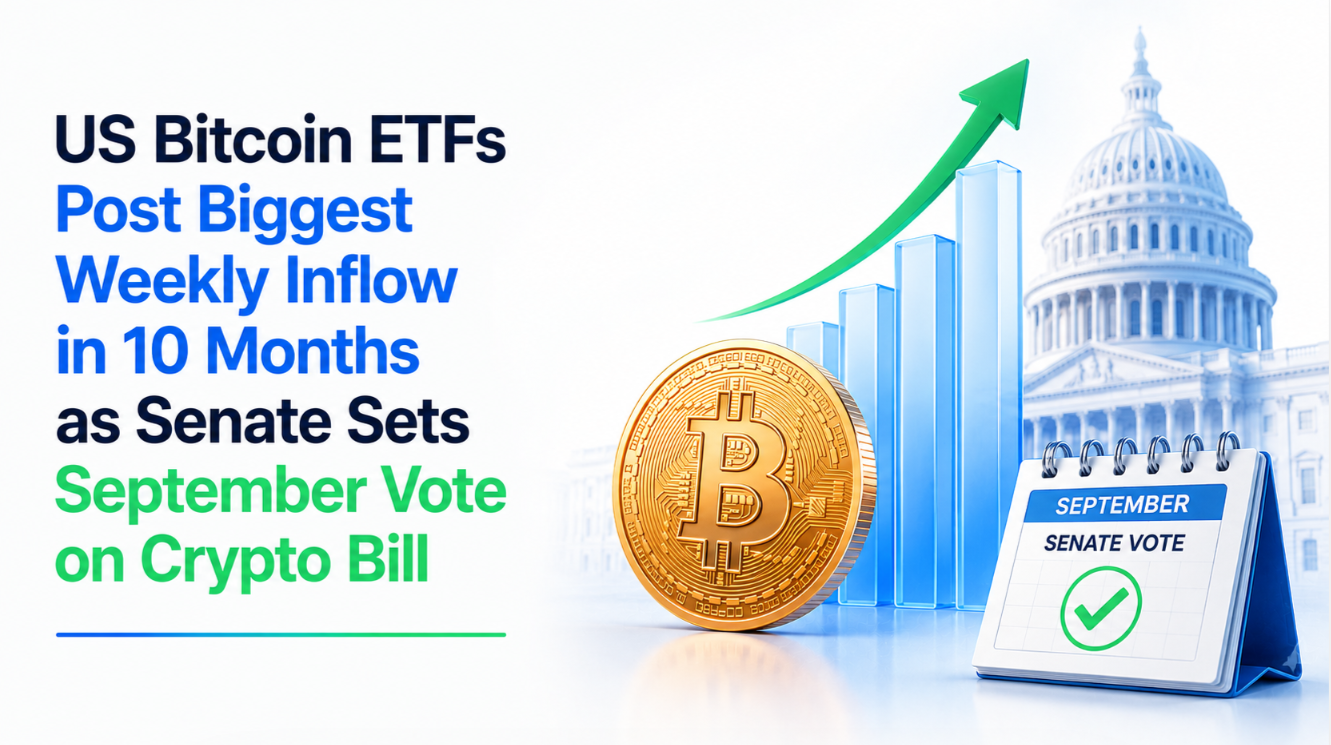
US Bitcoin ETFs Post Biggest Weekly Inflow in 10 Months as Senate Sets September Vote on Crypto Bill
America's crypto market delivered two milestones within the same week: institutional money returned to Bitcoin funds at a pace not seen in almost a year, and Washington finally put a date on the calendar for the industry's most-watched piece of legislation. Together, the two developments paint a picture of a market that is gaining both capital and regulatory momentum at the same time — even if neither trend is guaranteed to hold.
Record Money Flows Back Into Bitcoin Funds
The 13 US-listed spot Bitcoin ETFs pulled in a combined $1.92 billion last week, their largest weekly haul since early October of the previous year. The surge in demand tracked a sharp rally in the underlying asset: Bitcoin climbed roughly 23% over the same seven days, its strongest weekly gain in more than three years, pushing the price back toward the high-$70,000s.
Ether funds rode the same wave. Spot Ethereum ETFs collected close to $697 million over the week, while smaller inflows also landed in Solana and XRP-linked products, an indication that the renewed appetite for regulated crypto exposure isn't confined to Bitcoin alone.
For asset managers who spent much of the summer defending against outflows, the reversal is a notable shift. It suggests that once Bitcoin cleared key psychological price levels, institutional allocators moved quickly to add exposure rather than wait for a pullback — a pattern that has repeated through several rallies since spot ETFs launched.
Congress Sets a Date for the CLARITY Act
On the policy side, the Senate closed out its August session without the floor vote on the Digital Asset Market Clarity Act that industry groups had pushed for. Instead of letting the bill stall entirely, however, Majority Leader John Thune filed a cloture motion before the recess — a procedural step that keeps the legislation active and schedules a vote on whether to formally take up the bill for September 15.
That vote is not a final up-or-down decision on the CLARITY Act itself; it's the motion that would open debate on the Senate floor. Getting there still requires 60 votes, and the underlying disagreements haven't disappeared. Democrats are pushing for stronger ethics provisions, conflict-of-interest rules, and illicit-finance safeguards, while Republican sponsors are prioritizing the kind of regulatory certainty they argue the market needs to keep growing in the US rather than offshore.
Congressional aides and industry lobbyists have described the September timeline as realistic, but tight — lawmakers will have only a few weeks of floor time before attention shifts to the November midterms, leaving a narrow window to reconcile the House and Senate versions of the bill even if the cloture vote succeeds.
What It Means for the Market
Taken together, the ETF inflow data and the legislative calendar tell a consistent story: capital is already voting with its wallet, and Congress is under pressure to catch up. A successful cloture vote in September wouldn't immediately create new rules, but it would signal that market-structure legislation has a real path forward this year — something that could reinforce the same institutional confidence currently showing up in ETF flow data.
The reverse is also true. If the September 15 vote fails to advance, the CLARITY Act's chances of becoming law in 2026 would fade further, right as the midterms consume Congress's remaining bandwidth. For now, though, both threads — record fund inflows and a scheduled Senate vote — point toward a market and a policy process that are, for the moment, moving in the same direction.