America's crypto industry spent the back half of this week wrestling with two very different stories about the same underlying tension: how closely political power and digital assets should be allowed to mix. In Sacramento, lawmakers moved to shut the door on public officials cashing in on memecoins. In Washington and Abu Dhabi, new reporting showed just how deep foreign capital now runs inside the crypto venture tied to the Trump family.
California Says No More Official Memecoins
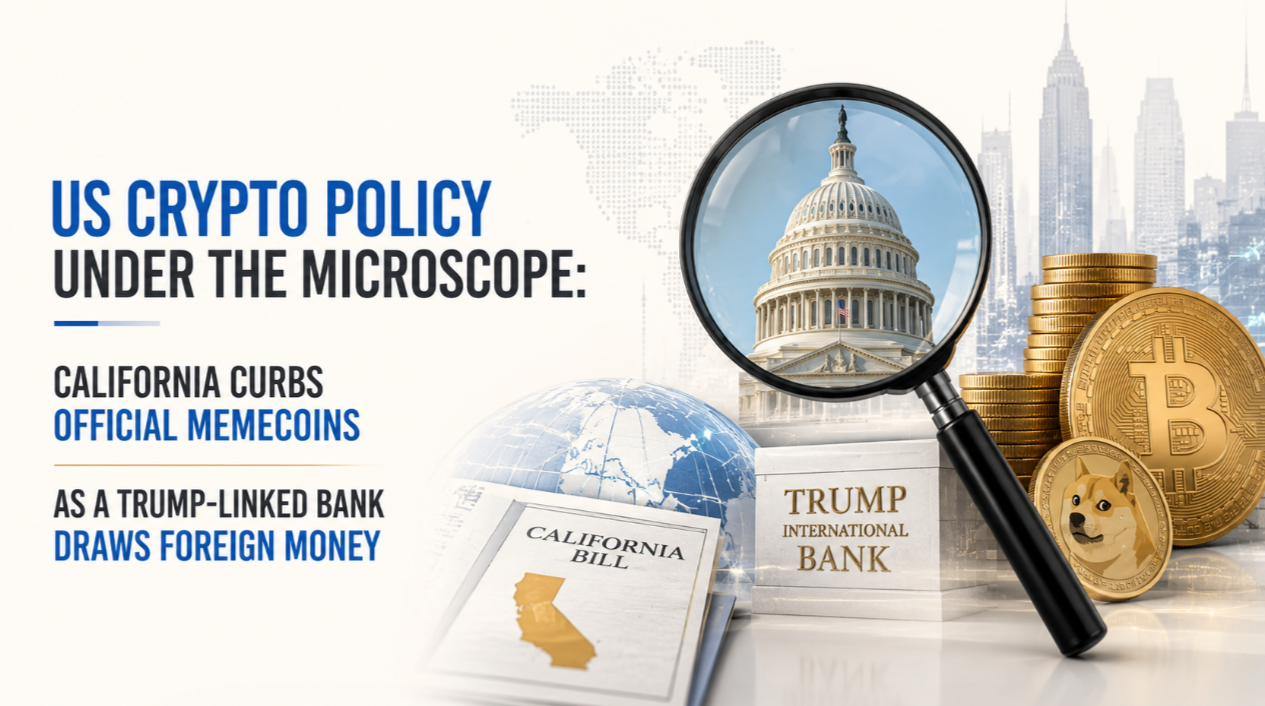
California's Assembly Bill 2409 would stop digital asset platforms from offering state residents memecoins issued by, or in partnership with, federal, state or local public officials, starting January 1, 2027. Lawmakers deliberately broadened the bill's language during an August 21 amendment, shifting the trigger from a coin bearing an official's likeness to any coin offered by or in partnership with a covered official — a change meant to close an obvious workaround.
The bill's authors cite conflict-of-interest concerns and so-called "pay-to-play" arrangements as the driving rationale. The California Senate passed the measure 40-0, and the Assembly voted 78-0 to concur with the Senate's amendments; it now sits enrolled and awaiting the governor's signature.
The timing is no accident. Federal lawmakers have spent much of 2026 debating similar restrictions, with Senator Kirsten Gillibrand pushing to bar members of Congress and their spouses from issuing or promoting memecoins, a proposal that followed President Trump's disclosure of roughly $1.4 billion in 2025 crypto-related income tied to his TRUMP token and World Liberty Financial. That disclosure turned crypto ethics into one of the thorniest sticking points in ongoing negotiations over the federal Digital Asset Market Clarity Act, and California's bill effectively pre-empts Congress by giving state regulators their own enforcement lane.
A Trump-Linked Bank Finds Its Biggest Backer — In Abu Dhabi
The second story hits closer to the center of American crypto politics. Sheikh Tahnoon bin Zayed al Nahyan, the UAE's national security adviser, and his co-investors have emerged as the largest shareholders in the holding company behind World Liberty Financial's planned trust bank, according to Wall Street Journal reporting. The investment vehicle, StringZ Holding RSC, holds a 49% stake in WLTC Holdings, while a Trump family-affiliated entity controls another 38%.
The disclosure lands only weeks after the Office of the Comptroller of the Currency granted World Liberty Trust Company preliminary approval to operate as a national trust bank, a structure the firm says would let it handle stablecoin issuance and redemption, custody and conversion services. That bank is built around USD1, World Liberty's dollar-pegged stablecoin, which now ranks as the fourth-largest stablecoin in the market with roughly $4 billion in circulation.
This isn't Tahnoon's first check to the Trump-backed venture. In January 2025, as Trump was returning to the White House, Tahnoon and fellow investors committed $500 million to World Liberty Financial in exchange for a 49% ownership share, a deal that directed $263 million to Trump family entities according to Trump's own 2025 financial disclosure. Sheikh Tahnoon separately chairs the AI company G42 and oversees additional investment vehicles, with the Journal citing a personal and state-linked fortune exceeding $1.3 trillion.
World Liberty has pushed back on the framing. A company spokesperson described the firm as an independent American fintech business rather than a political entity, emphasizing that its trust company operates under a separate governance structure.
Why It Matters
Together, the two stories sketch the same fault line from opposite directions. California is trying to legislate distance between elected officials and the tokens that carry their names, at the exact moment a foreign sovereign-linked investor is buying into the banking infrastructure surrounding the sitting president's own crypto venture. Analysts note the 49% stake could trigger foreign-investment reviews and may set a precedent for how regulators handle crypto-bank charters tied to political families going forward.
For US crypto markets, the practical takeaway is that scrutiny is intensifying on two fronts simultaneously: state-level consumer protection rules aimed at token issuance, and federal banking approvals for stablecoin infrastructure with politically connected ownership. Both threads are likely to keep surfacing as the federal market-structure debate in Congress continues.