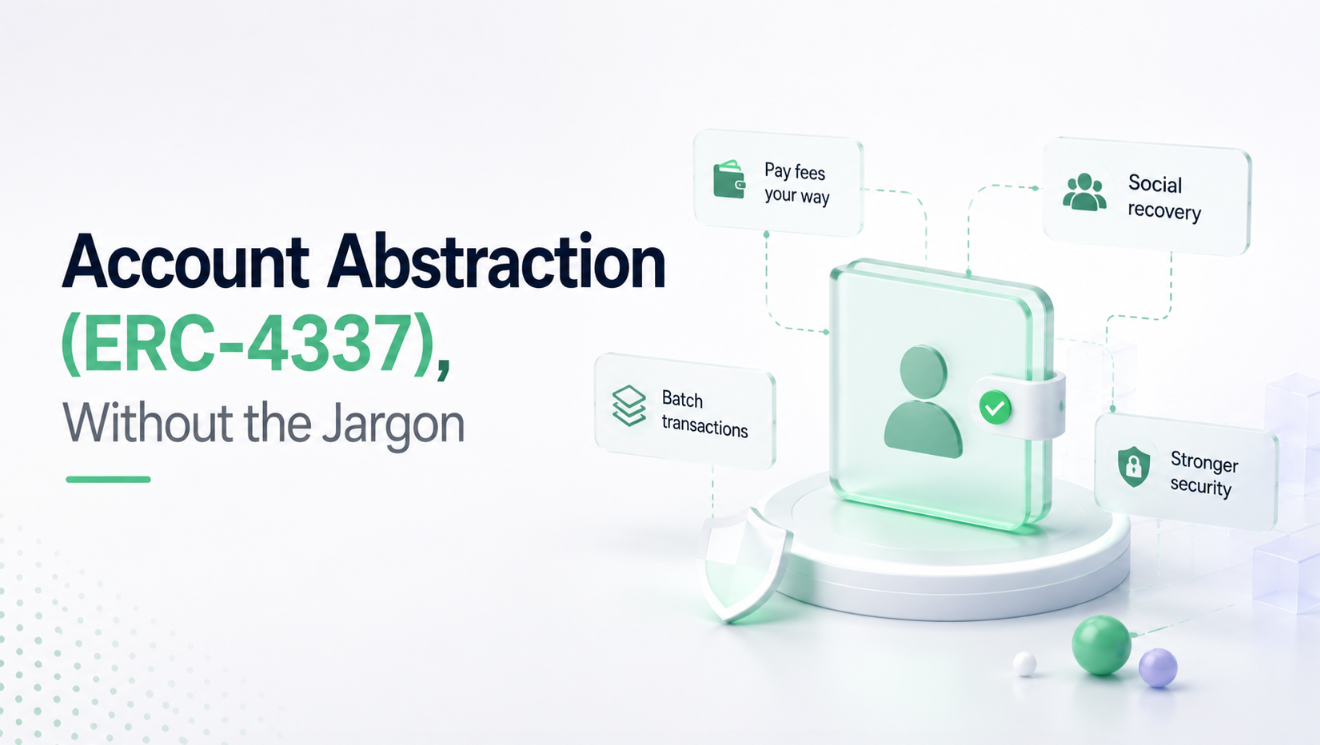
Account abstraction is one of those terms that sounds like it should be explained in a paragraph but usually gets thirty. The core idea is genuinely simple: let smart-contract accounts do everything that externally-owned accounts (EOAs) can do — including initiating transactions and paying gas in any token — without changing Ethereum's base protocol. ERC-4337 is the specific standard that made this work at scale, and it has been quietly reshaping wallet UX since it activated in March 2023.
The problem it solves
Before ERC-4337, only EOAs could initiate transactions. This meant every user needed:
1. An EOA — which required a private key or seed phrase 2. ETH in that EOA — because gas had to be paid in ETH, from the sender's balance 3. A wallet that could construct and sign transactions in the exact format Ethereum's base protocol requires
Every workaround for these constraints — social recovery, gasless transactions via meta-transactions, batch operations — was a bolt-on that broke in various edge cases. Every wallet was fighting against the underlying protocol's assumption that senders were EOAs with ETH balances.
ERC-4337 flipped this. Instead of making the protocol accept smart wallets as senders (which would require a hard fork), it added an entire alternative transaction layer on top of the existing protocol. Smart wallets get all the properties they always wanted; the base protocol didn't need to change.
The three roles
ERC-4337 defines three actors beyond the user:
**Bundlers**: services that watch a specialized mempool (separate from Ethereum's main mempool) for UserOperations — a new kind of pseudo-transaction. Bundlers pick up UserOperations, package many of them into a single Ethereum transaction sent to an EntryPoint contract, and pay the gas up-front. They earn back the gas cost plus a small profit from the fees the UserOperations include.
Bundlers are analogous to block builders. Multiple exist for competition, and any node operator can run one. Alchemy, Pimlico, Biconomy, and StackUp are the largest infrastructure providers.
**Paymasters**: smart contracts that agree to pay gas on behalf of specific users or operations. A paymaster's logic decides who to sponsor and under what conditions. Common patterns:
- Pay gas in USDC (user sends USDC to the paymaster, paymaster pays ETH gas)
- Sponsor gas for verified users of an app (like Web2 apps not charging you to use them)
- Prepaid gas balances (user tops up once, subsequent operations charge against balance)
Paymasters are optional. A UserOperation without a paymaster charges gas to the user's own wallet balance.
**Entry Point**: a canonical singleton contract deployed once, permissionless, that all bundlers submit their bundled operations to. The EntryPoint enforces the ERC-4337 protocol rules — validating signatures, calling paymasters, executing user operations in order. Currently at address 0x5FF137... on all EVM chains.
What changes for users
The user-facing effects of ERC-4337 are the reason it exists:
**Pay gas in any token**: with a paymaster, users can pay in USDC, DAI, or the app's own token. No more "I have $500 in USDC but can't do anything because I lack $5 of ETH."
**Batch operations**: one UserOperation can atomically do many things. Approve a token AND swap in one operation, instead of two transactions. Sign a permit AND execute the swap AND stake the LP token. All-or-nothing.
**Session keys**: a smart wallet can authorize a "session key" — a scoped, time-limited key that can execute specific actions without user approval. Perfect for games and complex apps where the user doesn't want to sign every mouse click.
**Recovery**: because the smart wallet is a contract, its authorization logic can include social recovery, multisig, time-locked recovery via passkeys, or any custom scheme. Losing your daily-use key doesn't mean losing your funds.
**Sponsored onboarding**: apps can sponsor the first transaction (or first ten) for new users. The user never needs to touch ETH to try the app.
The flow, end to end
A typical ERC-4337 flow:
1. User's smart wallet constructs a UserOperation describing what they want to do (swap tokens, mint an NFT, whatever). The user signs it. 2. The wallet sends the UserOperation to a bundler's mempool (via a bundler API). 3. The bundler picks it up along with other UserOperations, packages them into a single Ethereum transaction sent to the EntryPoint contract, and broadcasts. 4. The EntryPoint contract validates each UserOperation (signature check, paymaster check, nonce check). 5. The EntryPoint executes each UserOperation's actual logic. 6. The EntryPoint charges gas — either from the user's smart wallet or from the paymaster. 7. The bundler is reimbursed for the gas it paid up-front, plus profit.
From the user's perspective this is invisible. They see "click confirm, transaction happens." From the developer's perspective there's a lot of infrastructure to understand.
The infrastructure landscape
The bundler and paymaster ecosystem is a genuine business now. Major players:
- **Alchemy**: bundler + paymaster infrastructure with smart-wallet SDKs
- **Pimlico**: bundler infrastructure, ERC-4337 focused
- **Biconomy**: paymaster infrastructure with app-integration tools
- **Stackup**: bundler infrastructure
- **Coinbase Developer Platform**: bundler + paymaster with Smart Wallet integration
Each offers slightly different SDKs, pricing, and enterprise features. For an app builder, choosing one is a real vendor decision — the paymaster relationship in particular is long-term.
Wallets that use ERC-4337
The current landscape:
- **Coinbase Smart Wallet**: launched 2024, passkey-first UX, ERC-4337 under the hood, works on Ethereum and multiple L2s
- **Safe{Core}**: the Gnosis Safe stack now supports ERC-4337 for its smart-multisig accounts
- **Argent X (StarkNet)**: Argent's account abstraction implementation, though StarkNet has native AA rather than ERC-4337
- **ZeroDev**: modular smart-wallet infrastructure that many apps use to embed smart wallets
MetaMask has added optional smart-wallet features via EIP-7702 (2025) rather than fully embracing ERC-4337. This is a hybrid approach — your existing MetaMask address stays, but you can opt into smart-wallet behavior when needed.
EIP-7702: bridging the gap
EIP-7702 activated in Ethereum's Pectra upgrade (2025). It lets an EOA temporarily execute smart-contract logic for a single transaction — effectively "borrowing" the capabilities of a smart contract without changing addresses.
For users, this means your existing EOA (with its transaction history, ENS name, verified reputation) can get smart-wallet features like batching, session keys, and paymaster gas — without migrating to a new address.
For developers, EIP-7702 is a way to onboard existing users to account-abstraction features without asking them to move funds. Combined with ERC-4337, it's the practical bridge for the entire installed base of MetaMask/Rabby/Ledger users.
What ERC-4337 does not fix
ERC-4337 is not:
- A privacy solution (transactions are still visible on-chain)
- A way to make Ethereum cheaper at the base layer (gas is still gas)
- Backward-compatible with old dApps that assume EOA senders (some dApps have compatibility issues with smart-wallet signatures — the EIP-1271 standard fixes this but adoption is uneven)
- A replacement for hardware wallets (a smart wallet can be signed by a hardware wallet, but hardware wallet signing is orthogonal to account abstraction)
The scope is: make smart-contract wallets first-class, enable gas abstraction, standardize the infrastructure. That's meaningful, but it's not everything.
The realistic timeline
By 2026, ERC-4337 is deployed at scale. Every major chain that runs the EVM (Ethereum, Arbitrum, Optimism, Base, Polygon, and dozens of others) has bundler and paymaster infrastructure available. Coinbase Smart Wallet has millions of users. Major dApps offer sponsored onboarding.
But most user activity still happens through EOAs — MetaMask, Rabby, hardware wallets — because that's what most existing users have. The migration to smart wallets is gradual, driven mostly by new-user onboarding and app-embedded wallets rather than existing users switching.
The end state is probably a mix: EOAs remain the choice for cold storage and self-sovereign power users, smart wallets become the norm for daily-use wallets, and EIP-7702 lets both coexist without forcing anyone to move. Account abstraction ends up being a feature set that any user can access, not a one-size-fits-all replacement.