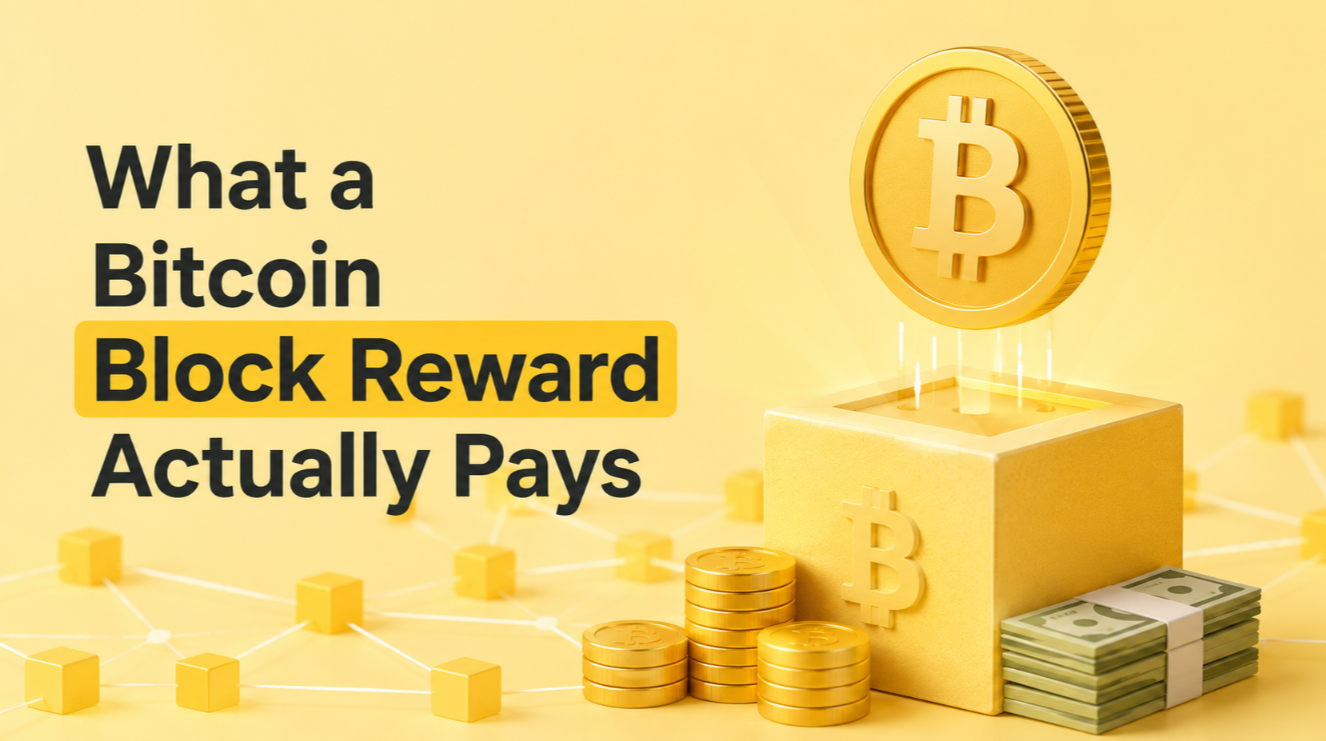
Every ten minutes, a Bitcoin miner earns a block reward. It is a single payout with two very different parts: the subsidy — freshly minted BTC created by the protocol — and the transaction fees paid by everyone whose transaction lands in that block. Miners keep both. The mix between the two shifts every four years, and it is the mechanism by which Bitcoin transitions from an inflationary bootstrap phase to a security model paid for entirely by users.
Understanding the two halves separately is the difference between reading a chart of miner revenue and reading the network's long-term incentive design.
The subsidy: predictable and shrinking
When Bitcoin launched in 2009, each block minted 50 BTC out of thin air. That number is the subsidy. It halves every 210,000 blocks — roughly every four years — on a schedule the code enforces without exception. The subsidy has stepped down four times: to 25 BTC in 2012, 12.5 BTC in 2016, 6.25 BTC in 2020, and 3.125 BTC in 2024. The next halving, to 1.5625 BTC, is expected in 2028.
The subsidy exists because someone had to pay miners to secure a network with no history. In 2009 there were no fees to speak of, because there were no meaningful transactions to compete for block space. The subsidy was Bitcoin's stimulus package — a way to buy security while the ecosystem grew large enough to fund itself.
Because halvings are deterministic and known years in advance, the subsidy is arguably the most predictable revenue stream in any market. That predictability is why it also fails to matter for miner economics past a certain price point — everyone has priced it in. What matters is the relationship between the subsidy and the second half of the reward.
Fees: volatile and increasingly load-bearing
Every Bitcoin transaction pays a fee, measured in satoshis per virtual byte (sat/vB). The mempool — the queue of unconfirmed transactions — sorts by fee rate, so miners naturally pick the transactions offering the most sats per byte of block space. The sum of those fees across all transactions in a block is the fee revenue.
Fees are highly cyclical. They spike when block space is scarce — during bull runs, memecoin manias, Ordinals inscription waves, or NFT drops on Bitcoin L2s — and they compress to near zero when demand fades. A block during Ordinals hype in 2024 paid more fees than the entire year of blocks in 2019. Miners cannot forecast fees the way they can forecast the subsidy.
The subsidy is the floor. Fees are the ceiling. In quiet periods, the subsidy is almost the entire reward; in busy periods, fees can equal or exceed it.
The trade-off over halvings
Because the subsidy halves every four years while fee demand grows with adoption, the mix between the two shifts predictably: subsidy trends toward zero, fees trend toward everything. The precise trajectory is impossible to know, but the direction is not.
At Bitcoin's launch, fees were essentially 0% of the reward. By the mid-2020s the fee share averages 10-20% of total miner revenue and spikes as high as 40-60% during peak periods. By the 2040s, the subsidy will be under 0.1 BTC per block; whatever miners earn will come almost entirely from fees.
That is the design. Nakamoto's paper explicitly assumed that block space demand would grow into a market big enough to fund security once the subsidy stopped being meaningful. Whether that assumption holds is the single most-debated question in Bitcoin economics.
Why the mix matters for security
Bitcoin's proof-of-work security is priced in dollars, not BTC. Miners spend electricity to earn their reward, then sell most of it to cover operating costs. The higher the total reward denominated in dollars, the more electricity miners can afford to spend, and the more expensive an attack becomes.
If BTC price stays flat while the subsidy halves, miner revenue falls unless fees pick up the slack. That is exactly the argument for why fee-generating activity on Bitcoin — Ordinals, Runes, Lightning routing, sidechain settlement — matters strategically even if the individual protocols are controversial. They generate the demand for block space that eventually replaces the subsidy.
The counter-argument is that fee demand is too cyclical to reliably pay for security. A year with no fee spikes could underpay miners just as the subsidy compresses. If that happens, hashrate drops, difficulty adjusts down, and the attack cost falls with it. This is the "security budget problem" that every Bitcoin researcher writes about at least once.
What miners actually see
For any active mining operation, the reward is denominated in BTC, converted to dollars at spot, and compared against the cost per terahash. Two identical rigs in different jurisdictions can have radically different profitability because the electricity bill is the biggest variable. The subsidy is a global constant; the profit margin is local.
When people ask "when do halvings hurt miners?" the answer is: when the price appreciation in the following months does not offset the 50% subsidy cut in BTC-denominated terms. Historically it has, but that is a market phenomenon, not a protocol guarantee.
The endgame
At some point after 2140 the subsidy rounds to zero. Every satoshi that will ever exist will already be in circulation. Miners will earn fees only. That endpoint is the reason to care about the fee-share ratio today: every halving is a rehearsal for the eventual all-fees world.
Whether that world looks like healthy competition for scarce block space or a security shortfall depends on choices being made now — around L2 settlement, inscription protocols, sidechain designs, and the pipeline of transactions Bitcoin's economic layer can generate. The block reward is not just a payout. It is Bitcoin's long transition, block by block, from bootstrap to self-sustaining.