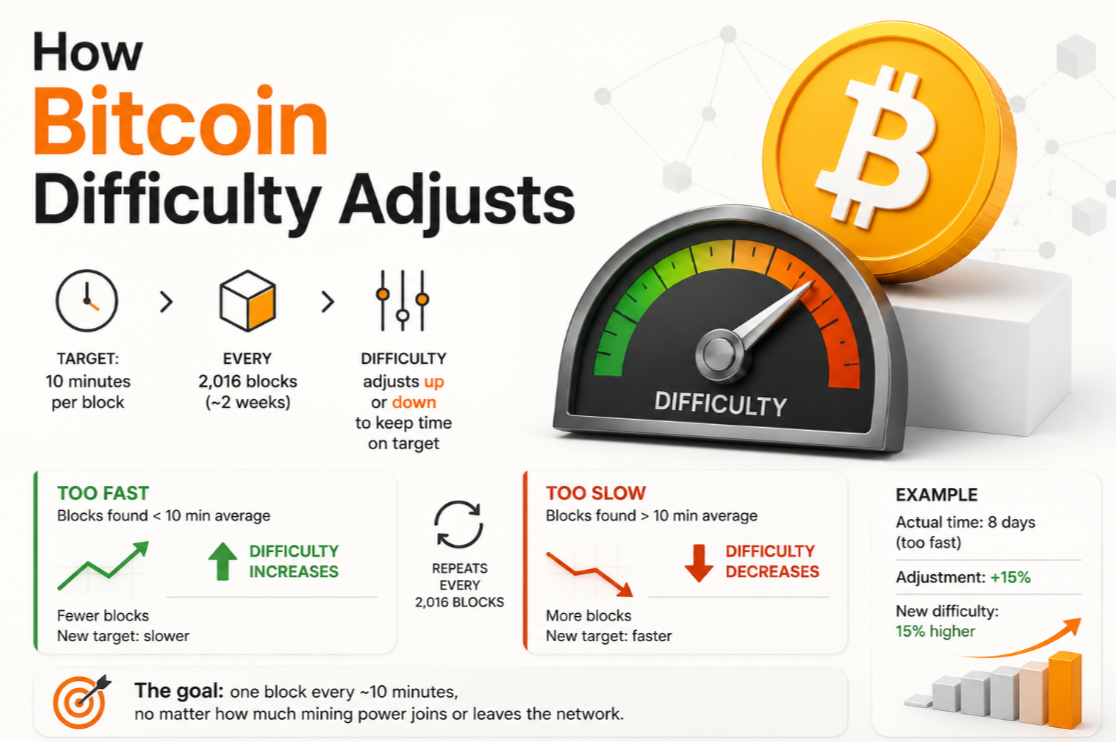
Bitcoin's difficulty adjustment is the single rule that keeps blocks arriving about every ten minutes regardless of how many miners are competing. It is a self-correcting feedback loop, tuned once per fortnight, that makes the entire security budget viable. The rule itself takes one paragraph to state; its consequences shape everything from miner survival to the network's throughput.
The 2,016-block rule
Every 2,016 blocks — which at exactly 10-minute average blocks would be exactly two weeks — Bitcoin nodes compute how long the last 2,016 blocks actually took, and then adjust the mining difficulty target so that the next 2,016 blocks would take exactly two weeks at the current hashrate.
If the last epoch took 12 days instead of 14, difficulty goes up by 14/12 ≈ 16.7%. If it took 16 days, difficulty goes down by 14/16 = 87.5% (a 12.5% cut). There is a hard cap of 4x in either direction per adjustment, which has never been hit in practice.
The target is a number: valid blocks must have a hash below that target. Lowering the target makes fewer hashes valid, so more hashing is needed per block on average. Raising the target does the opposite. The adjustment is deterministic — every node runs the same math on the same block headers and arrives at the same target.
Why the ten-minute average matters
Ten minutes is a compromise between two competing needs. Short block times mean faster confirmations for users; long block times mean less orphaned work (blocks mined at nearly the same time by different miners, only one of which survives). Nakamoto picked ten minutes as roughly balancing the two — long enough that orphans stay under 1% of blocks even with mining spread across continents, short enough that a payment feels tolerable to wait for.
The rate does not have to be exact per block. Individual blocks routinely take between 1 and 60 minutes; the ten-minute number is a long-run average. Over hundreds of blocks, the average converges. That convergence is what the difficulty adjustment enforces.
The feedback loop
Because the adjustment reacts to how long the previous epoch actually took, it lags reality by up to two weeks. If hashrate suddenly doubles at the start of an epoch, blocks will initially arrive every 5 minutes instead of 10. The difficulty adjustment at the end of that epoch will bump difficulty up by about 2x, restoring the 10-minute cadence.
The same in reverse: if half the miners power off suddenly, blocks initially take 20 minutes; the adjustment at the epoch boundary cuts difficulty roughly in half. Blocks return to 10-minute cadence, and profitability for the remaining miners rises because they earn the same subsidy per block against half the total hashrate.
This is the feedback mechanism that made Bitcoin survivable through the 2021 China mining ban. Chinese hashrate — about half the global total at the time — went offline over a matter of weeks. Difficulty adjusted down by 28% in a single epoch, then by 20% and 15% in the next two. Miners outside China saw revenue in BTC-denominated terms nearly double before the adjustment normalized their share.
What the adjustment does not fix
Difficulty adjustment does not smooth out block times within an epoch. Even at perfect steady-state hashrate, block times follow a Poisson distribution — most blocks take 5-15 minutes, some take an hour or more, some take under a minute. If you send a low-fee transaction and the next block takes 45 minutes to appear, that is normal statistical variance, not a network problem.
Difficulty adjustment also does not respond to fee revenue. Miners could be earning a fortune in fees or almost nothing; the adjustment target is purely about block cadence, not economics. This means during fee spikes, hashrate can surge (new miners bringing rigs online for the extra revenue) and blocks will temporarily arrive faster until the next adjustment.
Difficulty vs hashrate
Difficulty and hashrate move together but are not the same. Hashrate is the actual computing power on the network — the total hashes per second miners are producing. Difficulty is the target set by the protocol.
You cannot measure hashrate directly — it is a global aggregate that no one observes. You estimate it by looking at how quickly blocks are arriving relative to the current difficulty. If blocks are 20% faster than target, hashrate is roughly 20% above the difficulty setting.
That is why hashrate charts always have some noise: they are estimates derived from block-time distributions, and they get more accurate the more blocks you average. Daily hashrate charts are noisier than weekly, which are noisier than monthly.
Why the design works
Bitcoin's difficulty adjustment is deceptively elegant. It requires no central coordination, no oracle, no committee vote. Every node runs the same math, every node arrives at the same next target, and the whole network stays in sync on how hard mining should be — all without anyone talking to anyone.
The rule is old enough now that it is battle-tested through every conceivable shock: China bans, price crashes, halvings, hardware generation shifts. It has never failed. It has, at moments, produced dramatic swings — 30% single-adjustment moves have happened — but the network kept operating and the ten-minute average kept holding on longer time frames.
Every proof-of-work chain that has copied Bitcoin has copied this mechanism, sometimes with different epoch lengths (Litecoin adjusts every block using LWMA-3 or similar), but the same underlying idea: measure what happened, adjust to hit the target next time. Simple feedback control, doing security's heavy lifting.