Every crypto investor eventually asks: how much of my portfolio should be in Bitcoin? In ETH? In this altcoin I've been researching? The answer isn't "as much as I feel confident about" — that's how you end up over-concentrated in whatever coin was most exciting six months ago. Position sizing is the discipline of deciding allocation systematically, so that no single decision can wreck the whole portfolio. This is the framework that separates traders who compound wealth from traders who occasionally get lucky and then blow up.
The core insight
The math is unforgiving: a 50% loss requires a 100% gain to recover. A 90% loss requires a 900% gain. Losses hurt more than proportional gains help.
This means: any single position that could plausibly lose 90% of its value must be sized so that a 90% loss doesn't take you out of the game. If a single coin's failure would mean you're done investing (financially or emotionally), it's sized too large.
Position sizing is fundamentally about surviving the losers so you can benefit from the winners.
The two main frameworks
**Fixed fractional**: allocate the same percentage of total portfolio to each position. If your policy is "no single altcoin gets more than 5%," then a $100K portfolio would put at most $5K into any given altcoin.
**Kelly criterion**: mathematically optimal sizing based on your edge and win rate. Formula: f = (bp - q) / b, where b is the odds, p is win probability, q is loss probability. In practice, most traders use "half Kelly" or "quarter Kelly" because full Kelly is aggressive and requires accurate inputs.
Fixed fractional is simpler and works fine for most retail investors. Kelly is theoretically optimal but requires estimates you probably don't have.
Guidelines for retail investors
For a typical crypto portfolio in 2026:
**Bitcoin as core (30-50%)**: BTC is the safest crypto asset. High allocation is defensible for anyone with long-term crypto conviction.
**Ethereum as secondary core (20-40%)**: ETH is the second-safest. Adds diversification within crypto's safest tier.
**Top-tier alts (0-20% total)**: SOL, other large-cap chains. Meaningful upside potential but higher risk than BTC/ETH.
**Speculative alts (0-10% total)**: smaller-cap tokens, thematic bets. Position size any single one at max 2-3% of portfolio.
**Stablecoins (5-20%)**: dry powder for accumulation opportunities, or reduced volatility exposure.
Adjust these ranges based on your risk tolerance, time horizon, and other assets. Someone with 90% of net worth outside crypto can afford higher allocations to speculative positions than someone with 90% in crypto.
The single-name concentration risk
The most common mistake: getting into a coin, watching it go up, letting it appreciate to become 30-50% of your portfolio, then holding through the inevitable drawdown.
Example: you buy $10K of a promising L2 token at $1. It goes to $10. Your position is now $100K. If your overall portfolio is $300K, this one coin is 33% of everything.
If that coin drops 80% (which happens routinely to altcoins), you lose $80K in a single position. That's a huge blow.
The discipline: as positions appreciate beyond your allocation limits, trim them back. Selling half of a 10x return locks in real gains while keeping some exposure to continued upside.
The rebalancing question
When to rebalance:
- **Time-based**: rebalance quarterly or annually regardless of what's happened
- **Threshold-based**: rebalance when any position exceeds X% above target allocation (e.g., 20% deviation)
- **Both**: check thresholds monthly, rebalance when triggered
For crypto, threshold-based rebalancing works well because volatility creates frequent trigger events. If your BTC allocation goes from 40% target to 55% actual, that's a rebalance trigger.
Rebalancing means selling winners and buying laggards — psychologically difficult but mathematically sound.
Position sizing for trades vs long-term holds
Different rules apply for different types of positions:
**Long-term core holds** (BTC, ETH, ideally never sell): allocation limits are about avoiding concentration risk, not per-trade risk. Sizing rules of 30-50% for BTC or ETH are defensible.
**Medium-term positions** (alts you plan to hold 1-3 years): size at 5-15% of portfolio maximum. Diversify across several to avoid single-name risk.
**Short-term trades** (positions with specific thesis and exit plan): size at 1-3% of portfolio per trade. Never risk more than 2% of portfolio on any single trade.
**Leveraged trades**: risk should be measured by potential loss, not notional size. A 10x leveraged trade with a stop at -10% risks the full initial capital.
The 2% rule
A widely-used trading heuristic: no single trade should risk more than 2% of your portfolio.
"Risk" here means: (position size) × (distance to stop loss) / (portfolio value).
If your portfolio is $100K and you're taking a trade with a 20% stop loss, your position size should be at most $10K (2% of $100K risked / 20% stop distance = $10K).
This ensures you can survive many consecutive losing trades. Even 10 losses in a row at 2% each leaves you with 82% of your portfolio (compounding).
Applied consistently, the 2% rule is what keeps traders in the game long enough to have winning years.
Correlation and clustering
Sizing individual positions isn't enough — you need to think about clustered exposures.
If you have 8% in SOL, 5% in AVAX, 5% in APT, 5% in SUI, and 5% in NEAR (all L1 competitors), you have 28% in a single thematic bet. If L1 competitors underperform ETH as a category, all these correlate downward together.
Similarly, 4 different DeFi tokens or 4 different NFT tokens are less diversified than they appear.
Real diversification requires uncorrelated exposures. Within crypto, that's hard — most alts correlate to BTC at 0.6-0.9 during major moves. True diversification usually requires assets outside crypto (equities, bonds, real estate, cash).
The behavioral trap
The hardest part of position sizing isn't setting the rules — it's following them.
Common failure modes:
- Increasing position sizes after a winning streak (feeling invincible)
- Refusing to trim winners (feeling smart)
- Doubling down on losers (denying the loss)
- Loading up on a "sure thing" because "this time is different"
Every one of these has led to significant losses for otherwise-competent traders. The discipline of predetermined position sizes protects you from your own psychology.
Some traders write down their sizing rules and post them where they can see. Others use portfolio-tracking tools that alert them when positions exceed target sizes. Whatever mechanism works for you — build it before you need it.
Practical setup
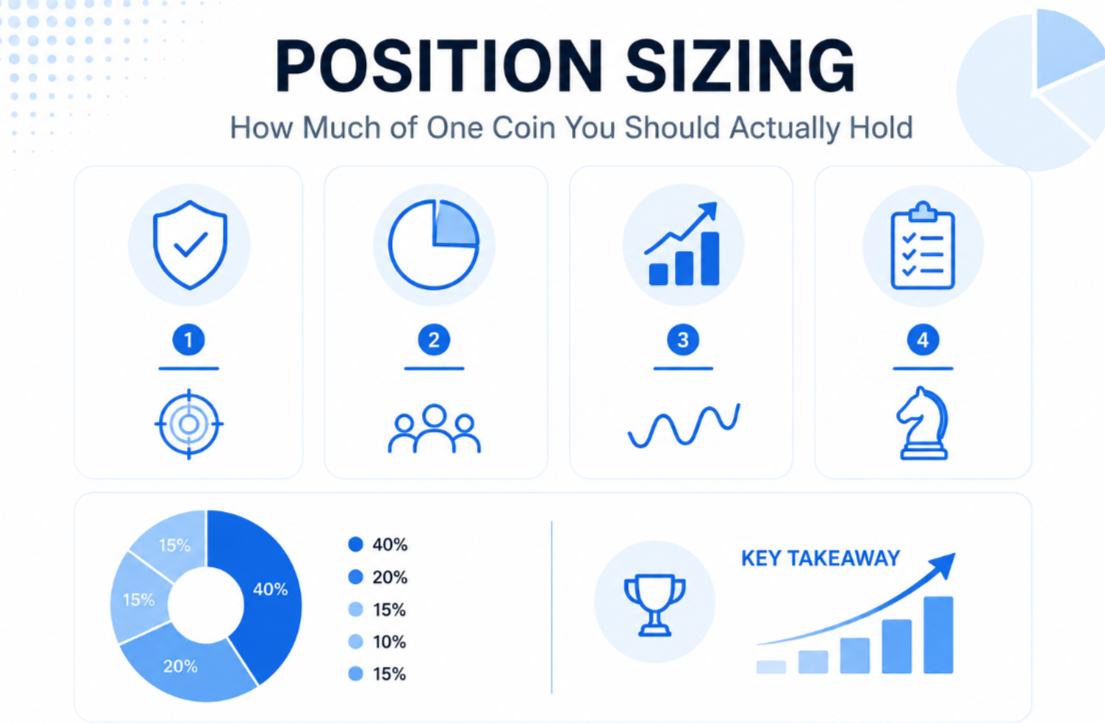
For a $50K crypto portfolio, a defensible allocation might be:
- 40% BTC ($20K)
- 30% ETH ($15K)
- 10% top alts, spread across 2-3 (~$5K total)
- 10% speculative (spread across 3-5 small positions of ~$1K each)
- 10% stablecoins ($5K dry powder)
Position sizing rules for this portfolio:
- Never let any single position exceed 50% (BTC can go to 50% but not 60%)
- Never let speculative positions collectively exceed 15%
- Trim winners quarterly if they've moved 20%+ above target
- Add to underweight positions with stablecoin reserves
These are examples, not prescriptions. Your specific numbers depend on your situation. But the structure — explicit limits, regular checking, trimming winners — is universal.
The takeaway
Position sizing isn't glamorous. It's the boring math that determines whether you're still in the game five years from now. Investors who master it compound wealth. Investors who don't occasionally have great years and eventually have catastrophic ones.
Set your rules. Write them down. Follow them. Adjust them thoughtfully when circumstances actually change, not just when you feel bullish or bearish.
Consistency beats brilliance in position sizing. Almost always.