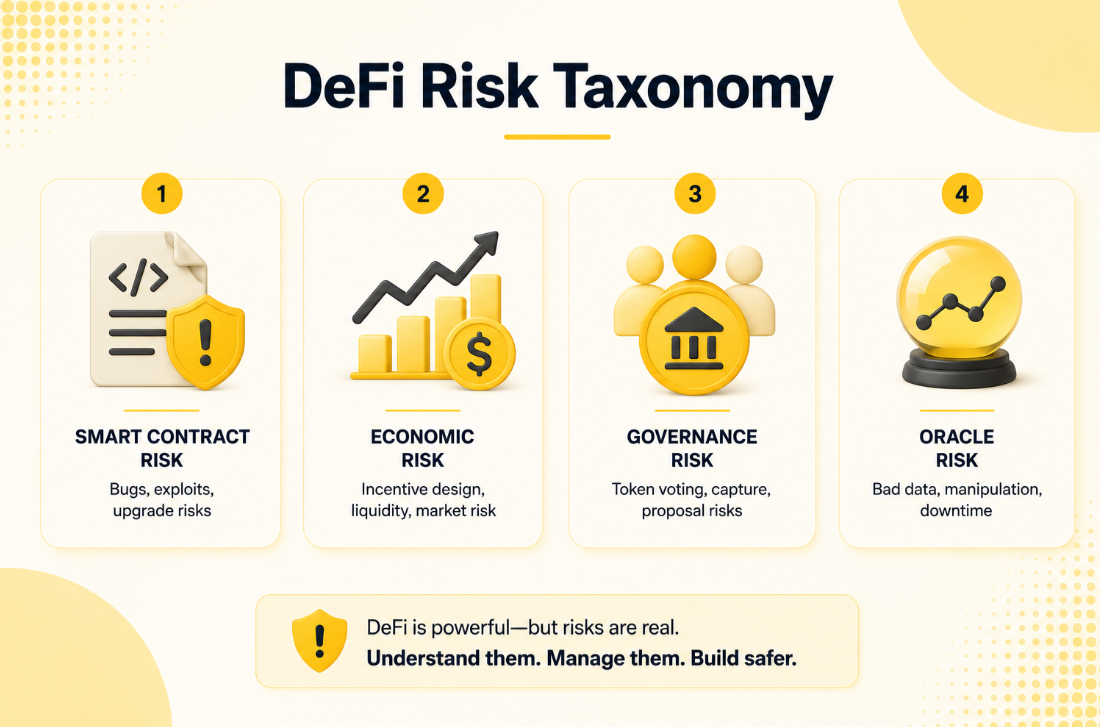
Every DeFi position — supplying to AAVE, providing liquidity on Uniswap, staking with Lido — carries risk. Users who lose money often say "I got hacked" without being able to specify which risk actually materialized. Understanding the four main categories of DeFi risk lets you name what you're actually exposed to, price it appropriately, and diversify against uncorrelated failure modes. This is basic financial literacy for anyone deploying meaningful capital in DeFi.
Category 1: Smart contract risk
Definition: the risk that the smart contract has a bug that lets it be exploited.
Examples:
- Reentrancy bugs (The DAO 2016, Cream 2021)
- Access control failures (various governance takeovers)
- Integer overflow / arithmetic bugs (rare post-Solidity 0.8, historical)
- Complex composability bugs (interactions between multiple protocols creating unexpected behavior)
- Compiler bugs (Curve Vyper 2023)
The primary defense is code auditing. Reputable audit firms (Trail of Bits, OpenZeppelin, ChainSecurity, Sherlock, Spearbit) review protocols before launch. Better protocols do multiple audits and have ongoing bug bounties.
But audits don't catch everything. A bug can hide behind complex interactions that no auditor thinks to test. Time in production is also a form of validation — a protocol that's been holding significant TVL for years without incident is safer than a brand-new one.
Sizing this risk: newly-launched protocols with novel mechanics are highest risk. Well-audited, long-running protocols (AAVE, Uniswap, Curve) are lowest risk. Assume 1-5% probability of smart contract failure over a multi-year time horizon even for the safest protocols.
Category 2: Economic risk
Definition: the risk that the protocol's economic mechanism fails without any code bug being involved. The code works exactly as intended — but the intended behavior turns out to be exploitable or unsustainable.
Examples:
- **Impermanent loss for LPs**: mathematical certainty, not a bug. LPs on Uniswap V2 always lose value vs holding the underlying when prices diverge significantly.
- **Depegs**: Terra/UST's collapse in 2022 was economic, not a code bug. The peg mechanism's design was flawed under stress conditions.
- **Cascade liquidations**: during Black Thursday 2020, ETH crashed so fast that liquidations couldn't process, creating bad debt in MakerDAO. Not a code bug — the system worked as designed but couldn't handle the market speed.
- **Governance token depreciation**: yield farmers earning tokens that then collapse in value. Emissions-heavy protocols routinely destroy value for participants.
- **Adverse selection for LPs**: on GMX-style pool-based perp DEXs, if traders systematically win, LPs lose. This has happened at various points.
Economic risk is subtler than smart contract risk because there's no clear "bug" to fix. The protocol is working exactly as designed. The design itself is the problem.
Sizing this risk: complex mechanisms with untested-at-scale assumptions are highest risk. Simple, well-understood mechanics (basic AMM, straightforward lending) are lower risk. All positions carry some economic risk; the question is whether you understand what it is.
Category 3: Oracle risk
Definition: the risk that the price data or external information a protocol relies on is manipulated or wrong.
Examples:
- Flash-loan-based oracle manipulation (bZx 2020, Cream 2021)
- Oracle sequencer downtime (temporary issues on L2s where oracles can't update)
- Read-only reentrancy on view functions (Balancer 2023)
- Stale oracle data during rapid market movements (various liquidations at wrong prices)
Oracle risk is especially relevant for lending protocols, perpetual DEXs, and stablecoins — anything that makes financial decisions based on price data.
Defenses:
- Chainlink and other reputable oracles with many independent nodes
- TWAP oracles to resist flash-loan manipulation
- Multiple oracle sources with cross-checking
- Circuit breakers that pause operations during extreme conditions
Sizing this risk: protocols using single-source pricing from thin markets are highest risk. Protocols using Chainlink with proper deviation and heartbeat controls are lower risk. Read the protocol's oracle design — it's a critical piece of their security model.
Category 4: Governance risk
Definition: the risk that whoever controls the protocol makes decisions that harm users.
Examples:
- Malicious upgrades (protocol admin changes contract code in ways that steal user funds)
- Parameter changes that damage certain user positions (LTV changes, interest rate changes)
- Governance takeovers (attacker acquires enough tokens to force malicious decisions)
- Team disappearance or key loss (Multichain 2023)
- Regulatory pressure forcing certain changes (blacklists, freezes)
Well-designed protocols have governance safeguards:
- Timelocks (24-72 hour delays on any governance action)
- Multi-sig requirements for upgrades
- Immutable core contracts (once deployed, cannot be changed)
- Emergency pause functions restricted to specific triggers
Sizing this risk: protocols with unaudited admin keys or no timelocks are highest risk. Protocols with immutable core + timelocked governance for parameters are lowest risk. Check who has upgrade permission and what safeguards exist.
Combining risk categories
Most exploits actually combine multiple risk categories:
- Oracle manipulation (oracle risk) enabled by flash loans (economic feature) exploiting a lending protocol (smart contract composability)
- Terra collapse: economic risk (design flaw) exacerbated by governance risk (admin decisions during crisis)
- Ronin bridge: smart contract risk (validation logic) + governance risk (multi-sig compromise)
Understanding risks in isolation is a starting point. Advanced risk analysis considers how they combine.
The one risk almost everyone ignores
There's a fifth category worth naming: **counterparty risk** — the risk that off-chain entities behind a protocol fail.
Examples:
- Circle failing (would affect USDC)
- Tether failing (would affect USDT)
- Coinbase failing (would affect cbETH, Coinbase-related infrastructure)
- Off-chain oracle sponsors failing to maintain their service
Counterparty risk isn't "DeFi" in the pure sense, but it's real for anyone using assets backed by off-chain infrastructure. Fully-decentralized alternatives exist (DAI vs USDC, rETH vs cbETH) but usually with tradeoffs.
Risk diversification
To minimize total DeFi risk:
- **Diversify across protocols**: don't concentrate all your DeFi in one protocol. If a bug hits it, you lose everything.
- **Diversify across categories**: use lending on AAVE, LP on Uniswap, staking on Lido. Different smart contract risks.
- **Diversify across chains**: don't put everything on one L2. Chain-specific failures happen.
- **Diversify across trust models**: mix centralized (USDC) and decentralized (DAI) exposure.
- **Keep some funds outside DeFi**: for meaningful net worth, at least some assets should be in cold storage not exposed to any DeFi risk.
The goal isn't zero risk — that's impossible in DeFi. The goal is uncorrelated risks so a single failure doesn't wipe you out.
Pricing risk
For any DeFi position:
**Expected return** = base yield - expected loss from all risk categories
If a protocol offers 8% APR and you estimate 2% annual probability of smart contract failure (with 100% loss) plus 1% annual probability of oracle exploit (with 50% loss), your risk-adjusted expected return is:
8% - (2% * 100%) - (1% * 50%) = 5.5%
If you can get 5% APR from a lower-risk alternative, is the extra 0.5% worth the risk? Depends on your risk tolerance.
Most DeFi participants don't do this math explicitly. Doing it (even roughly) puts you ahead of most participants.
The habit worth building
Before every DeFi position, ask:
1. What are the smart contract risks? (Which contracts am I touching?) 2. What are the economic risks? (What does the protocol assume that might fail?) 3. What are the oracle risks? (What prices are we relying on?) 4. What are the governance risks? (Who can change what?) 5. What are the counterparty risks? (What off-chain entities are involved?)
If you can answer these, you understand your position. If you can't, you're operating on trust rather than understanding.
DeFi returns come with real risks. Naming them is the first step to managing them. Managing them is the difference between long-term compound growth and periodic catastrophic loss.