Yield farming is the practice of moving capital between DeFi protocols to earn the highest returns available. During the 2020-2022 DeFi boom, headline APRs of 100%, 500%, even 10,000%+ were common. Most of those returns were unsustainable. Understanding the difference between yield that comes from real economic activity and yield that comes from token emissions is the single most important skill for evaluating DeFi opportunities. Get this wrong and you're a bagholder of a rapidly-depreciating token. Get it right and you compound over time.
The two sources of yield
Every DeFi yield ultimately comes from one of two sources:
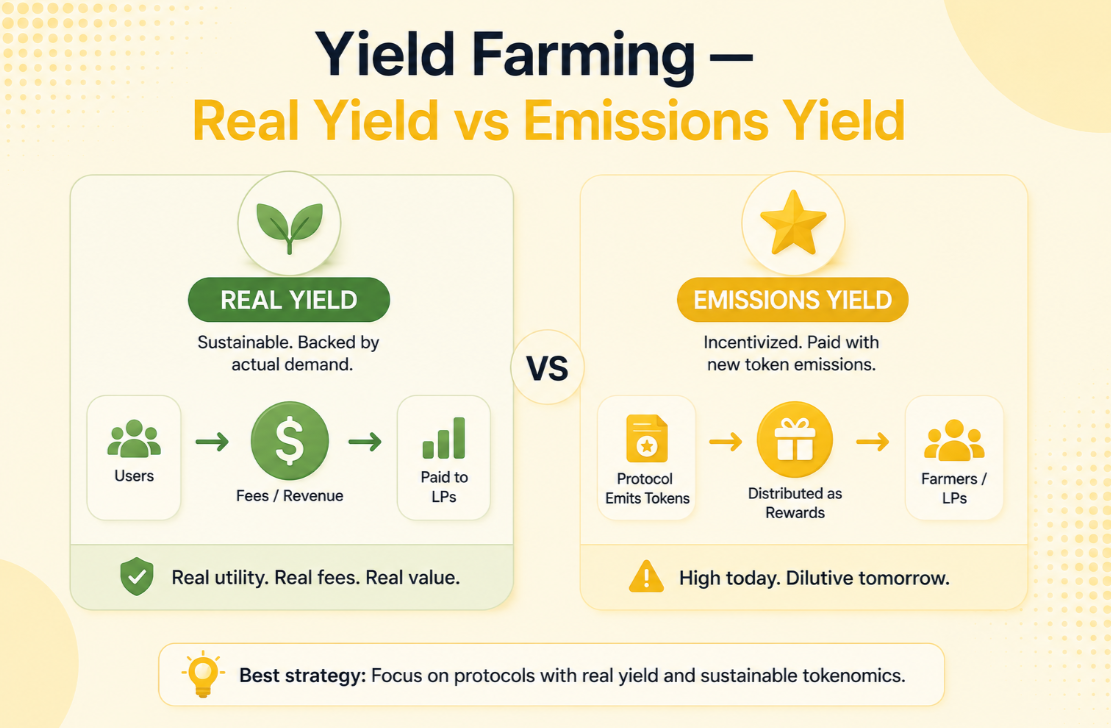
**Real yield**: paid from actual revenue the protocol generates — trading fees, borrowing interest, MEV, liquidation bonuses, off-chain revenue. This is money someone paid the protocol for a service.
**Emissions yield**: paid in the protocol's own token, minted from thin air. The user receives newly-created tokens as reward. The value of the reward depends entirely on whether someone will buy the token.
Both are labeled as "yield" in DeFi UI. Both accumulate to your balance. But they're economically very different.
The math of unsustainable emissions
Consider a protocol offering 500% APR on a stablecoin pool. What might that mean?
If the pool has $100M TVL, 500% APR means the protocol is distributing $500M worth of tokens per year.
Where do the tokens come from? The protocol's treasury or ongoing token emissions.
Who buys the tokens LPs are receiving? Other yield farmers speculate on the token, hoping to sell before the price collapses. Newer users chasing the same 500% APR are natural buyers.
But if the emissions are $500M/year and the natural buying demand is $200M/year, the token price falls to clear the excess supply. The 500% APR was calculated when the token price was high; as price falls, the effective yield in USD terms falls to match.
Over time: token price collapses → "yield" in USD terms collapses → users leave → less buying pressure → token price collapses further → death spiral.
This has played out hundreds of times. The pattern is always the same.
What real yield looks like
Real yield examples:
- Uniswap LPs on ETH/USDC 0.05% pool: earn 0.05% of every trade's volume. If volume is $1B/day and TVL is $100M, LPs collectively earn $500K/day = 180% APR. That yield comes from real trades paying real fees.
- AAVE suppliers of USDC: earn borrower interest. Borrowers pay 5-8% to borrow, suppliers earn a fraction. This is real interest paid by real borrowers.
- GMX LPs: earn trading fees plus PnL from traders. When traders lose (which they mostly do on leveraged positions long-term), LPs win.
- Ethereum staking (via LSTs): earn issuance rewards plus MEV. These are real economic yields Ethereum generates.
These yields might be lower than emissions yields (usually 3-20% APR instead of 100%+), but they're sustainable — they come from real economic activity and don't require token price to keep rising.
How to tell
For any yield opportunity, ask:
**Where does the return come from?**
If the answer is "we distribute XYZ token" — that's emissions yield. Sustainability depends on XYZ token price.
If the answer involves "trading fees," "interest paid by borrowers," "arbitrage profits," "MEV," or similar — that's real yield.
Many protocols mix both. A DEX might pay LPs both trading fees (real) plus its governance token (emissions). Split the analysis and treat each source separately.
**Is the emitted token price stable?**
Check the token's price chart. If it's been declining steadily, the "yield" is being paid in a depreciating asset. Your actual USD return is much lower than the headline APR.
**What's the token's utility?**
Governance tokens with no cash flow have to derive value from speculation. Tokens tied to protocol revenue (via buybacks, fee sharing, discount on services) have real underlying support.
**What's the TVL vs emissions ratio?**
Rough check: divide annual emissions (in USD at current price) by TVL. If emissions are 100%+ of TVL, the yield is highly likely to compress as emissions dilute the token.
The historical pattern
Some famous unsustainable yield situations:
**Terra Luna's Anchor Protocol** (2021-2022): offered 20% APR on UST stablecoin deposits. The yield came from Anchor's treasury, subsidized by Terra. When UST depegged in May 2022, Anchor's yields evaporated overnight. LPs lost most of their capital.
**Various "reserve backing" ponzis** (2021-2022): protocols promising 100,000%+ APY, backed by "algorithmic" reserve mechanisms. All eventually collapsed.
**Sushiswap's early emissions** (2020): SUSHI token was distributed heavily to LPs to bootstrap liquidity. This worked to steal liquidity from Uniswap short-term. But once emissions decreased, LPs left. SUSHI's price never recovered to peak.
**Convex/Curve emissions**: CVX price has declined significantly from peak. Users who provided liquidity earning CVX emissions saw their real returns compress dramatically.
Where real yield actually exists
For sustainable yields in 2026:
**DEX LP fees**: Uniswap V3 concentrated liquidity on major pairs can offer 5-30% APR from trading fees alone, no token subsidies. Real yield.
**Lending protocol rates**: AAVE, Compound V3, Morpho offer variable rates that reflect actual borrowing demand. 3-10% APR is typical for stables, higher during high-demand periods.
**Staking (LSTs)**: 3-5% APR from Ethereum staking, distributed via LST tokens. This is real yield from securing the network.
**Restaking + AVS rewards**: some AVS revenue is real (they're paying for actual service). Some is emissions of their own token. Analyze case by case.
**Perp DEX LPs (GMX)**: LPs earn real fees from trader activity. Not always positive (LPs can lose during sustained trader wins), but based on real economic activity.
**Stablecoin yield (US Treasuries-backed)**: some stablecoins (USDS via Maker RWA vaults, USDe via funding rates) generate real yield from underlying activity. 4-8% APR is typical.
The sizing question
Even for real yields, they can compress over time as more capital enters. A 20% real yield attracts capital; as more LPs enter, the same trading volume gets split among more providers, dropping per-LP yield.
Historical DeFi real yields have compressed over time as the market matured. In 2020, 50% APR on stablecoin lending was common. In 2026, 5-10% is more typical.
For any yield opportunity, ask: what's the equilibrium yield? If everyone piled in, what would returns be? Real yields tend to converge to something reasonable; emissions yields can stay artificially high until the tokenomics collapse.
Practical guidance
- Never chase yields above 20% APR without understanding exactly where they come from
- Assume all emissions yields will compress significantly over time as their tokens dilute
- Diversify across multiple protocols; don't concentrate in whichever has the highest current APR
- Rebalance periodically as opportunities change
- Real yields are boring but survive; emissions yields are exciting but often don't
The most sustainable DeFi returns come from consistent participation in real-yield activities (LP on major pairs, lending stables on established protocols, staking) rather than yield-farming the highest current APRs. The tortoise beats the hare in this game.
The philosophical takeaway
DeFi is not free money. Every yield has a source. If you can't identify the source, you're probably the source.
Emissions-heavy protocols work as long as new capital flows in faster than existing capital exits. When that ratio inverts, everything collapses. This has happened hundreds of times and will keep happening.
Real yield is what remains after the emissions collapse. If a protocol's only appeal is its emissions, it doesn't have a durable business. If a protocol generates real revenue that's distributed to token holders, it's more like a traditional business — with corresponding valuation logic.
Building this mental habit — always asking "where does the return come from" — is the single most valuable skill in DeFi. It saves you from a lot of losses.