You have $10,000 you want to put into Bitcoin. Do you invest it all today, or spread it out over 12 monthly purchases of ~$833 each? This question — lump sum versus dollar-cost averaging — has been debated forever, and the answer depends less on the math than most investors realize. Understanding both the statistical evidence and the behavioral reality is required before deciding for your own portfolio.
The math: lump sum usually wins
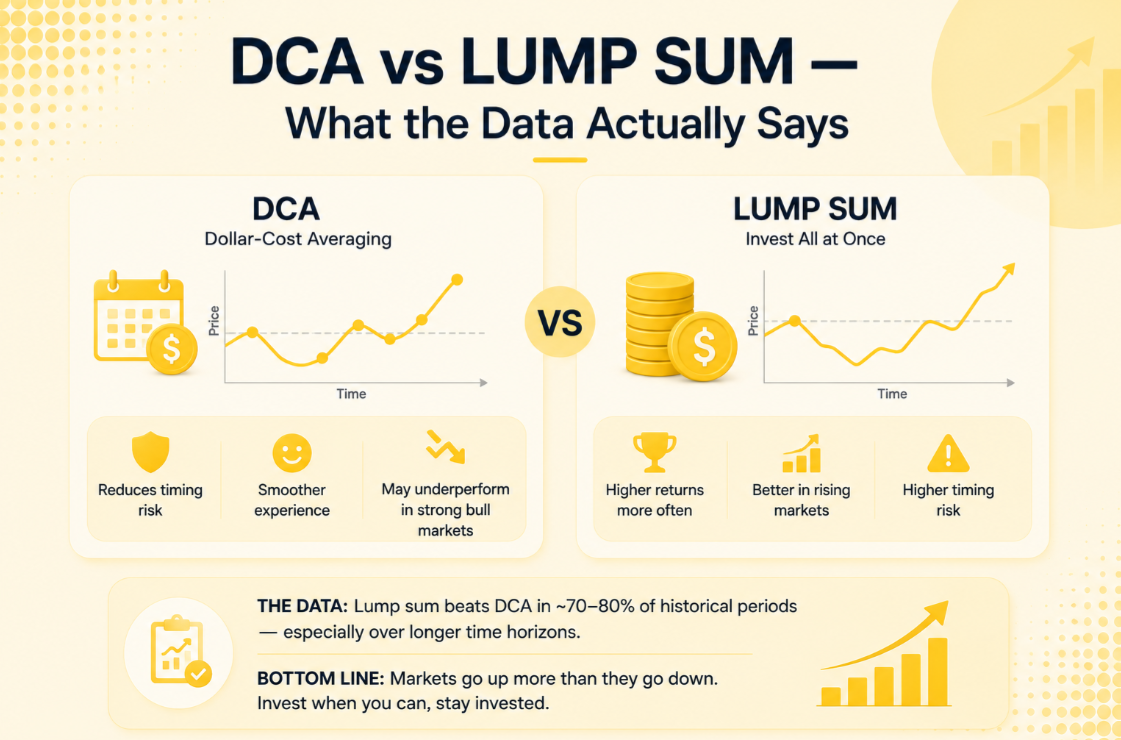
Historical studies (mostly from equity markets, since we have longer datasets) consistently show that lump sum investing outperforms DCA roughly two-thirds of the time.
The intuition: markets go up over long periods. The longer your money is invested, the more time it has to appreciate. DCA leaves capital sitting on the sidelines, missing the returns available to money that's already in.
For Bitcoin specifically, applying the same logic to available data:
- Rolling 12-month periods since 2013 where lump sum beat DCA-over-12-months: roughly 65-70%.
- Average outperformance of lump sum in those periods: ~10-15%.
- Average underperformance of lump sum when DCA won: ~5-8%.
The asymmetry favors lump sum. When lump sum wins, it usually wins bigger than when DCA wins.
So if you're optimizing purely for expected return, lump sum is statistically correct.
Where the math breaks down
The math assumes:
1. You have a lump sum in cash and can decide when to invest it 2. You can psychologically handle immediately losing 30-50% if you happen to buy at a peak 3. Your investment horizon is long enough that market direction dominates entry timing
For most retail investors, especially first-time crypto buyers, these assumptions don't hold cleanly.
The behavioral case for DCA
The real world case where DCA wins:
**You don't actually have a lump sum**: most people's wealth comes from ongoing income. If you're investing $500/month from your paycheck, "lump sum" isn't an option — you're DCA'ing by construction.
**Emotional resilience matters**: after buying $10,000 of Bitcoin at $80,000 and watching it drop to $40,000 within six months (which has happened multiple times historically), many investors panic-sell. DCA reduces the pain of any single bad entry, making it easier to stay invested.
**You have real cognitive limits**: knowing that "markets go up over time" is not the same as feeling it while watching your portfolio drop. DCA reduces the emotional exposure to any single entry point.
**Timing uncertainty**: even when lump sum is right, timing the actual purchase optimally is hard. DCA removes that decision from your hands.
For most retail investors, the statistical edge of lump sum is not worth the increased behavioral risk.
The case for lump sum
When lump sum is clearly better:
- **You have windfall cash** (inheritance, bonus, sale of an asset) that you specifically want to allocate to crypto
- **You have very long time horizons** (10+ years) where entry timing matters less
- **You have real conviction** in the asset and can psychologically handle short-term drawdowns
- **You're near an obvious market low** (though timing this is hard)
For high-conviction long-term investors, lump sum captures more upside.
The hybrid approach
Many investors compromise:
**"Half now, half over 6 months"**: put half your capital in immediately, then DCA the rest over the next 6 months. Captures some upside if the market runs, protects against buying a top with the whole amount.
**"DCA with market-driven acceleration"**: DCA over 12 months, but accelerate purchases if the market drops significantly (e.g., double the buy if BTC drops 25% from your first purchase price).
**"Fixed schedule with lump sum on big drops"**: normal monthly DCA, but treat any 30%+ drawdown as a signal to add extra capital.
These hybrids capture some of both approaches' benefits and are often what real investors do in practice.
The crypto-specific angle
Crypto is much more volatile than equities. Historical BTC has had multiple 70%+ drawdowns; Ethereum and altcoins are even more volatile.
For crypto specifically:
- Lump sum captures a larger expected return advantage when markets are trending up
- But the risk of buying near a local top is much greater than in equities
- DCA smooths the entry through even the largest drawdowns
For pure BTC or ETH investment, the historical data still favors lump sum. But the range of outcomes is much wider than for equities, and the emotional impact of a bad entry can be much larger.
Practical guidance
For most retail crypto investors, my recommendation:
- **Use DCA as your default** for regular allocation from income
- **Consider lump sum only for windfall capital** and only if you have high conviction and long horizons
- **Consider a hybrid approach** if you have moderate lump sum but uncertainty about timing
- **Never use lump sum with money you'll need in less than 3-5 years** — crypto volatility is too high
For institutional or high-net-worth investors with resources for professional portfolio management, the calculus can differ. For everyday retail investors, DCA is the psychologically safer choice even when it's statistically slightly suboptimal.
The counter-argument to "just DCA"
Some critics of DCA point out:
- If you truly believe in the long-term investment thesis, you should put as much money in as fast as possible
- DCA is really just a way of hedging against your own doubt
- If you're not sure enough to lump sum, maybe you're not sure enough to invest at all
There's truth to this. If you find yourself DCA'ing because you're nervous about buying, examine whether you actually want this exposure. Sometimes the right answer is "don't buy" rather than "buy slowly."
But most investors have real uncertainty even about assets they want long-term exposure to. DCA is a legitimate hedging tool against that uncertainty.
What actually matters more than DCA vs lump sum
Both approaches, applied consistently over 10+ years, produce similar long-term outcomes. The differences between them are dwarfed by:
- Whether you actually stay invested through drawdowns
- Whether you avoid panic selling at lows
- Whether you keep contributing over time
- Whether you avoid FOMO buying at obvious peaks
- Your total time horizon
If you can commit to a consistent strategy — either lump sum with resolve or DCA with discipline — the specific mechanism matters less than the consistency.
The investors who lose most in crypto aren't those who chose DCA when lump sum would have won. They're those who bought at tops with lump sum, panicked at lows, sold, and missed the recovery.
Whatever you choose, choose one and execute. That's the actually-hard part.