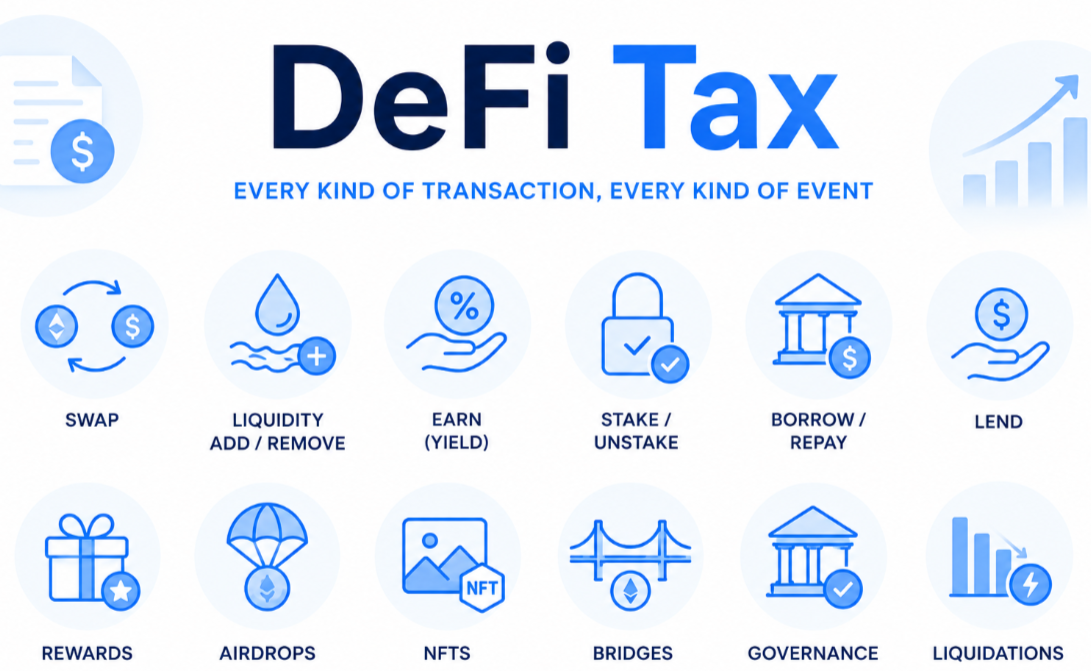
DeFi taxes are significantly more complex than centralized exchange taxes. On a CEX, you have relatively clean records — buys, sells, deposits, withdrawals. In DeFi, every swap is a taxable event, every LP position is a bundle of taxable events, every yield reward is income, and there are dozens of edge cases without settled tax treatment. Understanding how each type of DeFi transaction is typically taxed is the difference between accurate reporting and years of unresolved tax exposure.
**Important disclaimer**: this article describes common tax treatments and interpretations. It is not tax advice. Rules vary by jurisdiction and change over time. Consult a qualified crypto tax professional for your specific situation.
The core principle
In the US and most jurisdictions, any disposal of one crypto asset in exchange for another is a taxable event. This includes:
- Selling crypto for fiat
- Trading one crypto for another (BTC to ETH, ETH to USDC)
- Using crypto to pay for goods or services
- Any exchange where you receive something different from what you gave up
Each disposal triggers a calculation: was there a gain or loss vs your cost basis? Report accordingly.
The distinguishing feature of DeFi is how many transactions this generates. A single yield-farming strategy might trigger dozens of taxable events per week.
Swaps
Swapping one token for another on a DEX (Uniswap, Curve, 1inch, etc.) is a taxable event.
Example: you hold 1 ETH bought at $2,000. You swap it for USDC on Uniswap when ETH is worth $2,500. You receive ~2,500 USDC.
Tax treatment: you disposed of 1 ETH for $2,500. Cost basis was $2,000. Gain = $500. This is a taxable capital gain, short-term or long-term depending on how long you held the ETH.
The USDC you received has a cost basis of $2,500 (its fair market value at receipt). When you eventually swap or sell that USDC, you'll calculate gain/loss vs that basis.
Every swap generates one of these events. Active traders can have hundreds per year.
LP (Liquidity Provider) deposits
Providing liquidity to a DEX pool is where taxation gets contentious. Different jurisdictions and tax positions treat it differently.
**Conservative view**: LP deposit is a taxable event. You dispose of the underlying tokens in exchange for LP tokens. The LP tokens have a cost basis equal to the fair market value of what you deposited.
**Alternative view**: LP is a beneficial interest, not a disposal. No taxable event on deposit.
The IRS has not issued definitive guidance on LP tokens. Most tax professionals in the US take the conservative view: LP deposit is a disposal.
**Rebalancing within a pool**: Uniswap V2/V3 pools rebalance constantly as trades happen. Some interpretations require reporting the LP position's balance changes over time. Most tax software approximates by only recognizing at deposit/withdrawal.
**LP withdrawal**: reverse of the deposit. Disposal of LP tokens for the underlying assets. New cost basis for the underlying based on fair market value at withdrawal.
For active LPs, this creates significant tax complexity. Position dynamics that gain a few hundred dollars can trigger dozens of small taxable events. Software is essentially required for accurate accounting.
LP fees (income)
Fees earned as an LP are typically taxed as income at the time you effectively receive them.
For Uniswap V2-style pools: fees accrue to your LP token balance (the pool's share value increases). Interpretations vary on when this creates a taxable event. Conservative view: continuous accrual is continuous income.
For Uniswap V3: fees accumulate separately and can be collected via a claim function. Fees are typically taxed as income at the time of the collection transaction.
Most tax software treats collection as the taxable event.
Yield farming rewards
Tokens received as staking rewards or LP incentive tokens are typically taxed as ordinary income at fair market value on the day you receive them.
Example: your Curve LP position earns 100 CRV tokens over a week. Each token is worth ~$0.50 at the time you (or the protocol) recognizes them as yours. Total income: $50.
That $50 becomes your cost basis for those 100 CRV tokens. When you later sell them at $0.80 each, you have $30 of additional capital gain.
Complication: many DeFi rewards are auto-compounded (the protocol restakes them for you). Are they "received" at each compound event, or only when you actively claim? Interpretations vary. Software makes approximations.
For high-yield-farming users, tracking every reward event with per-day pricing is essentially impossible manually. Tax software handles this by pulling daily prices from oracles.
Wrapping (WETH, wstETH, etc.)
Wrapping ETH to WETH: is this a taxable event?
**Conservative view**: any change of token identity is a disposal. WETH is a different token contract than ETH, therefore wrapping is a taxable event with zero gain (assuming 1:1 exchange).
**Alternative view**: wrapping is a technical operation that doesn't change beneficial ownership. Not a taxable event.
The IRS hasn't definitively ruled. Most tax software treats wrapping as a non-taxable event for practical purposes, though the risk is that tax authorities could later disagree.
Similar for stETH → wstETH: wrapping a rebasing token into its non-rebasing variant. Same analytical question, same uncertainty.
Bridges
Bridging tokens between chains: taxable event or not?
**Native asset bridges** (bridging ETH from Ethereum to Arbitrum via canonical bridge): the token remains ETH throughout. Some views: no taxable event. Other views: the "Arbitrum ETH" is a different asset than "Ethereum ETH."
**Wrapped bridges** (bridging via lock-and-mint to get wETH on another chain): definitively a change of token identity. More likely to be treated as a taxable event.
Most tax software treats canonical bridging as non-taxable and wrapped bridging as taxable (though 1:1, so zero gain).
Stablecoin swaps
USDC → USDT is a taxable event with typically minimal gain/loss (both trade near $1). But you still need to report it.
For high-volume stablecoin traders, this can add up to significant reporting overhead even without much actual gain/loss.
Depegged stablecoins can create real gain/loss. Buying UST at $0.95 during its depeg and later selling at $0.20 would be a real loss to claim.
Airdrops
Receiving an airdrop is typically ordinary income at fair market value at the time of receipt.
Complication: some airdrops require action to claim (calling a contract). Others just show up in your wallet. Both are typically treated as income at time of receipt/claim.
Airdrop cost basis: the fair market value at receipt becomes your cost basis. Sell at higher price = capital gain; sell at lower price = capital loss.
Large airdrops can create massive taxable income events. The 2024 Uniswap governance airdrop (which distributed tokens worth thousands of dollars to many users) generated real tax bills for recipients even without them ever selling.
Restaking
Restaking rewards are ordinary income at receipt. Same principle as staking.
Complication: restaked positions often generate multiple types of income simultaneously — base staking yield, AVS rewards, potentially airdrops from AVSs. Each is taxable at its own fair market value.
LRT tokens (like eETH, rsETH) that appreciate against ETH: is the appreciation ordinary income (as rewards accrue) or capital gain (only recognized on sale)? Interpretations vary. Conservative view: continuous income; most software treats it as capital gain on sale.
Lending interest
Interest earned from lending on AAVE/Compound is ordinary income at receipt.
For AAVE, this is the appreciation of your aTokens over time (the aToken's exchange rate to the underlying increases). Some interpretations: continuous income. Common tax software approach: recognize only at claim/withdraw.
Borrowing
Borrowing crypto is not a taxable event. You didn't dispose of anything — you took a loan against your collateral.
But: if your loan is denominated in crypto and repaid in crypto, the repayment might involve gain/loss on the specific tokens used to repay. Complicated in practice.
Liquidation: if your position is liquidated, the disposal of your collateral is a taxable event. You disposed of your collateral in exchange for the debt being cleared plus any residual.
The record-keeping reality
For any active DeFi user, the number of taxable events per year is measured in hundreds or thousands. Manual tracking is impossible.
Essential tools:
- **Crypto tax software** (CoinTracker, Koinly, ZenLedger, TaxBit): imports transactions from wallets and exchanges, categorizes them, applies cost basis method.
- **Wallet activity exports**: keep ability to pull transaction history from your wallets (Etherscan CSV, wallet-specific tools).
- **Notes on unusual transactions**: for airdrops, unusual protocol interactions, or anything the software might miscategorize.
Even with software, expect significant manual review of DeFi tax data. Software gets 80-90% right; the remaining 10-20% requires judgment calls.
Practical recommendations
**Use software from day one**: retroactive reconstruction is painful. Start with your first DeFi transaction.
**Consider a specialized tax professional**: for anyone with DeFi activity beyond casual, professional review is worth the cost. Fees of $500-2,000 for a return with meaningful DeFi activity are typical.
**Keep detailed records**: dates, transaction hashes, protocol used, purpose of transaction. Software helps but doesn't replace organized records.
**Be conservative with novel situations**: if a transaction type isn't clearly addressed, take the more conservative position. Amending later is easier than dealing with an audit.
**Watch for regulatory changes**: DeFi tax treatment is evolving. Rules that applied in 2024 may change for 2025 or 2026.
The takeaway
DeFi tax is genuinely difficult. Even sophisticated CPAs unfamiliar with DeFi will struggle. Even DeFi natives without accounting background will make mistakes.
The pragmatic approach: 1. Use software to handle the bulk of transactions 2. Manually review anything unusual 3. Consult a crypto-specialized professional for complex situations 4. Take conservative positions on unsettled questions 5. Keep detailed records
The tax cost of DeFi participation is real. Factor it into your yield calculations — a 20% APR strategy that generates 10% of the total value in short-term ordinary income tax has meaningfully lower after-tax return than the headline suggests.
**Not tax advice. Consult a qualified professional.**