Until 2023, Bitcoin block space was competed for almost entirely by monetary transactions — payments, exchange withdrawals, cold-storage housekeeping. Since Ordinals launched in January 2023, block space has been shared with an entirely new class of demand: inscription protocols that use Bitcoin's transaction format to embed data, tokens, and NFT-like assets directly on the base layer.
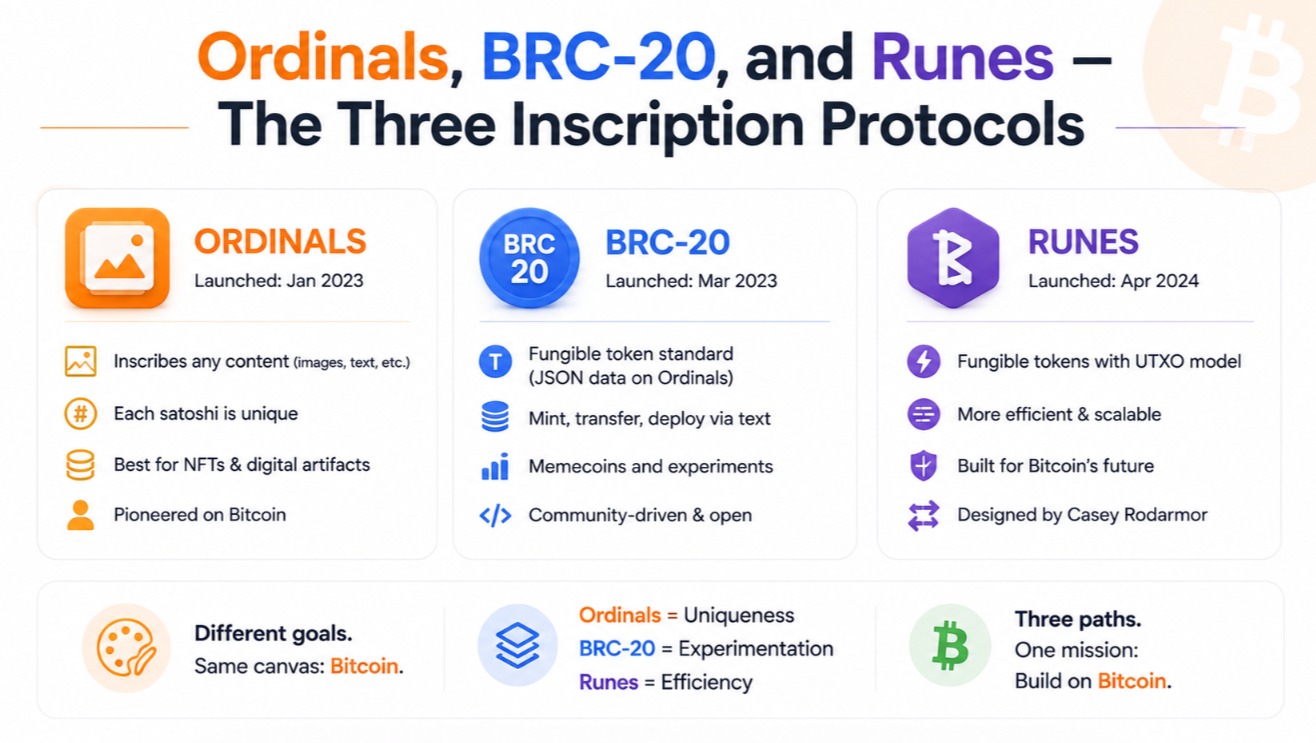
Three protocols dominate: Ordinals themselves (the substrate), BRC-20 (a token standard on top), and Runes (a competing, more efficient token protocol). They are related but distinct, and understanding what each does is now required for anyone reading Bitcoin fee dynamics or thinking about the network's long-term security model.
Ordinals: the substrate
Ordinals launched in January 2023 as a protocol that assigns a unique identity to each satoshi based on the order in which it was mined. Every satoshi ever created has an ordinal number, and any satoshi can carry inscribed data — text, images, videos, code — attached to it via Bitcoin's witness data (introduced by SegWit and expanded by Taproot).
Mechanically, an Ordinals inscription is a Taproot transaction whose witness data contains the inscribed content. The content is stored on Bitcoin permanently — every full node has a copy, forever. The witness data is discounted 4x in fee accounting, which is why inscriptions became economically viable at all.
Ordinals unlocked what people effectively called "Bitcoin NFTs": digital collectibles inscribed directly on the base layer, no separate token contract needed. Some collections (NodeMonkes, Bitcoin Puppets, Ordinal Maxi Biz) reached seven-figure floor prices. The technique also enables inscribing entire text files, code, or arbitrary media — the block space is agnostic to what data lives in it.
BRC-20: tokens as inscriptions
BRC-20 launched in March 2023 as an experimental token standard on top of Ordinals. The idea: inscribe a text document containing a JSON structure that declares a token deployment, mint, or transfer, and let an off-chain indexer interpret those inscriptions as token state changes.
Everything happens as regular Ordinals inscriptions. The Bitcoin protocol itself does not know BRC-20 exists — it just sees text inscriptions like {"p":"brc-20","op":"mint","tick":"ORDI","amt":"1000"}. Indexers (running off-chain services) parse these inscriptions in order and maintain the token balances, which wallets and exchanges then use to show users their holdings.
The consequence: every BRC-20 transaction is a full Ordinals inscription, meaning every mint, transfer, or deploy is a Bitcoin transaction. When ORDI (the first big BRC-20 token) surged in late 2023, Bitcoin mempool fees spiked as tens of thousands of users tried to mint tokens simultaneously. Fee spikes over $30/vB became common, dramatically changing miner economics.
BRC-20 is often called "inefficient" or "wasteful" by critics because each transfer requires two on-chain transactions (inscribe transfer, then send inscription). Defenders argue this is the price of a fully-permissionless token layer on Bitcoin. The debate continues.
Runes: the alternative
Runes launched at the April 2024 halving as an alternative token protocol designed by Ordinals inventor Casey Rodarmor. It aims to fix the technical inefficiency of BRC-20 while keeping the "tokens on Bitcoin" idea.
Runes uses Bitcoin's OP_RETURN mechanism — a small data field in every transaction — rather than full inscriptions. This makes Runes transactions much smaller (typically 100-200 bytes vs 500-2000 for BRC-20 transfers) and correspondingly much cheaper in fees. Runes has native UTXO-style transfers, which fit Bitcoin's model more cleanly than the inscribe-then-transfer pattern of BRC-20.
At launch, Runes attracted significant activity — the first Runes minted set new records for single-day Bitcoin fees, briefly pushing the fee market past $200 million per day. Since then, Runes activity has cycled with market conditions. It has established itself as a permanent part of the Bitcoin fee landscape, alongside BRC-20 and vanilla Ordinals.
Fee-market effects
Before 2023, Bitcoin fees averaged $1-3 during normal periods and spiked during major moves. Since Ordinals and its offspring, the baseline shifted. Median fees are higher year-over-year, spikes reach further, and miners have seen fee revenue account for 30-50%+ of block reward during peak periods — a huge shift from the 5-10% typical of pre-Ordinals years.
For ordinary Bitcoin users this creates ambient cost. A cold-storage housekeeping transaction that would have cost $2 in 2022 might cost $15-30 during a Runes minting wave. The fee market is more volatile and less predictable.
For miner economics, this is arguably good news — the security budget problem (see the halving cycle article) requires exactly this kind of fee-generating activity if Bitcoin is to remain viable long-term as the subsidy shrinks. Critics counter that speculative token mania is not the "real" fee demand that should back the network; supporters counter that any block-space demand is legitimate demand.
Why this all matters
If you care about Bitcoin's long-term security model, inscriptions and tokens are directly relevant. They generate fee revenue. Bitcoin needs fee revenue to secure the chain post-subsidy. Even if the specific tokens are speculative, the aggregate demand they create is what pays for hashrate in the coming decades.
If you care about Bitcoin as a payment or store-of-value network, inscriptions are noise — they make your transactions more expensive and add congestion. There are Bitcoin nodes and pool policies that filter inscriptions, but the majority of the network processes them normally.
If you care about NFTs or tokens as a category, Bitcoin inscription protocols are the maximalist take: tokens without a separate token contract, without a smart-contract virtual machine, and without any centralized issuance mechanism. They are ideologically distinct from Ethereum-style tokens.
Realistically all three positions are consistent with holding Bitcoin. The protocols are here to stay — no soft-fork will remove them, and no consensus change is being seriously proposed. Understanding them is required whether you love them or hate them.
Wallets and infrastructure
Regular Bitcoin wallets (Sparrow, Electrum, hardware wallets) do not know about inscriptions natively. If you receive an inscription to a legacy Bitcoin wallet, you cannot see it as an inscription — you can see the underlying UTXO but not that it carries an inscribed asset.
Wallets that natively handle inscriptions: Xverse, Unisat, Leather (formerly Hiro), Magic Eden's Bitcoin wallet. Marketplaces (Magic Eden, OKX NFT, Ordswap) are where trading happens. Indexers like Ord (the reference implementation) and third-party services like OrdSpace track what has been inscribed and who owns what.
If you accidentally spend a UTXO that carries a valuable inscription using a non-inscription-aware wallet, you may pay it as fee to a miner or send it to change. Recovery is often impossible. Always use inscription-aware software if you hold anything that matters.