The Byzantine Generals Problem is a 1982 computer-science puzzle about how a group of parties can reach agreement in the presence of unreliable messengers and potentially treacherous participants. For four decades it was considered impossible to solve fully in fully-open, permissionless settings. Bitcoin's whitepaper is, at its core, an argument that it can be solved — and every subsequent blockchain consensus algorithm is a variation on that argument.
Understanding the problem makes it much easier to see why blockchain consensus is designed the way it is, and why alternatives fall into predictable failure modes.
The classic scenario
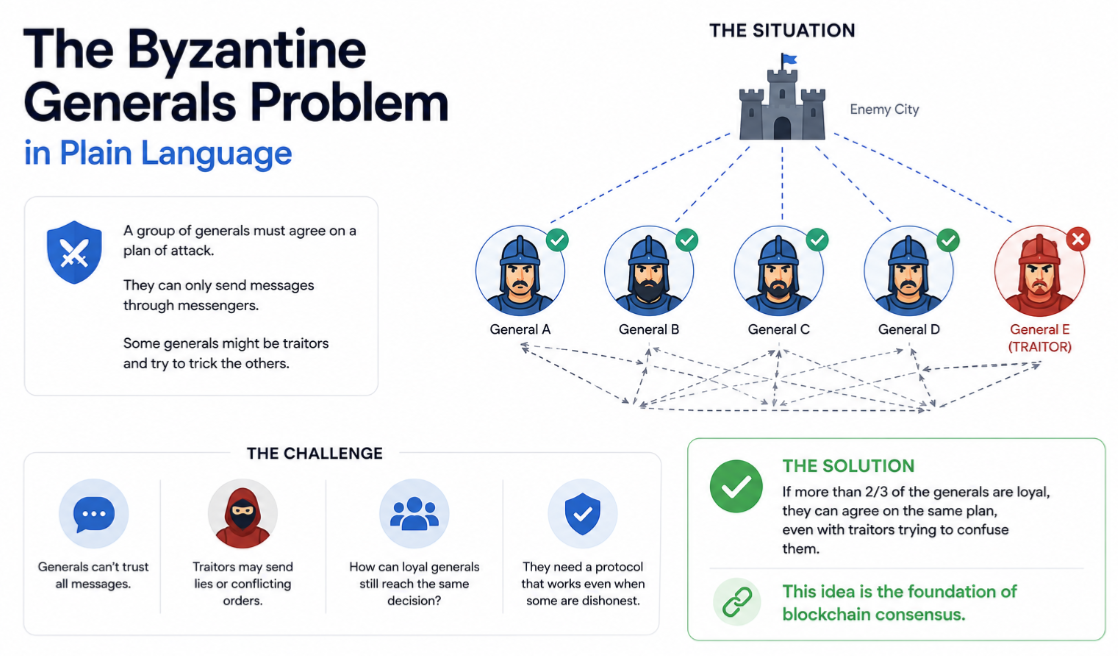
Imagine several generals surrounding an enemy city. They must decide together whether to attack or retreat. Each general commands part of the army; they need to make the same decision, at the same time, or the coordinated attack fails and everyone loses.
The generals cannot meet in person. They communicate only through messengers who can be captured, delayed, or lost. Worse: some of the generals themselves may be traitors trying to sabotage the plan — perhaps signaling "attack" to some and "retreat" to others to split the loyal generals into an ineffective force.
The question: is there an algorithm the loyal generals can follow to reach a common decision, given that they cannot trust their messengers and cannot know for sure which of them are traitors?
The formal answer (Lamport, Shostak, Pease 1982): yes, but only if fewer than one-third of the generals are traitors, and only if certain assumptions about message delivery hold.
Why this matters for blockchains
A blockchain has exactly the same problem. Thousands of nodes, distributed globally, receiving transactions and blocks over an unreliable network. Some nodes might be malicious. Others might be honest but temporarily disconnected. The network needs to agree on which transactions are valid, in what order, and consider them final.
Reaching this agreement — Byzantine fault tolerance — is the deep problem of distributed systems. The 1982 result says it is achievable only if you have some kind of authenticated messaging and less than one-third malicious participants. For decades this was thought to require permissioned settings, where you know the identity of every participant.
Bitcoin's contribution was showing that in a permissionless setting — where anyone can join, no identities are known — you can still achieve practical Byzantine agreement if you attach real costs to participation.
Bitcoin's solution
Nakamoto's mechanism does not solve the Byzantine Generals Problem in its classic form. It sidesteps it in a way that produces the same practical outcome:
1. Anyone can broadcast a proposed block. 2. Producing a valid block requires solving a computationally expensive puzzle (proof of work). 3. The chain with the most cumulative work wins. 4. Attacking the chain requires re-doing all the work of the honest chain plus the attacker's fork — which is either economically infeasible or overwhelmingly detectable.
This does not eliminate the possibility of dishonest actors. It makes attacks so expensive that they are irrational. The equivalent of "traitor generals" — miners producing invalid blocks — cannot make headway because their invalid work is rejected by honest nodes.
The elegance is that Nakamoto did not need to solve the classical BGP. He needed to make dishonest behavior more expensive than honest behavior, and let the economic incentive do the coordination that the classical algorithm required message-passing to do.
Where the argument gets subtle
Bitcoin's security assumption is often phrased as "50%+1 of honest hashpower." This is not quite the classical <1/3 dishonest threshold, because Bitcoin's setup is different.
In classical BGP, the network reaches deterministic agreement in a fixed number of message rounds. In Bitcoin, the network reaches probabilistic finality — the deeper a block is buried in the chain, the higher the probability it will remain part of the canonical chain. A block with 6 confirmations is virtually irreversible; a block with 100 confirmations is effectively permanent.
This probabilistic finality is achievable with just the honest majority assumption, whereas deterministic finality requires the classical threshold. Different trade-offs, similar practical outcomes.
PoS and the classical algorithms
Modern proof-of-stake chains actually implement more classical Byzantine agreement protocols. Ethereum's Casper FFG, Cosmos's Tendermint, and various BFT-based chains reach deterministic finality via multi-round voting — very close in structure to the classical BGP solutions.
The <1/3 dishonest threshold applies more directly here. Ethereum's finality assumes fewer than one-third of validators are Byzantine. If more than one-third go rogue, the chain can enter a state called "inactivity leak" that eventually recovers, but real-time finality can be violated.
Because these chains explicitly identify their validators (via staking), they can implement classical algorithms in a way that Bitcoin's fully permissionless model cannot. The trade-off: faster finality but tighter honesty assumptions.
What breaks the model
Every real Byzantine agreement algorithm has failure modes:
**Network partition**: if the network splits into two halves that cannot communicate, each half thinks the other has stopped participating. Both halves might continue producing blocks, and when the partition heals, one chain has to be discarded. Bitcoin handles this via longest-chain rule (the fork with more accumulated work wins). PoS chains handle this via inactivity penalties on the losing side.
**More than half hashrate (or one-third validators) coordinated**: Byzantine agreement breaks down. In Bitcoin this would let an attacker double-spend or censor transactions. In PoS chains this would let an attacker finalize invalid state or halt finality. Both scenarios are considered end-of-chain events, though recovery might be possible.
**Long-range attacks in PoS**: an attacker who acquires old validator private keys (perhaps through key sales or purchases from ex-validators) could potentially rewrite ancient history from the point where those validators were active. PoS chains use "weak subjectivity" checkpoints — occasional known-good block hashes — to prevent this.
Every consensus algorithm has some equivalent of these breaks. Understanding what breaks the model is understanding the actual security assumption.
Why this matters for reading chain designs
Any consensus algorithm you read about will express its Byzantine fault tolerance assumption in some form:
- Bitcoin: "50%+1 of hashpower must be honest"
- Ethereum PoS: "less than 1/3 of stake must be Byzantine" (for immediate finality); "less than 1/2 for long-term liveness"
- Tendermint: "less than 1/3 of validators must be Byzantine"
- DPoS chains: "less than 1/2 of the small validator set must be Byzantine" (which is often tighter in practice because the set is small)
These are the honesty assumptions the chain is built on. When you evaluate a chain's security, you are really evaluating: (1) how expensive would it be for an attacker to exceed the tolerated threshold, and (2) how quickly would the community respond if it happened.
The intellectual arc
The Byzantine Generals Problem was formulated in 1982 as a fundamental limit on distributed agreement. Nakamoto in 2008 showed that a specific practical relaxation — probabilistic finality via economic costs — makes the problem tractable in permissionless settings. The last fifteen years have been the industry working out the various trade-offs between the two extremes.
Every serious blockchain is, in this sense, an answer to Lamport-Shostak-Pease with different priorities. Understanding what problem they solved, and what constraints they lived within, is understanding why blockchain consensus works the way it does.