Consensus is how a decentralized network agrees on which transactions happened, in what order, and are now final. It is the deep problem that Bitcoin's whitepaper solved and that every subsequent blockchain has re-litigated with different trade-offs. Five families of consensus dominate the landscape as of 2026. Understanding what each optimizes for and where each has been deployed at scale is the shortest path to reading chain design intelligently.
Proof of Work (PoW): Bitcoin's answer
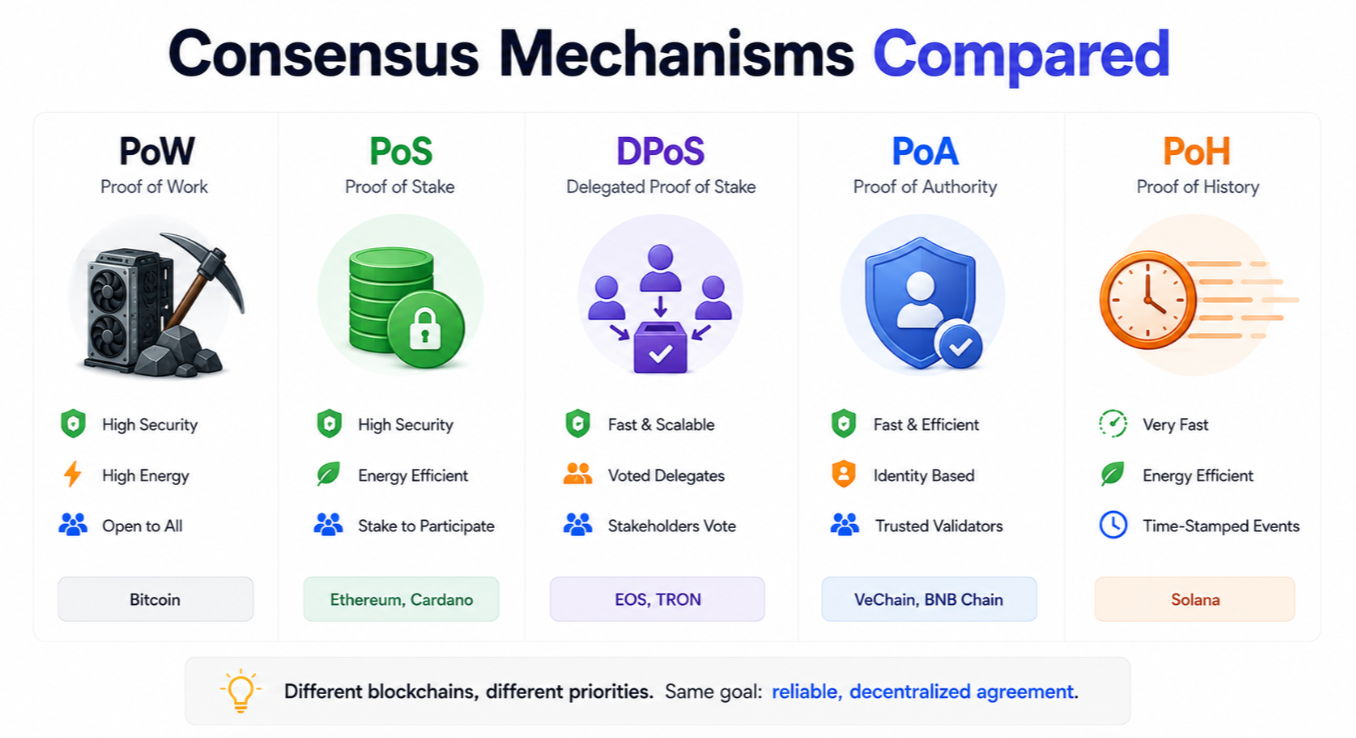
Miners compete to find a hash below a target by trying random inputs (nonces). Finding such a hash is expensive — you have to spend electricity trying. When a miner finds one, they broadcast the block, and other nodes verify quickly. The chain with the most cumulative work is the canonical one.
**Optimizes for**: security via physical cost. To attack the network you need to outspend the honest miners. If Bitcoin's hashrate consumes $30 million per day in electricity, an attacker needs to marshal comparable resources — and even then, they only get a 51% majority, which lets them double-spend but not create new coins or forge signatures.
**Gives up**: energy efficiency (obviously), throughput (Bitcoin's ~7 transactions per second is fundamental to the model), and hardware egalitarianism (specialized ASICs dominate mining).
**Deployed at**: Bitcoin, Litecoin, Dogecoin (via merged mining with Litecoin), Monero, Bitcoin Cash. The classical answer, still the largest by market cap.
Proof of Stake (PoS): Ethereum's answer
Instead of physical work, validators lock up ("stake") native tokens as collateral. The protocol pseudorandomly selects a validator to propose each block, with probability proportional to stake. Other validators vote on whether the block is valid. Misbehavior — voting for two competing chains, or being offline for critical votes — gets the validator's stake slashed.
**Optimizes for**: energy efficiency (no wasted computation), lower issuance (staking rewards can be paid at a much lower rate than mining rewards), and native economic finality (once a block has enough attestations, reverting it would cost billions in slashed stake).
**Gives up**: some measure of "physical" security — attacks are bounded by the market cap of stakers rather than by external resources. And in early phases of a PoS chain, the "nothing at stake" problem needed careful design to avoid.
**Deployed at**: Ethereum (since the Merge in 2022), Solana (with its own twist), Cardano, Cosmos ecosystem chains, most modern Layer 1s. Ethereum's shift from PoW to PoS in 2022 cut its energy consumption by 99.95%.
Delegated Proof of Stake (DPoS): the tradeoff
DPoS is PoS with a twist: token holders vote for a small fixed set of validators (often 21-101), who then take turns producing blocks. This centralizes block production for efficiency, delivering high throughput at the cost of removing "any staker can validate" from the model.
**Optimizes for**: throughput and predictability. Because the validator set is small and known, block times can be sub-second and finality can be near-instant.
**Gives up**: the broad-base security of open validation. If a majority of the fixed validators collude, they can attack the chain. Users trust the elected validators more explicitly than under vanilla PoS.
**Deployed at**: EOS (which pioneered the model with 21 validators, and whose troubles are cited as evidence for both sides), Tron, BNB Smart Chain (21 validators), Hive/Steem, Lisk. TON's design has DPoS-like properties.
Proof of Authority (PoA): pragmatic centralization
PoA drops the "who validates" question entirely: a fixed, known, publicly-identified set of validators sign blocks in a rotation. The security model is reputational — validators are companies or entities that would lose real-world reputation and licenses if they misbehaved.
**Optimizes for**: throughput, low latency, and cheap operation. Because validators are trusted, they can produce blocks constantly without economic penalty for missing rounds.
**Gives up**: decentralization entirely. This is not censorship-resistant — the validator set can freeze accounts, blacklist addresses, or reorganize the chain if legal pressure requires it.
**Deployed at**: private and consortium blockchains almost exclusively. Ethereum's Kovan and Rinkeby testnets used PoA (now deprecated). Some enterprise Hyperledger Fabric networks use PoA. Public blockchains rarely use pure PoA because trust is exactly what public blockchain users want to avoid.
Proof of History (PoH): Solana's timestamp
Proof of History is not exactly a consensus mechanism — it is a mechanism for producing a verifiable timestamp for events. Solana combines PoH with PoS: PoH provides an ordered clock that lets validators know when events occurred; PoS provides the security backing.
Mechanically, PoH is a sequential hash chain. Each hash depends on the previous one, so the sequence cannot be produced in parallel. This creates a verifiable "how much time has passed" measure without needing timestamps or synchronization.
**Optimizes for**: throughput. Because validators do not need to communicate about ordering, they can process transactions in parallel and reach finality quickly. Solana targets 400ms block times and thousands of TPS in normal operation.
**Gives up**: some robustness to hardware failure — Solana requires high-end validator hardware and has had network outages when validators struggled to keep up. The consensus is also more complex to analyze than pure PoS.
**Deployed at**: Solana specifically. Some newer L1s incorporate PoH-inspired ideas but Solana is the flagship implementation.
Other families worth naming
**PBFT and variants** (Practical Byzantine Fault Tolerance): validators run multi-round voting protocols to agree on each block. Used in Cosmos chains via Tendermint, in Aptos and Sui via similar BFT engines. Trades higher communication overhead for very fast, deterministic finality.
**Proof of Space / Proof of Space-Time**: uses disk space rather than compute as the scarce resource. Chia is the flagship. Interesting for reducing energy consumption; adoption has been niche.
**Proof of Burn**: participants burn tokens to earn the right to mine or validate. Occasionally used as a bootstrap mechanism (some early Proof of Stake chains used PoB for initial coin distribution).
**Hybrid schemes**: some chains combine two mechanisms. Decred combines PoW mining with PoS voting. Some rollup designs use ZK proofs plus PoS validator sets. Hybrid schemes are common in newer designs trying to combine strengths.
Choosing between them
For a general-purpose L1 today, the practical field narrows to PoS (Ethereum, Cosmos, most others) and Solana's PoH+PoS combo. PoW is universally used only by Bitcoin and a few maximalist derivatives. DPoS survives on BNB Chain and Tron with real usage. PoA is essentially only for private chains.
The tradeoffs:
- **Security via physical cost**: PoW wins
- **Energy efficiency**: PoS wins
- **Throughput**: DPoS and PoH win
- **Finality speed**: BFT-based PoS wins
- **Decentralization**: PoW and open PoS with large validator sets tie
There is no free lunch. Every chain is a bet on which tradeoffs matter most for its use case. Understanding what each family optimizes for makes the design choices legible instead of just tribal.
The center of gravity
Ethereum's successful move from PoW to PoS in 2022 shifted the industry's center of gravity. PoS is now the default answer for new general-purpose L1s. PoW retains a fortress in Bitcoin, backed by both technical maturity and a fiercely conservative culture that would resist changing consensus.
The frontier is in fine-tuning: how to prevent validator centralization, how to implement fair MEV distribution, how to handle validator failures gracefully, how to reach finality faster. These are engineering problems on top of a settled foundation, not choices between consensus families.