Bitcoin's main network — Layer 1 — settles a payment every ten minutes, at a fee that ranges from cents to dollars depending on demand. That is fine for large transactions where the fee is a rounding error. It is terrible for buying coffee, tipping a streamer, or sending micropayments. Lightning Network is the Layer 2 built on top of Bitcoin to solve exactly that problem.
The core promise: near-instant Bitcoin payments, at fees measured in fractions of a cent, without giving up custody of your funds. The catch: it is not magic. Lightning has its own mental model, its own limitations, and its own set of things that can go wrong. Understanding what it actually is closes the gap between "I heard Lightning is cool" and "I can send Bitcoin like this."
The problem Lightning solves
A Bitcoin transaction on the base layer is a permanent settlement — every node records it forever. That permanence is why Bitcoin is valuable, but it also means every transaction consumes block space, which is finite. If Bitcoin tried to handle every coffee purchase, the network would grind to a halt and fees would spiral.
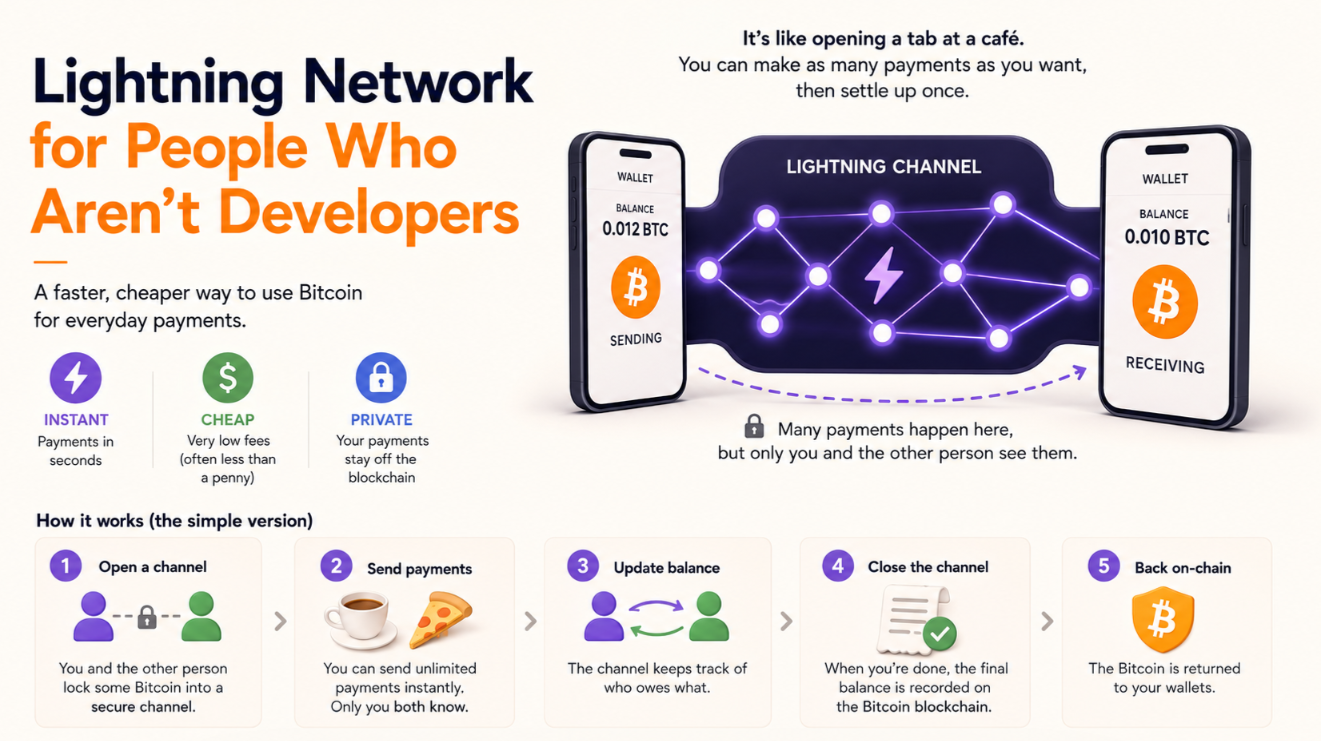
Lightning takes a different approach: most payments happen off-chain, between two parties who have opened a payment channel, and only the opening and closing of the channel touch the base layer. In between, they can exchange thousands of payments instantly and cheaply. The base layer records the beginning and end; everything in between is between them.
What a payment channel is
Two people who transact often — say, a coffee shop and a regular customer — can open a payment channel by co-signing an on-chain transaction that locks up some Bitcoin in a shared 2-of-2 multisig. That opening transaction goes on-chain and pays a normal fee.
Once the channel is open, they update the balance between themselves off-chain by exchanging signed messages. Neither party needs to broadcast anything for a payment to be final — the messages themselves are cryptographic commitments that either side could bring to the base layer if the other cheated. In practice, they just keep updating the balance ledger between them.
When either side wants to close the channel, they broadcast a closing transaction that settles the final balances on-chain. That closing transaction pays a normal fee, and both sides walk away with their final balances.
Between the opening and closing, the two parties could have exchanged one payment or ten thousand — the on-chain cost is the same. That is where the savings come from.
Routing: paying someone you don't have a channel with
Two parties with a direct channel is a nice model but not scalable — you cannot open a channel with everyone you might ever pay. Lightning solves this with routing. If Alice has a channel with Bob, and Bob has a channel with Charlie, Alice can pay Charlie by routing the payment through Bob.
The routing happens automatically: Alice's wallet finds a path through the Lightning network graph, and each hop along the way updates its channel balances accordingly. Bob doesn't get custody of Alice's payment — cryptographic hash locks make sure the whole route settles atomically or not at all.
Routing works because there are thousands of Lightning nodes that maintain channels with many peers, and payment paths are usually 3-5 hops. Each hop takes a tiny fee (usually a few satoshis) for the service. Total routing fees are typically under 0.1% of the payment.
Invoices, not addresses
Lightning does not use Bitcoin addresses. It uses invoices. An invoice is a one-time payment request that specifies an amount, an expiration time, and a description. The sender scans or pastes the invoice and their wallet handles the routing.
Invoices are single-use for a specific amount by default. There are also newer formats — BOLT12 "offers" — that support reusable static payment codes (like an email address for Bitcoin), and Lightning addresses (username@domain format) that work like an email address on the front-end and translate to invoices on the back-end. Lightning addresses are how most tips and one-off payments work today.
When Lightning is the right tool
Lightning is genuinely great at:
- Small payments (under $100) where base-layer fees would be disproportionate
- Recurring payments to the same recipient (podcasts, streamers, subscriptions)
- Point-of-sale purchases where waiting for confirmation is not acceptable
- International remittances where traditional payment rails are slow and expensive
- Machine-to-machine payments (APIs charging per call, IoT devices)
Lightning is less good at:
- Large one-off payments where an on-chain confirmation is cheap enough anyway
- Payments to someone without inbound liquidity or a well-connected wallet
- Anywhere the recipient is not Lightning-enabled
Custodial vs non-custodial Lightning
There are two main ways to use Lightning:
**Custodial**: the wallet provider (like Wallet of Satoshi, historically) holds your funds and manages Lightning channels on your behalf. Easy to set up, easy to use, but you are trusting a third party with your Bitcoin. This is fine for small amounts and daily spending; it is not self-custody.
**Non-custodial**: you run your own Lightning node, open your own channels, and manage your own liquidity. Wallets like Phoenix, Breez, and Zeus offer this model with varying degrees of hand-holding. You are always in control of your funds, but you take on the operational overhead — channel management, backups, occasional need to top up outbound liquidity.
Phoenix is the easiest non-custodial option most people can start with — it auto-manages channels using their liquidity service and feels roughly like using a regular Bitcoin wallet.
Common gotchas
**Channel liquidity is directional.** If a channel has 1 BTC on your side and 0 BTC on the counterparty's side, you can only send in your direction. To receive, you need someone else's Bitcoin on the other side of the channel. Non-custodial users hit this occasionally when trying to receive their first payment.
**Watchtowers matter for long-offline periods.** If someone tries to cheat by broadcasting an old channel state, you (or a watchtower service on your behalf) need to catch it within the challenge window. Non-custodial wallets that go offline for weeks should either close channels first or subscribe to a watchtower.
**Fees are usually tiny but not zero.** A payment might cost 1-10 sats in routing fees, plus an implicit cost for the on-chain fee whenever a channel opens or closes. If you are opening a channel just to make one small payment, on-chain is probably cheaper.
The current state
Lightning has been around since 2018 and is used at meaningful scale — millions of payments per day globally, though small next to Visa or Bitcoin base-layer volume. Merchant adoption is patchy but growing: cash apps, some POS providers, and specialty crypto payment processors accept Lightning natively.
For most users the honest recommendation is: try a Lightning wallet with a small amount, get a feel for how invoices and payments work, then decide whether it fits your use case. It is a different mental model from base-layer Bitcoin, and the payoff is real for the workflows it fits.