When your Bitcoin wallet checks whether a transaction has been confirmed, it does not download the entire block containing the transaction. It downloads a short cryptographic proof — a Merkle proof — that fits in a handful of kilobytes. That proof convinces the wallet, with mathematical certainty, that the transaction was included in a specific block. The mechanism is a Merkle tree, and it is one of the most elegant pieces of engineering in cryptocurrency.
Every blockchain uses Merkle trees somewhere. They are the reason SPV wallets can exist. They are why light clients are practical. They are how Ethereum's state can be efficiently proven. Understanding them takes ten minutes and unlocks how a huge fraction of the ecosystem actually works.
The problem Merkle trees solve
A Bitcoin block contains anywhere from hundreds to thousands of transactions. If you want to prove that a specific transaction is in the block, the naive answer is: give me the whole block. That works but is wasteful — you download a megabyte or more to verify one transaction.
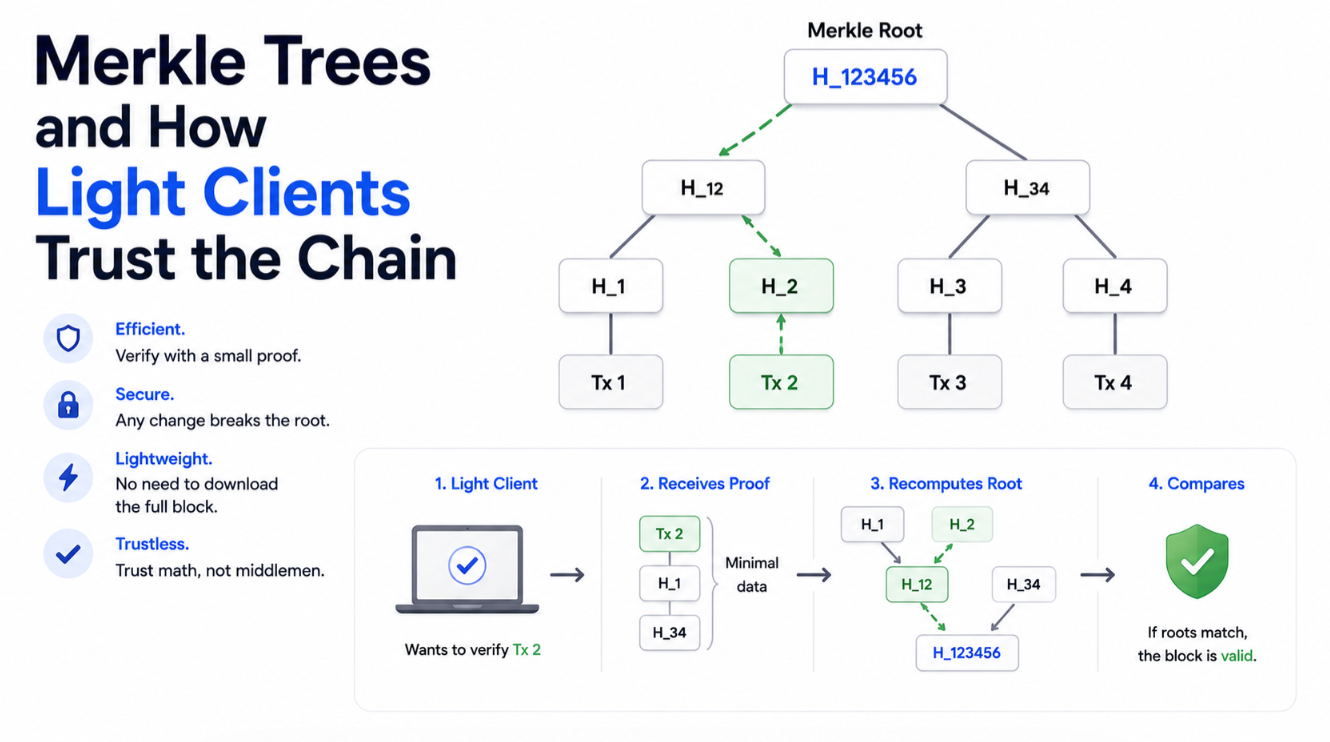
The Merkle tree answer: build a hierarchical hash structure over all the transactions, publish only the top-level hash (the Merkle root) in the block header, and then anyone can prove that a specific transaction is in the block by producing a small "path" up the tree. The proof size grows logarithmically with the number of transactions — for a block with 1,024 transactions, the proof is only 10 hashes (about 320 bytes).
How the tree is built
Take all the transactions in a block. Hash each transaction to get a leaf hash. Then pair the leaves up and hash each pair together, producing a level of parent hashes half the size. Repeat until you have a single hash at the top — the Merkle root.
If you have 8 transactions: hash each to get 8 leaves. Pair them into 4 parent hashes. Pair those into 2 grandparent hashes. Pair those into 1 root. Total tree depth is 3 levels above the leaves.
If the number of transactions is odd, the last leaf is duplicated to pair with itself. This is not a security issue but has occasionally caused subtle bugs (the "CVE-2012-2459" incident in Bitcoin).
The root — a single 32-byte hash — gets included in the block header. That block header is what miners are actually hashing when they compete for proof-of-work. So the root is baked into the chain permanently.
The proof of inclusion
To prove that transaction T is in a block, you provide:
1. The transaction T itself. 2. The list of sibling hashes at each level of the tree from T up to the root.
The verifier hashes T to get its leaf, then combines with the sibling hash to get the parent, then combines with the next sibling hash to get the grandparent, and so on until they compute a candidate root. If that candidate root matches the Merkle root in the block header, T is definitely in the block.
If T is not in the block, no set of sibling hashes will let a verifier reconstruct the correct root — the math is one-way in the same sense as any hash function.
Why this matters for light clients
SPV (Simplified Payment Verification) is the mechanism Bitcoin's whitepaper describes for mobile wallets. An SPV wallet downloads only block headers (80 bytes each, a few megabytes for the entire chain) rather than full blocks. To verify a specific transaction, the SPV wallet:
1. Requests a Merkle proof from a full node. 2. Verifies the proof against the block header it already has. 3. Confirms the block header is part of the chain by walking the chain of block hashes.
This lets a wallet running on a phone verify Bitcoin transactions without downloading anywhere near the full blockchain. The tradeoff is that the SPV wallet trusts full nodes not to lie about what transactions do not exist (they cannot lie about what does — Merkle proofs prevent that).
Ethereum's light-client protocol works similarly, though the tree structures are more complex (Ethereum uses Merkle Patricia Tries for state, which are a generalization of Merkle trees).
Merkle trees in Ethereum state
Bitcoin's Merkle trees are over transactions only. Ethereum extends the idea to the entire state — every account balance, every contract storage slot, every deployed contract — all hashed into a giant Merkle Patricia Trie whose root is committed in each block header.
This lets Ethereum light clients not just verify transaction inclusion, but also verify account state ("what is the balance of address X at block Y?") with logarithmic-size proofs. Contract execution can be verified similarly through proofs of the specific storage slots that changed.
Ethereum's zk-rollups take this further: they generate zero-knowledge proofs of correct state transitions, and those proofs are effectively very compact commitments to a Merkle root of the resulting state. Merkle trees are the connective tissue between execution and consensus.
Merkle proofs in the wild
You will encounter Merkle proofs whenever a system needs to prove one specific element belongs to a larger set without revealing the whole set:
- **Airdrop claims**: airdrops often publish a Merkle root of eligible addresses. Each eligible user submits their address plus a Merkle proof to claim, proving eligibility without the contract needing to store the whole list.
- **Rollup withdrawals**: withdrawing from an optimistic rollup involves a Merkle proof that your funds exist in the rollup's state.
- **Cross-chain bridges**: locking-based bridges use Merkle proofs to demonstrate that funds were locked on one chain before minting them on another.
- **NFT allowlists**: Merkle-based allowlists are cheaper than storing every address on-chain; users prove they were on the list with a Merkle proof.
Whenever you see "Merkle root" or "Merkle proof" in a contract or airdrop, this is the mechanism.
Merkle Patricia Trees vs Merkle trees
Bitcoin uses simple binary Merkle trees. Ethereum uses a variant called Merkle Patricia Tries, which are radix trees combined with Merkle hashing. They allow keyed lookups (given an address, find its balance) with logarithmic-sized proofs — not just proofs of inclusion but also proofs of specific values.
For most user-facing purposes the difference is invisible. Wallet code handles the specifics. What matters is the guarantee: a small proof can convince a light client of a specific fact about the full state.
What Merkle trees do not solve
Merkle proofs prove membership: "this element is in this set." They do not prove non-membership by themselves — proving "this transaction is NOT in this block" is harder and requires additional structure (Merkle sum trees or exclusion proofs).
Merkle trees do not prevent malicious nodes from omitting information — they only ensure that any information provided is correct. If a full node refuses to give you a Merkle proof, you cannot verify anything, but neither can they lie to you about what they do give.
Merkle trees do not compress the underlying data. If you actually want the whole block or state, you still need to download it. Merkle proofs are for verification, not distribution.
The compact power
The elegance is: every SPV wallet, every rollup withdrawal, every airdrop allowlist, every cross-chain proof relies on the same underlying construction. A single 32-byte root commits to arbitrarily large data. Anyone with the root can verify any specific fact about the data with a proof size that grows only logarithmically.
Merkle trees are, in a real sense, the reason cryptocurrencies scale to consumer devices at all. Without them, using Bitcoin on a phone would require a phone with 600 GB of storage. With them, it requires 20 MB and a network connection.