"Run your own node" is one of Bitcoin's oldest pieces of advice, repeated often enough to become a shibboleth. The advice is not wrong — nodes are how you actually verify the rules of Bitcoin for yourself instead of trusting a wallet or explorer to tell you the truth. But the advice is also incomplete. Not every node type gives you the same guarantees, and not every user needs the same node.
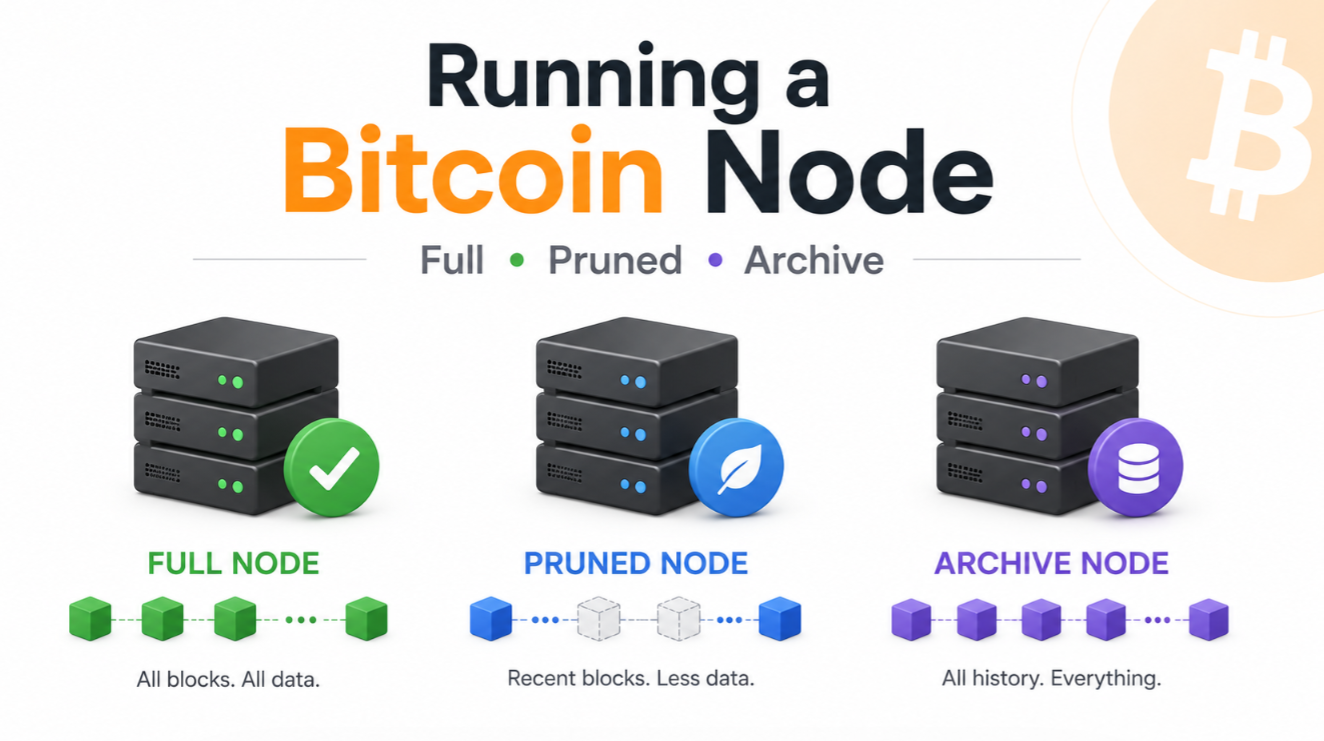
Three main configurations dominate: full nodes, pruned nodes, and archive nodes. Each has a different storage cost, different capability set, and different answer to who should run it.
What a node is (and is not)
A Bitcoin node is a computer running Bitcoin Core (or a compatible implementation) that connects to other Bitcoin nodes, downloads and verifies blocks, and enforces the network's consensus rules. Every node runs the same rules independently — that is the whole point.
A node is not a miner. Mining is a separate activity: producing new blocks, competing for the block reward. Running a node is passive: you download blocks other miners produced, verify them, and relay them.
A node is also not a wallet, exactly. Bitcoin Core includes a built-in wallet, but most people connect their own wallet software (Sparrow, Electrum, hardware wallets) to their own node for privacy and verification. The node does the verification; the wallet does the signing.
Full node: the reference
A full node — sometimes called "archive full" in modern parlance — downloads every block Bitcoin has ever produced, verifies every transaction back to genesis, and keeps the entire blockchain on disk. As of 2026 that is around 600 GB and growing by roughly 50-70 GB per year.
You need real hardware for this: a machine with 700+ GB of SSD storage, 4+ GB of RAM, and a reasonable internet connection. Initial Block Download (IBD) — the first-time sync — takes 1-3 days depending on your hardware. After that, keeping in sync is trivial (a few hundred kilobits per second of bandwidth).
What a full node gives you: complete verification of every rule for every transaction ever made, and the ability to answer any historical query (was this output spent in block N?). If you serve blocks to other nodes, you help distribute the network. If you connect your own wallet, you gain full privacy — the network cannot infer which addresses you care about from your queries.
Overkill for most users. Necessary for developers, block explorers, historical analysts, and anyone building infrastructure.
Pruned node: the practical middle
A pruned node also verifies every rule and every transaction back to genesis — the security guarantee is identical. The difference is what it keeps on disk after verification. You configure a "prune target" (minimum 550 MB), and after IBD, the node discards old block data beyond that target, keeping only enough to answer routine queries and re-verify the recent chain.
Storage drops from 600 GB to essentially whatever prune target you set. A 5 GB prune keeps a few weeks of recent blocks and works fine for wallet queries. A 50 GB prune keeps months of history and lets you answer more historical questions.
The main tradeoff: a pruned node cannot serve historical blocks to other nodes. It is a leech on the network's historical serving capacity. If everyone pruned, the network's ability to bootstrap new nodes would collapse. But if 5% of nodes prune, the network is fine and those 5% get almost all the security benefits at a fraction of the disk cost.
For most self-custody users, a pruned node is the correct answer. A Raspberry Pi 5 with a 1 TB SSD, using a 200 GB prune, gives you full verification of Bitcoin for around $150 in hardware and 30 watts of continuous power draw.
Archive node: for infrastructure
An archive node keeps everything a full node keeps, plus additional indexes: the "txindex" that lets you look up any historical transaction by ID, the "coinstatsindex" for supply auditing, sometimes the "blockfilterindex" for compact block filters used by SPV wallets.
Storage for a full archive node with all common indexes runs to around 1 TB. Not much more than a plain full node, but the indexes take significant CPU during IBD.
You need an archive node if you are running a block explorer, a payment processor, an academic research setup, or a wallet backend for many users. For personal use, a plain full node is enough — indexes are for services, not individuals.
Hardware options: the practical grid
**Raspberry Pi 5 with SSD**: cheapest option, ~$150 total, runs a pruned node comfortably, or a full node with slightly slower IBD. Good for a "run and forget" setup. Umbrel, Start9, and Bitcoin Machines all package this experience.
**Old laptop or mini PC**: often the free option if you have hardware lying around. Fine for pruned. Full nodes work if the SSD is big enough. Power draw is higher than a Pi.
**Dedicated PC or NAS**: overkill for a single node but reasonable if the node is one of many services running. A repurposed home server is a common setup.
**VPS**: costs $10-30 per month for enough disk and bandwidth. Convenient but you are trusting the VPS provider — the whole point of self-verification is undermined if the operator controls your view. Not recommended for security-first users.
Who actually benefits
The strong case for running a node applies if you meet any of these:
- You hold non-trivial amounts of Bitcoin and want to verify network rules yourself
- You use Lightning at a non-custodial layer (Lightning nodes need to talk to a Bitcoin node)
- You value the privacy of not leaking your addresses to public explorers
- You are technically inclined and view the operational overhead as trivial
The weak case: you use a custodial wallet or exchange for everything, you check balances via a mobile app, and you have no strong preference between "trust the explorer" and "verify myself." Nothing wrong with that. Running a node in that scenario is a hobby, not security.
What running a node does not fix
Running your own node does not make you more anonymous on-chain if you use exchanges that KYC you. Running a node does not protect against wallet compromise if your private keys are stolen. Running a node does not speed up your transactions or reduce your fees.
The node's job is verification and privacy of queries. It is one component of a self-custody stack. It is not a silver bullet, and you can be perfectly safe as a Bitcoin user without ever running one if your threat model does not require it.
But: if your Bitcoin holdings are meaningful, a pruned node on a Raspberry Pi is small enough to just set up and leave running. The security floor it gives you — you personally verifying the rules — is worth the $150 and one afternoon of setup.