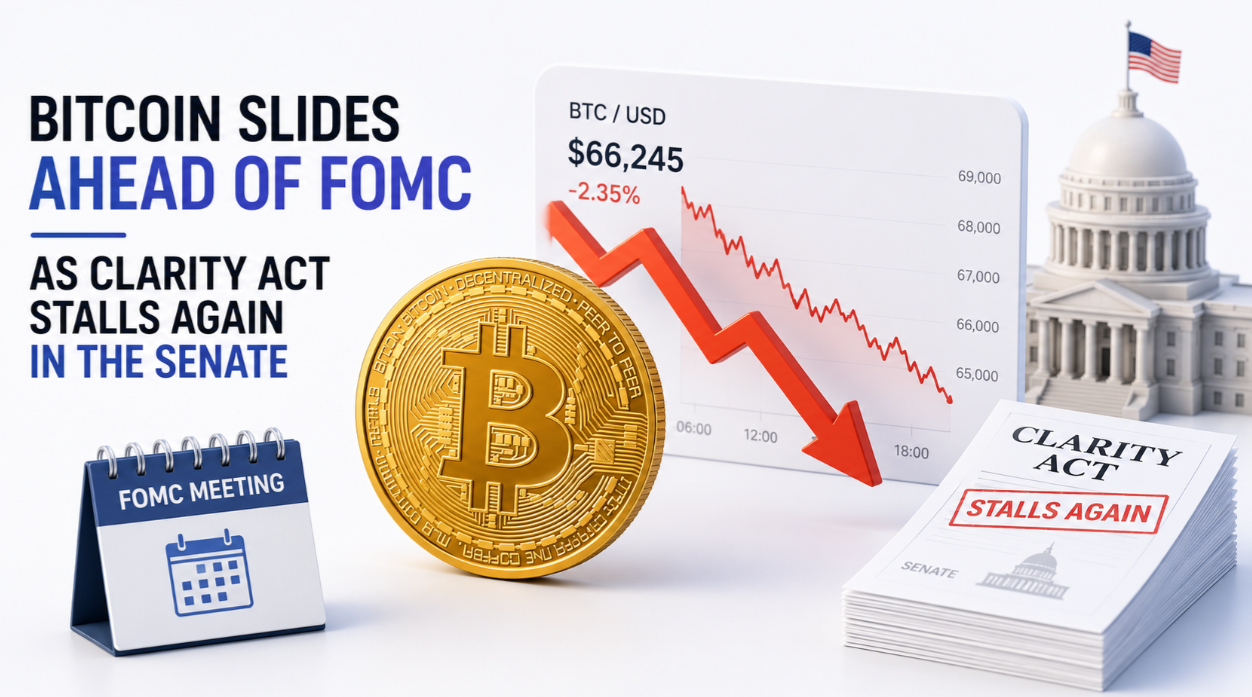
Bitcoin Slides Ahead of FOMC as CLARITY Act Stalls Again in the Senate
Bitcoin Slips as Traders Brace for the Fed's July Decision
Bitcoin retreated toward the $63,200 level on Tuesday, giving back gains from earlier in the week as investors positioned themselves ahead of the Federal Reserve's two-day policy meeting on July 28–29. The broader digital asset market pulled back roughly 1.6% over the past 24 hours, with total market capitalization slipping to around $2.26 trillion. Ethereum followed Bitcoin lower, trading near $1,870, while overall trading volume across the market held above $65 billion.
This marks the second FOMC gathering chaired by Fed Chair Kevin Warsh since he took office in May, and market participants are watching closely for any signal on the path of interest rates for the remainder of the year. Warsh has previously signaled limited tolerance for persistently elevated inflation, and traders are weighing the odds of further tightening later in 2026 against hopes for a more accommodative stance. With crypto assets increasingly trading in step with broader risk sentiment, the outcome of the meeting — and, more importantly, the tone of the accompanying statement — could set the direction for digital assets heading into August.
Adding to the cautious mood, easing geopolitical tensions between the United States and Iran had briefly supported a "risk-on" bid in crypto markets over the weekend, but that momentum faded as attention shifted back to monetary policy. Bitcoin's dominance of the overall crypto market has held in a tight range near 56–59% throughout the week, suggesting capital is consolidating in majors rather than rotating aggressively into altcoins ahead of the Fed decision.
CLARITY Act's Path Through the Senate Narrows Further
On the regulatory front, the Digital Asset Market Clarity Act — widely seen as the industry's best shot at a comprehensive federal framework in 2026 — continues to stall on the Senate floor. Senate Majority Leader John Thune has indicated the bill is unlikely to advance before lawmakers leave for the August recess, a delay that markets had largely hoped to avoid.
The bill already cleared the House by a wide, bipartisan 294–134 margin back in mid-2025, and the Senate Banking Committee advanced its own version in May 2026. Since then, however, the legislation has remained stuck on the calendar without a scheduled floor vote or filed cloture motion. Sticking points include unresolved ethics provisions tied to conflicts of interest in the crypto space, disagreements over federal preemption, and the still-unfilled leadership seats at the SEC and CFTC.
Prediction markets have taken notice: implied odds of CLARITY Act passage in 2026, as tracked on Polymarket, have slid to roughly 37%, down sharply from highs above 80% earlier in the year. Policy analysts describe the next few weeks — before the Senate's August 10 effective deadline — as the last realistic window for the bill to move in 2026. A miss would likely push the debate into 2027, an election-shadowed year that could complicate negotiations further.
For now, exchanges, custodians, and institutional investors operating in the U.S. remain in a holding pattern, continuing to plan around regulatory uncertainty rather than the clear rules the bill was designed to provide.