Almost every active crypto user ends up using both centralized and decentralized exchanges — for different jobs. Knowing which to use when, and why, saves money and avoids the worst categories of risk.
Centralized exchanges (CEX)
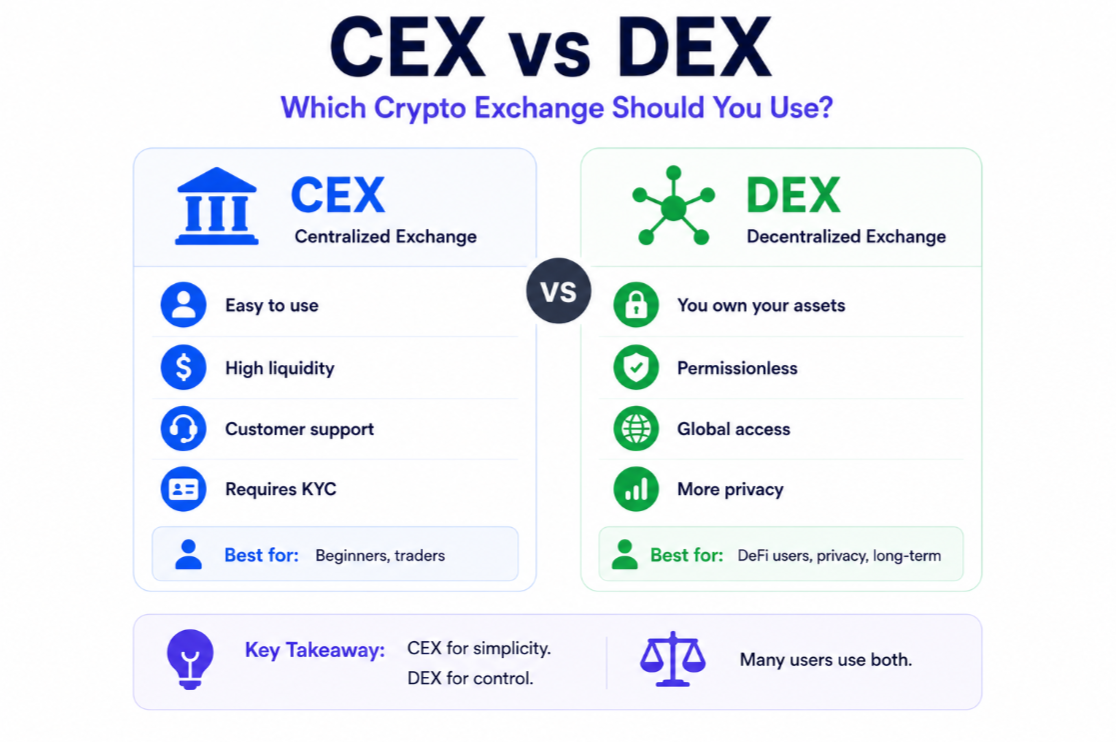
A CEX (Binance, Coinbase, Kraken, Bybit) runs an order book matched off-chain. You deposit assets, the exchange holds them, you trade against other users. Fiat on/off-ramps, deep liquidity, and instant matching make CEXs the default starting point.
Decentralized exchanges (DEX)
A DEX (Uniswap, Jupiter, Curve, Hyperliquid) is a smart contract. You connect a wallet, the contract executes trades against either a pool or an order book. You keep custody throughout. No KYC, no withdrawal limits, no off-ramp.
The five dimensions that matter
- Custody — CEX holds your keys; DEX leaves them with you. The CEX trade-off is operational risk (FTX, Mt. Gox) versus the DEX trade-off of smart-contract risk and key-loss.
- Fees — CEX spot fees are 0.05–0.20%. DEX fees are 0.05–0.30% plus gas. On L2s, all-in DEX cost is usually comparable to CEX.
- Liquidity — CEX wins for majors (BTC, ETH, SOL). DEX wins for long-tail tokens that may not even list on CEX.
- Speed — CEX matches in milliseconds. DEX speed depends on the chain (Ethereum L1 ~12 s, Solana ~400 ms, perps DEXes like Hyperliquid are near-instant).
- Regulation — CEX accounts can be frozen, reported, or geofenced. DEX positions only respond to your wallet signature.
When to use a CEX
Fiat on/off-ramps, large BTC/ETH purchases, derivatives trading with cross-margin, staking with no slashing exposure, and earning interest on stablecoins where you accept counterparty risk.
When to use a DEX
Trading new tokens not yet listed on CEX, swapping between chains via aggregators, using DeFi yield strategies, and keeping custody when you do not trust intermediaries (sanctioned countries, frozen-account risk, or principle).
The middle ground: aggregators and hybrid DEXes
Tools like 1inch, ParaSwap, and Jupiter route trades across many DEXes to find the best price. Hybrid platforms — dYdX, Hyperliquid — combine off-chain order books with on-chain settlement, giving you CEX-like speed without custodial risk.
Need details? See our best crypto exchanges 2026 comparison or our dex aggregator guide.