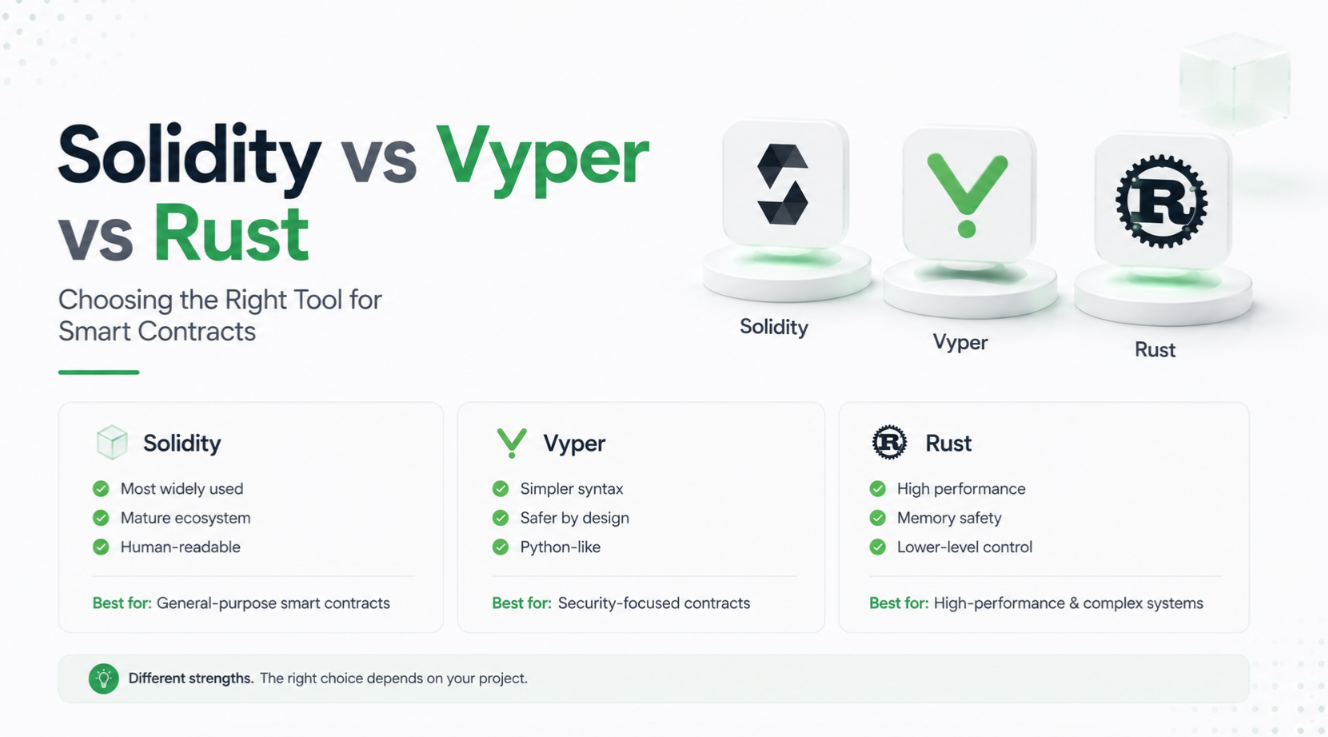
The choice of language for writing smart contracts is not just an implementation detail. It shapes what the contract can express, how easy bugs are to introduce, what tools exist to check for those bugs, and what talent is available to review the code. Three languages dominate: Solidity (by far the most used), Vyper (the security-focused Ethereum alternative), and Rust (for non-EVM chains like Solana). Understanding what each optimizes for is required literacy for anyone evaluating smart-contract projects seriously.
Solidity: the incumbent
Solidity has been the default language for Ethereum since 2015. It looks like a mix of JavaScript, C++, and Java — familiar syntax for anyone with general programming background. Ethereum's entire ecosystem of libraries, tools, and best practices is built around it.
**What it optimizes for**: expressivity and developer productivity. Solidity has features for most patterns you'd want in a contract — inheritance, interfaces, libraries, modifiers, events, custom errors. If you can imagine a contract shape, Solidity can express it.
**Ecosystem**: enormous. OpenZeppelin (audited contract templates), Hardhat and Foundry (development frameworks), Slither (static analysis), Mythril (symbolic execution), and dozens more tools all target Solidity first. Any auditor knows Solidity. Any smart-contract engineer can read it.
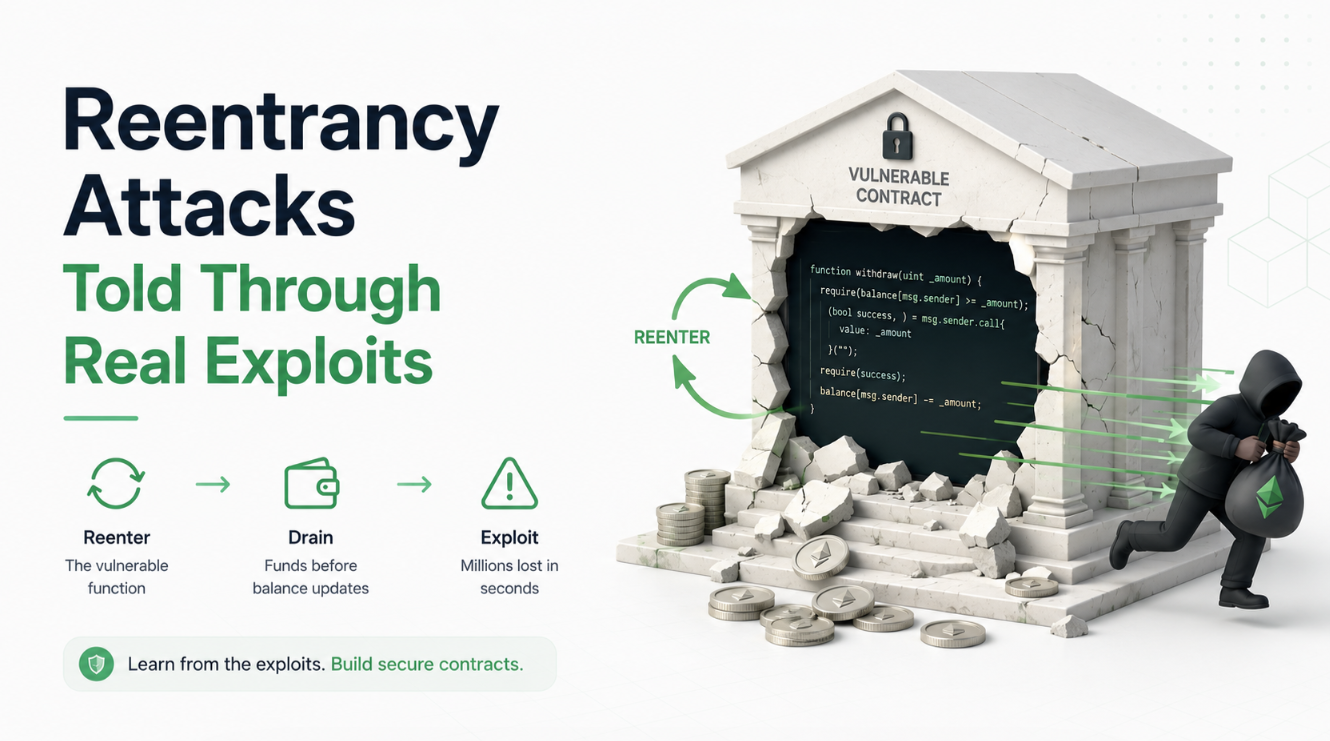
**Security profile**: mixed. Solidity's flexibility means it's easy to write insecure contracts. The language allows reentrancy patterns (fixed by discipline), integer overflow (fixed by SafeMath in older Solidity, native in 0.8+), unchecked delegatecall (still dangerous), and many other footguns. The counter is that these are all well-known and tools/audit patterns exist to catch them.
Every deployed Ethereum bug you've heard of is almost certainly Solidity. That's not because Solidity is uniquely bad — it's because Solidity has ~99% of the contract deployment volume.
**Where it dominates**: Ethereum, all EVM L2s, BNB Chain, Polygon, Avalanche C-Chain — essentially every EVM-compatible chain. That's most of the smart-contract ecosystem by TVL.
Vyper: the security-focused alternative
Vyper was created explicitly to be a safer alternative to Solidity for the same target — the EVM. It looks like Python: indentation-based syntax, no braces, minimal keywords.
**What it optimizes for**: security and readability. Vyper deliberately omits features that are common sources of bugs in Solidity: no inheritance, no infinite loops (all loops must have a fixed upper bound), no modifiers (which can hide behavior), no operator overloading, no assembly by default. The idea is that a Vyper contract is what you see — no hidden layers of abstraction.
**Ecosystem**: smaller than Solidity but non-trivial. Curve Finance is the flagship Vyper project — their entire multi-billion-dollar DeFi protocol is written in Vyper. That's a massive vote of confidence. Yearn, Curve-adjacent projects, and various pool implementations use Vyper. Auditors have gotten fluent in it. Tools like Titanoboa (a Vyper-focused testing framework) exist.
**Security profile**: better in principle. Vyper's simpler language surface makes some entire classes of bugs impossible. But: Vyper is less mature. The Vyper compiler has had bugs. In 2023, a compiler bug in Vyper's reentrancy protection led to $70M in exploits across several Curve pools. This is a real reminder that "safer language" doesn't mean "no bugs" — it means "different bugs."
The Curve incident was fixed within a day and post-mortem analysis was rigorous. It didn't kill Vyper as a language, but it did remind the ecosystem that new languages take time to reach the reliability level of established ones.
**Where it dominates**: nowhere by market share, but has strong footprint in specific DeFi domains where security matters extremely (Curve, some pool implementations). Not a general-purpose choice; specifically chosen when the team has strong security preferences.
Rust: the non-EVM story
Rust doesn't run on the EVM. It's the language for Solana (via the Anchor framework), NEAR, Aptos and Sui (though these use Move, which is Rust-like), and various other non-EVM chains. It's also the language for zkVM prover circuits and for Ethereum client development.
**What it optimizes for**: performance, memory safety, correctness by construction. Rust's borrow checker prevents entire classes of bugs (use-after-free, data races, null pointer dereferences) at compile time. For smart contracts, this translates to compiler-enforced discipline that's harder to violate.
**Ecosystem**: growing rapidly. Solana's Rust-based smart-contract ecosystem is mature — Serum, Raydium, Jupiter, Kamino, Marinade, and hundreds of others are Rust. Anchor is the dominant framework for writing Solana programs; it wraps Rust with macros that reduce boilerplate.
**Security profile**: rust's guarantees prevent many memory-safety bugs, but smart-contract-specific vulnerabilities (integer overflow, reentrancy analogues, authority bypasses) still require care. Solana has had significant exploits — the 2022 Wormhole hack ($325M) was a Solana program bug. Rust doesn't automatically make contracts safe; it removes some categories of bugs but not the domain-specific ones.
**Where it dominates**: Solana entirely (there's no other language). Also NEAR, Aptos (via Move), Sui (via Move). For non-EVM smart contracts, Rust or Rust-derived languages are the default.
Move: worth mentioning
Move is a Rust-derived language designed at Meta for the Diem blockchain (later killed). It survived through Aptos and Sui, both of which use Move as their contract language.
Move's distinguishing feature is a resource-oriented type system — assets (like tokens) are first-class types that the language ensures can't be duplicated or dropped accidentally. In principle, this eliminates entire classes of asset-management bugs.
In practice, Move is small — Aptos and Sui are meaningful chains but nowhere near Solana's scale, let alone Ethereum's. It's worth knowing about as an interesting design point but not a language most developers will encounter.
Language-choice reality by chain
- **Ethereum L1, all EVM L2s, BNB, Polygon, Avalanche C-Chain**: Solidity is default. Vyper is a security-focused option (Curve). Yul or inline assembly for extreme optimization.
- **Solana**: Rust, usually with Anchor framework.
- **NEAR**: Rust (or AssemblyScript for lighter contracts).
- **Aptos, Sui**: Move.
- **Cosmos ecosystem chains with CosmWasm**: Rust.
- **Substrate-based chains (Polkadot ecosystem)**: Rust (ink! framework) or Solidity via compatibility layers.
Practical implications for users
You don't write contracts, but the language choice matters when you evaluate a project:
- **Solidity project**: broadest talent pool for reviewing, largest tooling ecosystem, most known vulnerabilities catalogued. A well-audited Solidity contract with active bounty and multiple audits is as safe as smart contracts get today.
- **Vyper project**: usually a signal the team specifically chose security-first. Read the audits, but the language choice itself is a positive signal.
- **Rust project (Solana etc)**: language provides some benefits but doesn't eliminate need for audits. Solana ecosystem has been through several major exploits; the language isn't a shield.
- **Move project (Aptos, Sui)**: interesting language properties, but small ecosystem means fewer audit patterns established. Extra scrutiny warranted.
For any smart-contract project, the language is a piece of context. The presence of audits, the reputation of auditors, the age and battle-testedness of the code, and the presence of a bug bounty all matter more than the language choice per se.
Where each fails
Every language has failure modes at scale:
**Solidity**: massive attack surface. Any custom logic can go wrong. Even well-audited contracts have had exploits (Nomad, Wormhole's ETH side, various DeFi hacks). The mitigation is defense in depth: audit + fuzzing + formal verification + bug bounty + battle-testing.
**Vyper**: fewer footguns but immature compiler. The 2023 Curve compiler bug is a reminder that "simpler language" trades one risk (developer error) for another (compiler/tooling error).
**Rust for Solana**: language provides safety guarantees but Solana's runtime is complex — programs interact via cross-program invocations, accounts, and complex authority patterns that are easy to get wrong. Wormhole and Mango's exploits show this.
**Move**: youngest ecosystem. Fewer patterns established, fewer auditors fluent, fewer libraries battle-tested. Time and volume are the only fix.
The direction of travel
Language ecosystems evolve slowly. In 2026, Solidity remains dominant on Ethereum (~95%+ of new contracts). Vyper has stabilized at ~2-5% with strong footprint in specific DeFi domains. Rust dominates Solana entirely and is significant in Cosmos and NEAR ecosystems.
The interesting frontier is compilation targets: language-agnostic zero-knowledge proving means that in theory, any language that can prove correctness could be used for smart contracts. RiscZero and similar zkVM projects are experimenting with letting you write in Rust or Go and prove correct execution on-chain.
For now, learning Solidity remains the highest-leverage smart-contract skill by a large margin. Learning Rust is second (for anyone eyeing non-EVM ecosystems). Vyper is niche but a great addition if you're specifically interested in security.