The path a transaction takes from your wallet to a mined block is more complex than "broadcast, wait, done." On Ethereum since 2021, the block-building process is a multi-party auction with formal roles, dedicated infrastructure, and a market that generates hundreds of millions of dollars annually. The system is called Proposer/Builder Separation, and the middleware most validators use to participate is MEV-Boost.
For anyone doing serious on-chain work — trading, arbitrage, liquidations, or just wanting to understand why your transaction sometimes lands in a different position than you expect — this is required background.
The pre-Flashbots era
Before 2021, block ordering was chaotic. Miners (this is pre-Merge) would look at their own mempool, pick the transactions with the highest gas prices, and pack them into blocks. If they had connections with MEV searchers, they might do private deals — a searcher would send transactions directly to a friendly miner in exchange for a cut.
The problem: this was opaque and unequal. Miners with better connections got more MEV. Retail users had no way to interact with the extraction, so they were always on the losing side. Some miners resorted to "generalized front-running" — inspecting every mempool transaction for profit opportunities and copying them.
The system worked but was ugly. It was clearly extractable value being captured, mostly by a few well-connected miners, and there was no clean way to democratize participation.
Flashbots emerges
Flashbots launched in 2020 as a research organization and infrastructure provider to solve this. Their pitch: create a formal marketplace where MEV searchers can bid to have their transactions included in specific positions in specific blocks, and where any miner can participate as a buyer.
The mechanism was a system called MEV-Geth — a modified Ethereum client that accepted transaction bundles from searchers via a private channel. A bundle is an atomic group of transactions with a specified minimum profit; if the profit can be extracted, the miner includes the bundle. Searchers pay for inclusion via a coinbase transfer or the priority fees within the bundle itself.
By late 2021, over 90% of Ethereum miners were running MEV-Geth. The system worked well enough that it became the de facto standard for MEV extraction, replacing the ad-hoc private deals.
The Merge and the redesign: MEV-Boost
When Ethereum switched from PoW to PoS in September 2022, MEV-Geth needed to be redesigned for the new consensus. The result was MEV-Boost — a separate piece of software that any validator can run alongside their consensus client.
MEV-Boost implements a cleaner version of the same idea, but with an explicit split of roles:
- **Proposer**: the validator selected by the beacon chain to propose the next block. They don't need to build blocks themselves anymore — they can outsource that.
- **Builder**: an entity that constructs profitable blocks by combining public mempool transactions with private MEV bundles. Builders compete to produce the most valuable blocks.
- **Relay**: a trusted middleware that connects builders to proposers, holds bids privately until a proposer commits, and enforces that the proposer signs off on what they claim to be signing off on.
The proposer, running MEV-Boost, asks all connected relays: "what's the most valuable block I could propose right now?" Each relay responds with its highest bid — the payment the winning builder is offering the proposer in exchange for using their block. The proposer picks the highest bid, signs off on that block header, and receives the payment. They never see the block contents until after signing.
Why the separation matters
The core insight of Proposer/Builder Separation (PBS) is that validators shouldn't need to be sophisticated MEV-extraction professionals to earn full MEV revenue. The specialty economy — building profitable blocks, running fast infrastructure, coordinating with searchers — should be handled by dedicated builders. Validators just choose the best bid.
This has several consequences:
- **Even small stakers get full MEV revenue**: as long as they run MEV-Boost, they're paid by builders competing to build for them. No sophistication required.
- **Builders compete on efficiency**: the more MEV a builder can extract cleanly, the higher a bid they can offer, the more likely they win. This drives professionalization and specialization.
- **Searchers have clear channels**: they send bundles to builders (private channels like Flashbots Protect), who compete to include them.
Currently, around 90% of Ethereum blocks are proposed via MEV-Boost. The alternative — proposers building their own blocks — is used mostly by validators who philosophically object to MEV extraction or who're running experimental setups.
The block-building process, step by step
For an actual block being built right now on Ethereum:
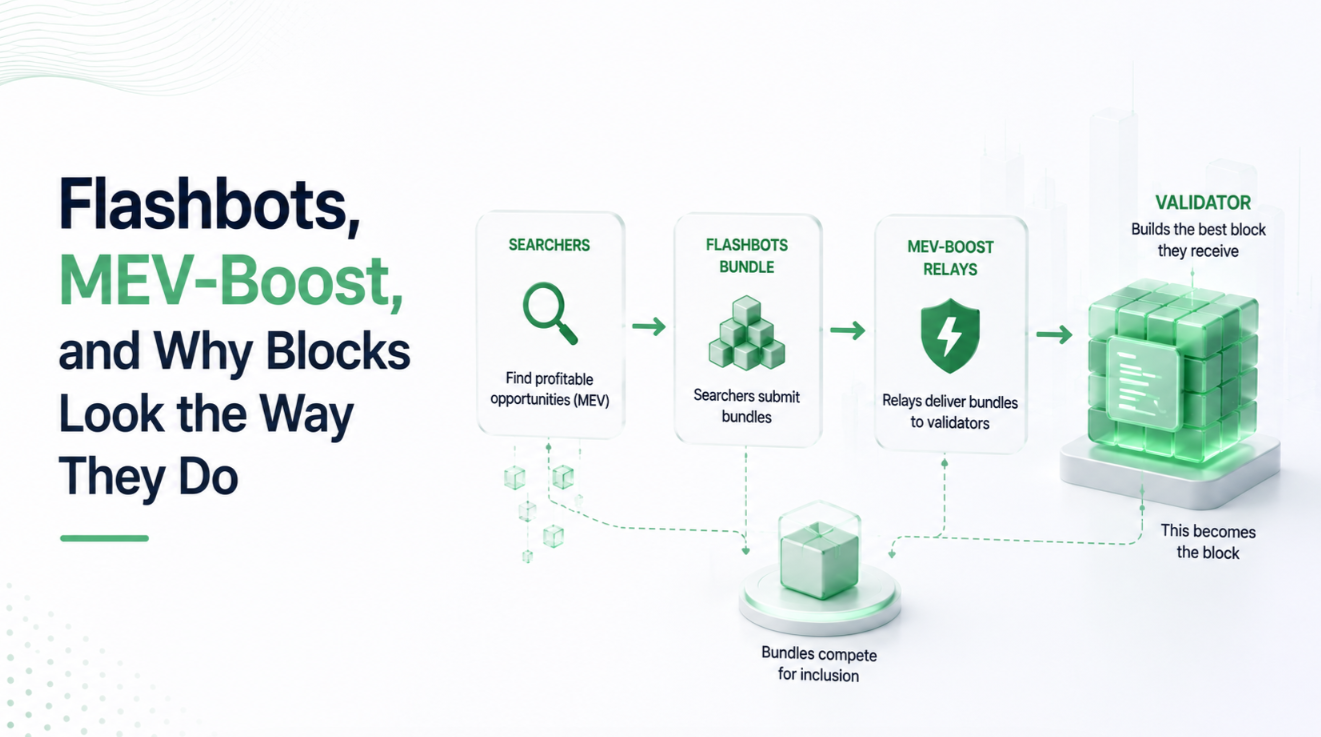
1. **Searchers submit bundles**: MEV searchers (arbitrage bots, sandwich bots, liquidation bots) submit atomic bundles to builders via private channels. A bundle typically includes a target transaction from the public mempool plus their own front-running and back-running transactions.
2. **Builders assemble blocks**: builders take public mempool transactions, apply bundles from searchers, and construct proposed blocks with maximum total priority fees + MEV. They evaluate thousands of combinations per slot.
3. **Builders submit bids to relays**: builders submit their best-block bid to one or more relays. The bid is essentially "if you use my block, I'll pay this validator X ETH."
4. **Relays hold sealed bids**: each relay holds the bids privately, showing the proposer only the summary (which builder is winning, at what bid).
5. **Proposer selects a bid**: MEV-Boost on the proposer's validator picks the highest bid from any connected relay. The proposer signs the block header committing to that specific bid.
6. **Relay releases the block**: only after receiving the signed header does the relay release the actual block contents to the proposer, who broadcasts it to the beacon chain network.
7. **Payment settles**: the winning builder's payment is included in the block itself, going to the proposer's fee recipient address.
The entire process happens in the 12 seconds between when the proposer is selected and when their block must be published. The bidding auction is fast and competitive.
The relay layer
Relays are trusted middleware. They see block contents (so they can validate that builders are honest) and they see bids (so they can rank them). They must not reveal block contents to the proposer before commitment, or the proposer could steal the MEV without paying the builder.
Because relays are trusted, the choice of which relays to connect to is a security decision. The main relays operated in 2026:
- Flashbots (original, largest volume)
- BloXroute (multiple variants including "regulated" filtered relay)
- Manifold
- Aestus
- Eden Network
- Ultra Sound Relay
Some relays filter transactions (regulated relays block sanctioned addresses); some don't. Validators can choose which relays to trust, with implications for what kinds of MEV they capture and what kinds of censorship they participate in.
What breaks the system
The design has known weaknesses:
**Builder centralization**: block-building is capital-intensive and requires deep MEV searcher relationships. The top 2-3 builders currently produce 60%+ of MEV-Boost blocks. If those builders start filtering transactions or coordinating in unfriendly ways, censorship resistance suffers.
**Relay trust**: relays could theoretically censor bids or misbehave. Multiple relays exist for redundancy, but the top relays handle most of the volume.
**Timing games**: builders and searchers try to time their bids optimally within the 12-second window. This creates a game-theoretic dynamic where the actual final bid isn't the "true" maximum profit but rather what emerged from the timing game.
Long-term, Ethereum researchers are working on "enshrined PBS" — a version of proposer/builder separation baked into the protocol itself rather than existing as optional middleware. This would reduce reliance on Flashbots and other trusted relays. Timelines are speculative; production deployment isn't imminent.
What you can do with this
For a normal user, MEV-Boost is transparent — your transactions go through it whether you know it or not. The relevant considerations are:
- If you want to avoid public mempool sandwich attacks, use Flashbots Protect RPC. Your transactions go directly to builders as private submissions, bypassing the public mempool.
- If you're a validator or thinking of running one, MEV-Boost is essentially required — non-MEV-Boost validators earn substantially less. Choose your relay set carefully (censorship-resistant vs regulated).
- If you're a serious searcher, you're already deep in this system. Your competition is other searchers with better strategies and lower latency.
For everyone else, the takeaway is that Ethereum's block-building is a real market with real players making real money. Understanding the players and their incentives is what turns "why did my transaction get sandwiched" from a mystery into a comprehensible outcome of a market you now know exists.