Every Ethereum transaction goes through a period between broadcast and inclusion where it is public but not yet final. During those seconds, other actors can see what you intend to do and act on that knowledge. When those actions extract value that would otherwise have gone to you, that value is MEV — Maximal Extractable Value. Understanding the three main patterns of MEV is required literacy for anyone doing serious trading or DeFi work on Ethereum.
MEV is not a bug. It is a natural consequence of any system where transactions are public and ordering matters. It exists on every chain to some degree. On Ethereum, where the mempool is public and DeFi volume is high, MEV extraction is a professional industry generating billions of dollars per year.
The mechanism
The moment you sign a transaction and broadcast it, your transaction appears in the public mempool. Every validator, every MEV searcher, every block builder can see it. Between broadcast and inclusion — usually 10-30 seconds — the transaction is essentially a public promise of what you're about to do.
If your transaction reveals valuable information — a big trade that will move a price, an approaching liquidation, an arbitrage opportunity you're about to close — that information can be acted on. The actor with the best information and the fastest response usually wins.
The way to win is to have your transaction included before, after, or around the target transaction. This requires influencing block ordering, which is done by paying a higher gas price (priority fee) and using specialized infrastructure to reach block builders efficiently.
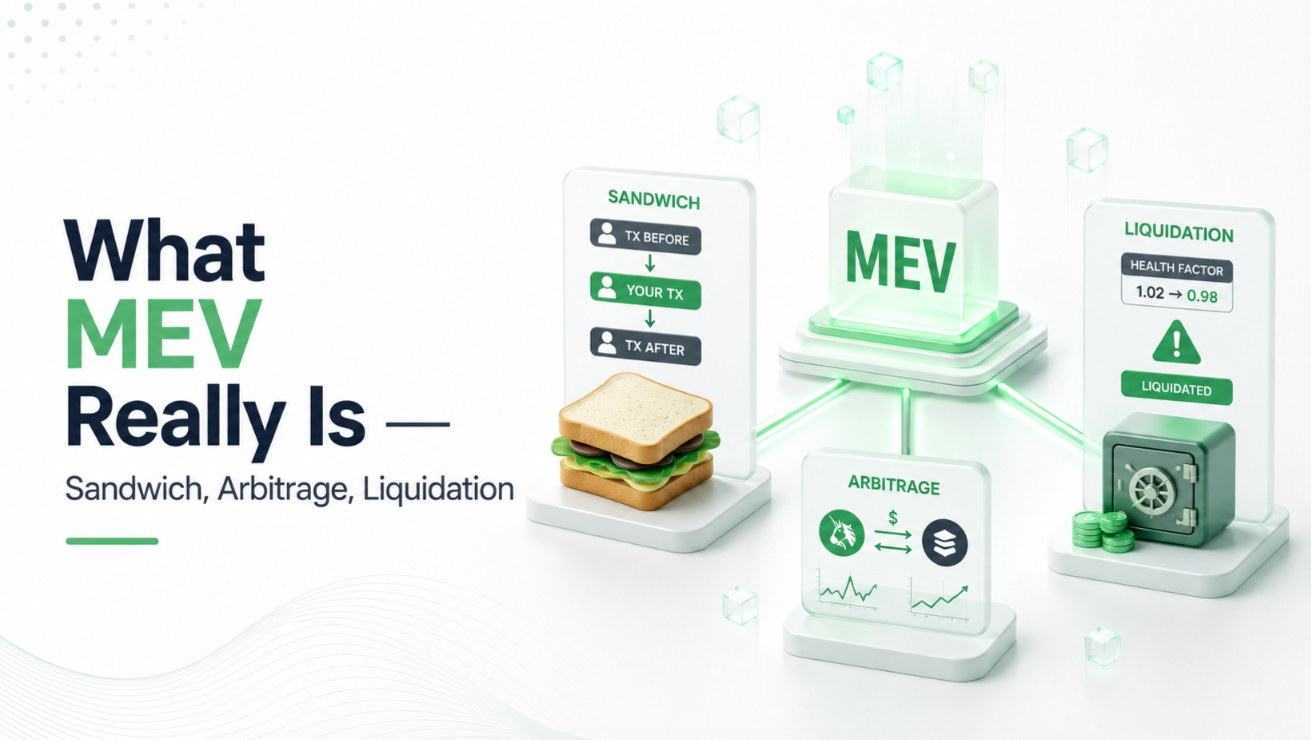
Pattern 1: Sandwich attacks
The sandwich is the most common MEV pattern in DeFi and the most visible to retail users. It works when a large trade will move the price of an asset on an AMM.
**The setup**: a retail user submits a swap of 10 ETH for USDC on a Uniswap pool. Because the trade is large enough to move the pool's price, the user is willing to accept slippage of up to 1% (they set this in their wallet).
**The attack**: 1. A searcher sees the pending 10 ETH swap in the mempool. 2. They front-run it: submit their own swap of 5 ETH for USDC at a higher gas price. Their swap gets included first, driving the ETH price down against USDC. 3. The retail user's swap executes at the now-worse price (they get less USDC than they would have). 4. The searcher immediately back-runs: submits a USDC→ETH swap that captures the price movement. They end up with slightly more ETH than they started with.
The searcher's profit comes from the retail user's slippage. If the user set 1% slippage tolerance, the searcher can extract up to 1% of the trade value.
For a 10 ETH trade at $2,000/ETH, that's up to $200 of extraction per trade. On busy days, millions of dollars per day are extracted this way across all EVM chains.
**Defense**: use tighter slippage (0.1-0.3% instead of 1%), use RFQ-style aggregators like Cow Swap that batch trades and eliminate front-running, or use L2s where sandwich MEV is less prevalent due to different transaction ordering.
Pattern 2: Arbitrage
Arbitrage MEV is when two markets have the same asset priced differently and a searcher captures the spread. This is the "healthy" MEV that most people don't object to.
**The example**: ETH is trading at $2,000 on Uniswap V3 and $2,005 on Curve. A searcher spots this. They construct a transaction that buys ETH on Uniswap at $2,000, sells on Curve at $2,005, and pockets the $5 spread — minus gas and any other costs.
The searcher is paid by the two market prices converging. The rest of the market benefits because the arbitrage moves the two prices back together, eliminating the imbalance for other traders.
Arbitrage MEV extracts value from price inefficiencies rather than from user slippage. It's what keeps DEX prices tracking each other across venues. Without arbitrage MEV, prices could stay disconnected for extended periods, leading to worse execution for everyone.
The competition is fierce. Multiple searchers watch every pool. Successful arbitrage often requires being first (highest priority fee) and being able to execute complex multi-hop routes in a single transaction. The typical arbitrage opportunity is captured within one block of appearing.
Pattern 3: Liquidations
Lending protocols like Aave, Compound, and Morpho let users borrow against collateral. If the collateral value drops enough that the position becomes undercollateralized, the position is liquidatable — anyone can repay part of the debt in exchange for a discounted claim on the collateral.
The liquidation bonus is typically 5-15% of the collateral value. That's a large profit if you can be first to liquidate.
**The mechanics**: liquidation bots run continuously, watching the health factor of every position on major lending markets. When a position's health drops below 1 (undercollateralized), the bot fires off a liquidation transaction.
The competition to be the liquidator is intense. Bots pay astronomical priority fees during liquidation cascades because winning a single large liquidation can be worth tens of thousands of dollars in bonus. During major market moves, liquidation bots collectively consume a significant fraction of block gas.
For users being liquidated, this is bad — they lose collateral at a discount. For the lending protocol, it's essential — liquidations keep the system solvent. The bot economy is what makes lending protocols work.
Other patterns
Beyond the big three, MEV includes:
**JIT (Just-In-Time) liquidity**: a searcher provides concentrated liquidity to a pool right before a large trade, captures most of the fees the trade would have paid to existing LPs, then removes the liquidity immediately after.
**Backrunning without slippage impact**: any large trade creates temporary imbalances (in prices, oracles, funding rates) that can be arbitraged in the block right after. Backrunning is often ethically less questionable than sandwiches because it doesn't degrade the user's execution.
**NFT sniping**: bots watch for listings priced below fair value and buy them faster than any human can. This is MEV in the NFT market equivalent to arbitrage.
**Cross-chain MEV**: coordinated actions across two chains (buy on one, sell on another, or provide liquidity for a bridge event).
The economics
Aggregate MEV extracted on Ethereum has been in the range of $500M-$2B per year since 2022, depending on market activity. The breakdown roughly:
- Arbitrage: ~40% (healthy, cross-market efficiency)
- Liquidations: ~30% (necessary for lending markets)
- Sandwich attacks: ~15% (harmful to users)
- Other backruns and JIT: ~15%
This is extracted by a relatively small set of professional MEV searchers — perhaps a few hundred entities globally — who invest heavily in infrastructure. They compete for the same opportunities, which drives up priority fees and eventually returns most of the profit to validators.
Where the money ends up
Under Ethereum's post-Merge post-Flashbots system, MEV revenue is captured by:
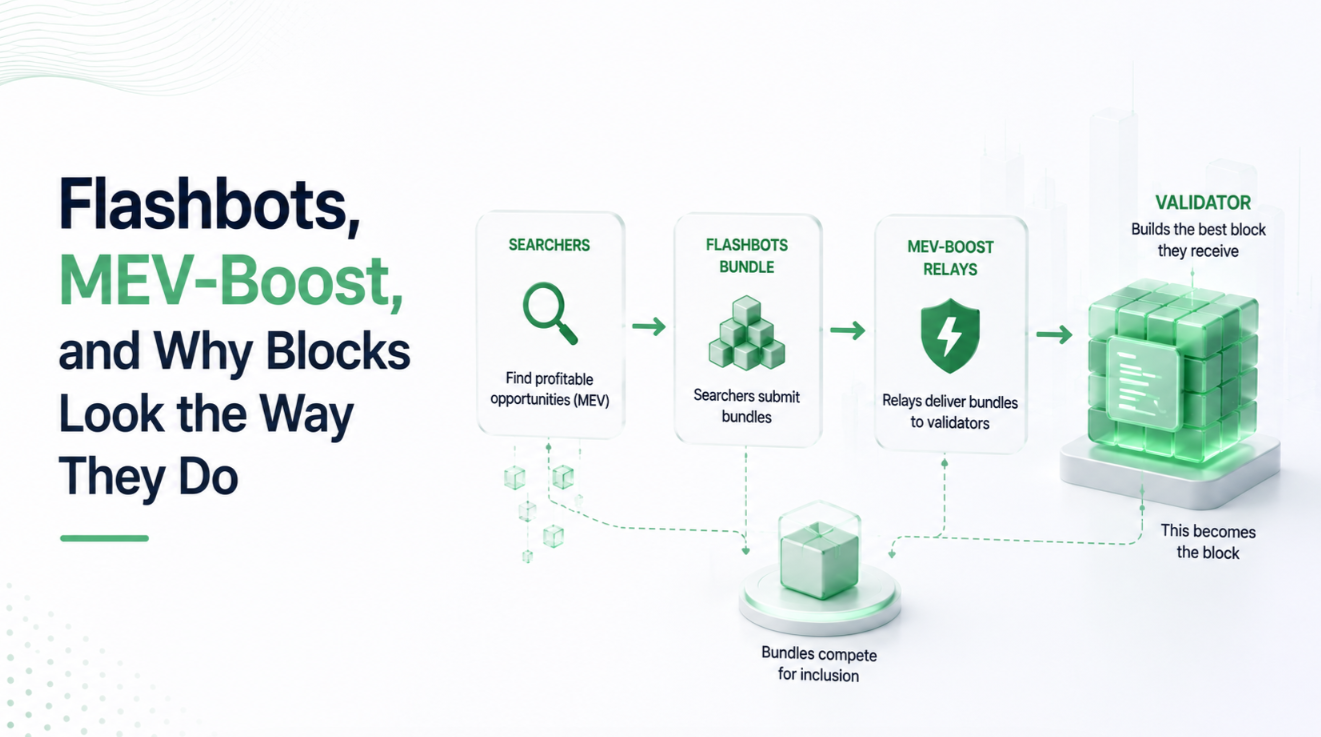
1. **Validators**: through priority fees on MEV-heavy blocks. The validator who proposes a block gets whatever priority fee is paid, which for MEV-rich blocks can be significant. 2. **Block builders**: entities that specialize in constructing profitable blocks. They receive priority fees but pay validators for the right to build the block. 3. **MEV searchers**: whoever spotted the opportunity and paid to have their transaction included in the profitable position.
MEV-Boost is the middleware that connects validators, block builders, and MEV searchers into a market. Most Ethereum validators run MEV-Boost, which means most of the MEV extracted on Ethereum flows through this system.
The user perspective
For most users, MEV is invisible until they're on the wrong side of a sandwich. You submit a trade, it goes through, you don't realize you got a slightly worse price than you would have without a sandwich sitting on top.
The concrete defenses:
- **Tight slippage tolerance**: never leave slippage at 1% for large trades on major AMMs. 0.3% or lower is defensible; 0.1% is aggressive.
- **RFQ aggregators**: Cow Swap, 1inch Fusion, UniswapX — these use off-chain matching that doesn't reveal your trade to the public mempool.
- **Private mempools**: Flashbots Protect, MEV Blocker — services that route your transactions through private channels to block builders directly, avoiding the public mempool entirely.
- **L2 usage**: sandwich MEV is less common on L2s because sequencers have different ordering rules. Not zero, but lower.
None of these are silver bullets. But combined they meaningfully reduce your MEV exposure.
The deep argument
Whether MEV is "bad" depends on which pattern you look at. Sandwich attacks extract value from users who chose to use a public mempool AMM with lax slippage settings — arguably preventable by the user. Arbitrage keeps markets efficient — a net good. Liquidations keep lending markets solvent — necessary.
The industry has largely moved from "MEV is bad, we should eliminate it" (early 2020s consensus) to "MEV is inevitable, we should democratize it" (current consensus). MEV-Boost is the pragmatic answer: rather than have MEV extracted opaquely by a few players, make the market transparent, competitive, and let the value flow through validators back to stakers.
Whether that's the right endpoint or a stepping stone to something better (encrypted mempools, threshold decryption, formal MEV-share mechanisms) remains an active research area. For now, MEV is a permanent feature of DeFi that every serious user needs to understand.