Compound Finance was one of the pioneering DeFi lending protocols. V2 launched in 2019 and defined the shape of on-chain money markets. V3 launched in 2022 with a fundamentally different architecture — single borrowable asset per market, base assets, and a simplified user experience. Understanding the changes from V2 to V3 tells you what Compound (and the broader DeFi industry) learned about lending in the intervening years.
Compound V2 — the multi-asset pool
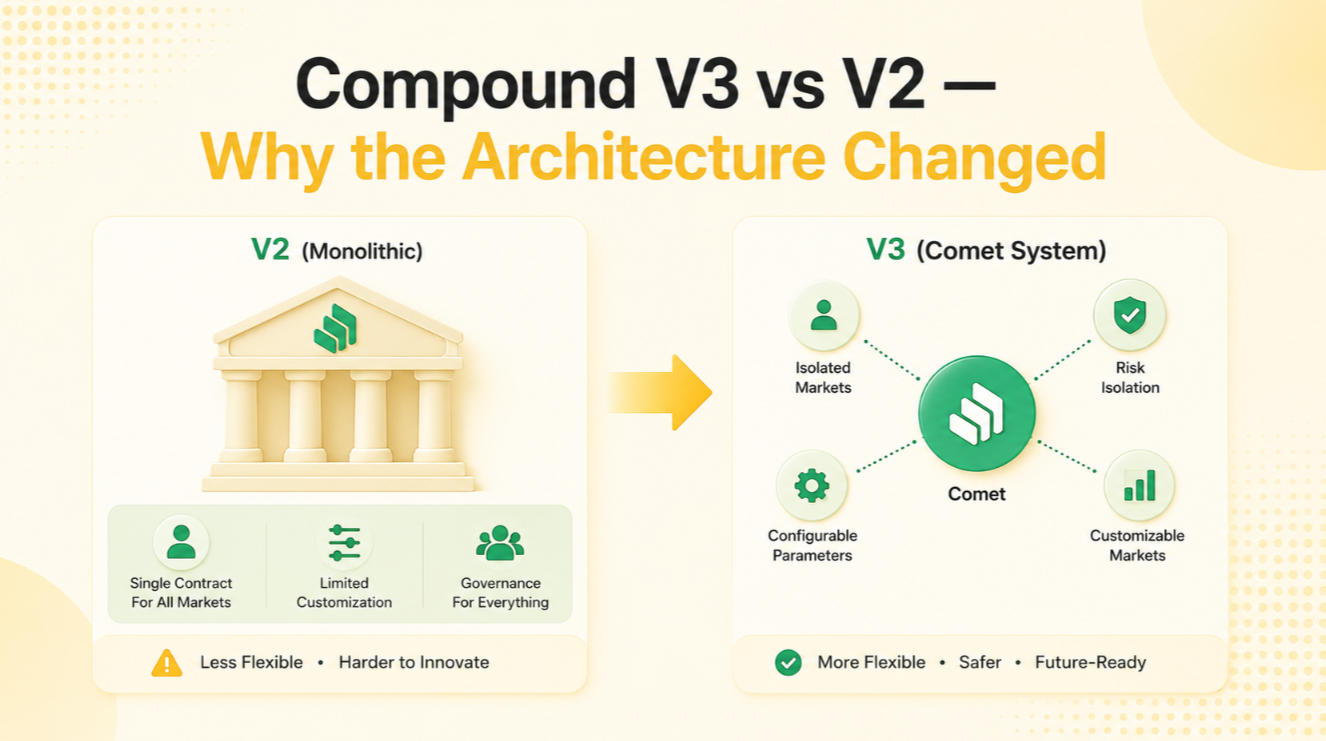
V2's design: one big pool per asset. Every asset (USDC, USDT, DAI, ETH, WBTC, etc.) has its own pool where users can supply and borrow. Any supplied asset can be collateral for borrowing any other asset. Interest rates for each asset are determined by that pool's utilization.
This design has advantages: capital efficiency (all supplied assets earn interest, all borrowable assets are available), and simplicity (one architecture supports everything).
But it also has problems:
- **Complex risk model**: because any supplied asset backs any borrowable asset, the collective collateral quality determines protocol safety. A single misbehaving asset (thin liquidity, oracle manipulation) threatens all markets.
- **Correlated risk**: during a crash, everything correlates. Multi-asset collateral doesn't diversify as much as you'd hope.
- **Governance overhead**: adding a new asset requires evaluating its impact on all other markets. This has slowed listings.
V2 is still operational in 2026 — Compound has never shut it down — but new asset listings on V2 have essentially stopped, and most user activity has migrated to V3.
Compound V3 — the redesign
V3's design: each market has one "base asset" that can be borrowed, and multiple collateral assets that can be supplied but not borrowed.
Concretely:
- **Compound V3 USDC market**: USDC is the only borrowable asset. ETH, WBTC, LINK, and others can be supplied as collateral to borrow USDC.
- **Compound V3 ETH market**: ETH is borrowable. WBTC, cbETH, stETH can be supplied as collateral.
If you want to borrow USDT and DAI, you use a different market — each stablecoin has its own market (or doesn't exist yet).
Why this design
Several problems that V2 had are solved by V3:
**Isolated risk**: bad behavior in one market can't affect others. A USDC market failure doesn't threaten the ETH market.
**Simpler risk model**: for each market, you only need to think about "which collateral is safe against this specific borrow asset." Much easier to reason about than V2's cross-market matrix.
**Better rate mechanics**: interest rate curves can be tuned per market, per direction. USDC borrowing on V3 can have very different dynamics than ETH borrowing.
**Easier governance**: adding a new collateral asset only affects one market. Faster listings, more flexibility.
The tradeoff: capital fragmentation. If you have USDC as collateral in the ETH market, that USDC isn't earning USDC-market interest. To earn interest on USDC, you'd supply it to the USDC market. But then it's collateral for USDC borrowing, not ETH borrowing.
For sophisticated users, this segmentation is fine. For newer users, it can be confusing.
Comet — the underlying architecture
Compound V3 (called "Comet" internally) uses a fundamentally different smart contract design than V2. It's built for efficiency and per-market isolation.
Key features:
- Single base asset per market
- Multiple collateral assets with per-asset LTVs
- Interest rate curve specific to that market
- Rewards mechanism (COMP token distributions to users)
- Guardian pause mechanism for emergencies
The code is smaller and more focused than V2, which had grown into a large multi-purpose lending framework. This makes V3 easier to audit and less exposed to unexpected interactions between features.
What using V3 looks like
For a user:
1. Choose a market based on what you want to borrow. USDC market? ETH market? 2. Supply collateral (any of the accepted collateral assets). 3. Borrow up to your collateral's LTV. 4. Manage health factor, similar to AAVE.
The UX is simpler than V2 in some ways (you don't have to think about multi-asset borrow ratios) and more complex in others (you might have positions in multiple markets to cover different needs).
Comparing to AAVE
AAVE and Compound V3 are the two dominant lending protocols in 2026:
- **AAVE**: multi-asset markets like Compound V2 but with more mature risk controls (eMode, isolation mode).
- **Compound V3**: single-borrow-asset markets, more per-market isolation.
Neither is universally "better." AAVE offers more integrated cross-asset borrowing; Compound V3 offers more per-market safety. Choice depends on use case:
- Simple borrow-a-stablecoin-against-ETH: either works fine, likely similar rates.
- Complex multi-asset strategies: AAVE is often more capital-efficient.
- Risk-averse for a specific market: Compound V3's isolation can be safer.
USDC-centricity of V3
Compound V3 launched with USDC as its first market and remains USDC-centric. The USDC market is the most-used, has the most collateral options, and is where the majority of Compound V3 activity happens.
Other markets exist (ETH, USDT, WETH on some chains) but with less liquidity and fewer collateral options. This is a real usability limit — Compound V3 doesn't really cover the same breadth as AAVE.
Governance and evolution
Compound governance (COMP token) manages both V2 and V3. Adding new markets, changing parameters, and evolving the code all go through governance. Compound has been more conservative than AAVE in adding new markets and features, reflecting a different philosophical stance.
For a user choosing
For most users in 2026:
- If you want the largest asset selection and cross-asset flexibility: AAVE.
- If you want simpler per-market risk and USDC borrowing is your main use case: Compound V3.
- Rates are usually competitive between the two.
- Don't concentrate all your DeFi lending in one protocol — diversify across AAVE + Compound + Morpho or similar.
Compound V3 represents an important architectural evolution. Even if you use AAVE, understanding V3's design tells you something about where lending protocol design is heading — toward more isolation, simpler per-market risk models, and fewer cross-market dependencies.
Why architectures matter
For DeFi as a whole, V3's rewrite is a case study in "the second attempt at a well-known design is often better." V2 defined a category; V3 refined it based on lessons from three years of production operation. Every mature DeFi category (DEXs, lending, derivatives) has similar evolution patterns.
Watching how designs evolve tells you what problems the industry has learned. For lending: pooling assets creates correlated risk that isolation better manages. For DEXs: general liquidity is less efficient than concentrated. For stablecoins: single mechanisms fail differently than combined mechanisms.
Understanding architecture makes you a better user, whether you're building or just holding.