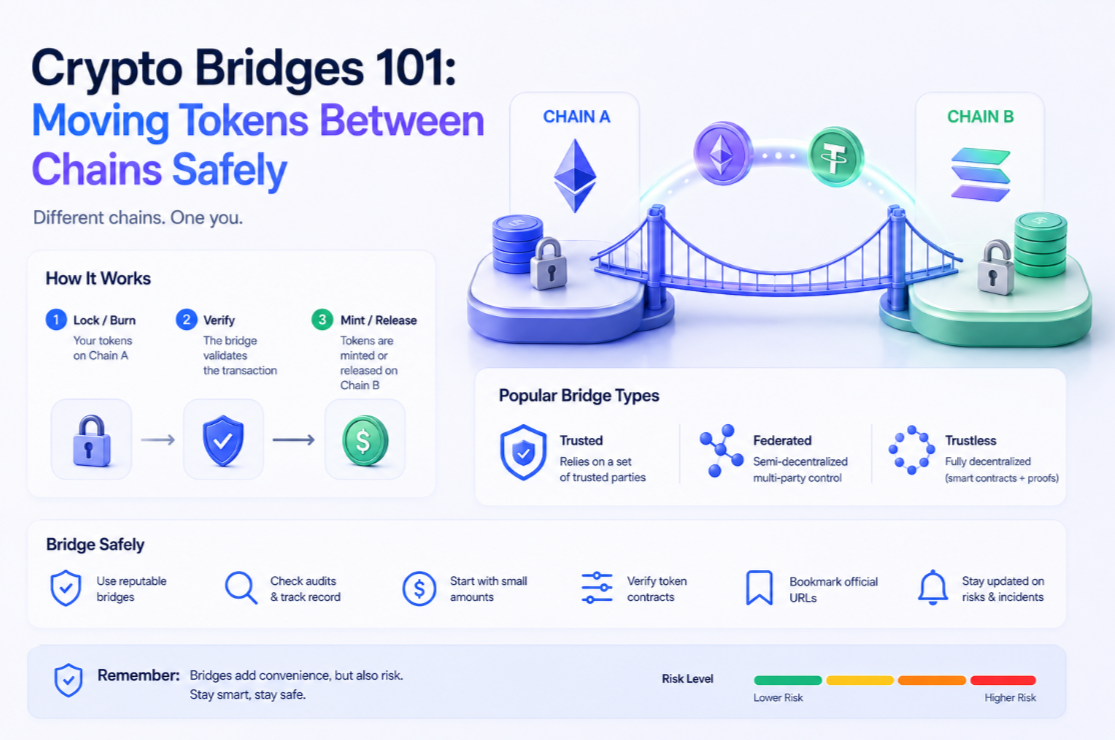
Moving USDC from Ethereum to Solana, or ETH from L1 to Base, requires a bridge. Bridges have lost more crypto to hacks than any other DeFi category — $2.5B+ across Ronin, Wormhole, and Nomad alone. The 2026 landscape is safer, but choices still matter.
What a bridge actually does
A bridge locks tokens on the source chain and mints (or releases) equivalent tokens on the destination chain. Some bridges use a multisig of validators. Some use light clients that verify the source chain cryptographically. The trust model determines how exploitable the bridge is.
The four bridge types
- Native bridges — operated by the destination chain (Arbitrum Bridge, Optimism Bridge, Base Bridge). Slowest but safest.
- Liquidity network bridges — Across, Stargate, Synapse. Fast, uses LP pools instead of mint/burn.
- Messaging bridges — Wormhole, LayerZero, Axelar, CCIP. Generalized cross-chain messages with bridge applications on top.
- Centralized bridges — Binance Bridge, Coinbase Wallet. CEX-operated, simple, but you trust the company.
How to bridge step by step
- Pick a reputable aggregator: Jumper Exchange, Bungee, or Across for cross-chain routing.
- Connect your wallet on the source chain.
- Enter the destination chain and asset.
- Review the route the aggregator chose — read which underlying bridge is being used.
- Confirm the transaction and wait. Most L2 ↔ Ethereum bridges take seconds via fast bridges; native bridge withdrawals from optimistic rollups take 7 days.
Safety tips
- Bridge small test amounts first.
- Prefer audited, battle-tested bridges over new ones.
- Beware of "bridge UI" phishing sites — bookmark the official URL.
- Check that the destination address is correct on the wallet preview, not just the dApp screen.
When not to bridge
If your destination chain has a native CEX deposit option, withdrawing from your CEX directly is usually cheaper and safer than bridging. Binance and Coinbase both support direct withdrawals to Arbitrum, Base, Optimism, and Polygon.
For more, see our Layer 2 bridges deep-dive and our Layer 2 networks comparison.