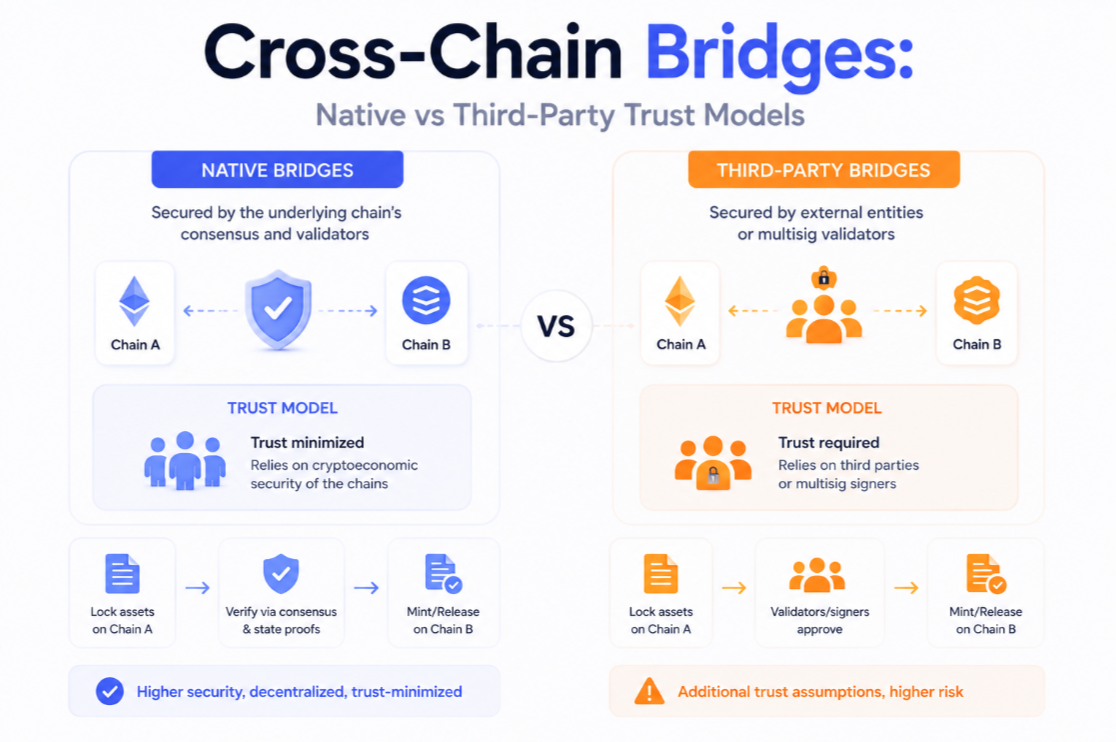
Bridges have lost more crypto to hacks than any other DeFi category. The 2026 landscape is safer — but the trust models still vary widely. Understanding what you are trusting matters more than which UI you use.
Trust model 1: Native (canonical) bridges
Each rollup has a native bridge operated by the rollup's own protocol. Funds are locked on L1 and minted on L2 (and vice versa) using the rollup's own state proofs. Most secure design — same trust assumptions as the rollup itself. Trade-off: L2 → L1 withdrawals on optimistic rollups take 7 days.
Trust model 2: Liquidity networks
Across, Stargate, and Synapse use LP pools and relayers to enable fast transfers. You deposit on chain A, an LP gives you funds on chain B, the protocol settles between LPs and relayers later. Fast (seconds to minutes) but trust the relayer and LP integrity.
Trust model 3: Messaging protocols
LayerZero, Wormhole, Axelar, CCIP, and others provide generalised cross-chain messages. Bridge applications build on top. Trust assumption: the protocol's validator set. LayerZero uses configurable security (you choose who validates). Wormhole uses a 19-guardian multisig. Axelar uses a validator set. Each has different worst-case scenarios.
Trust model 4: Centralised bridges
Binance Bridge, Coinbase Wallet bridge, and CEX deposit/withdrawal flows. Trust the company. Simple, fast, and often the best choice for casual users moving between specific CEX-supported chains.
Picking a bridge
- For L1 ↔ L2 native rollup transfers: use the canonical bridge unless you need speed (then liquidity networks).
- For L2 ↔ L2: liquidity networks (Across, Stargate) are usually fastest and cheapest.
- For unusual chain pairs: messaging-based aggregators (Jumper, Bungee) find the best route.
- For large institutional amounts: native bridges or CEX flows are safer.
See our crypto bridges 101.