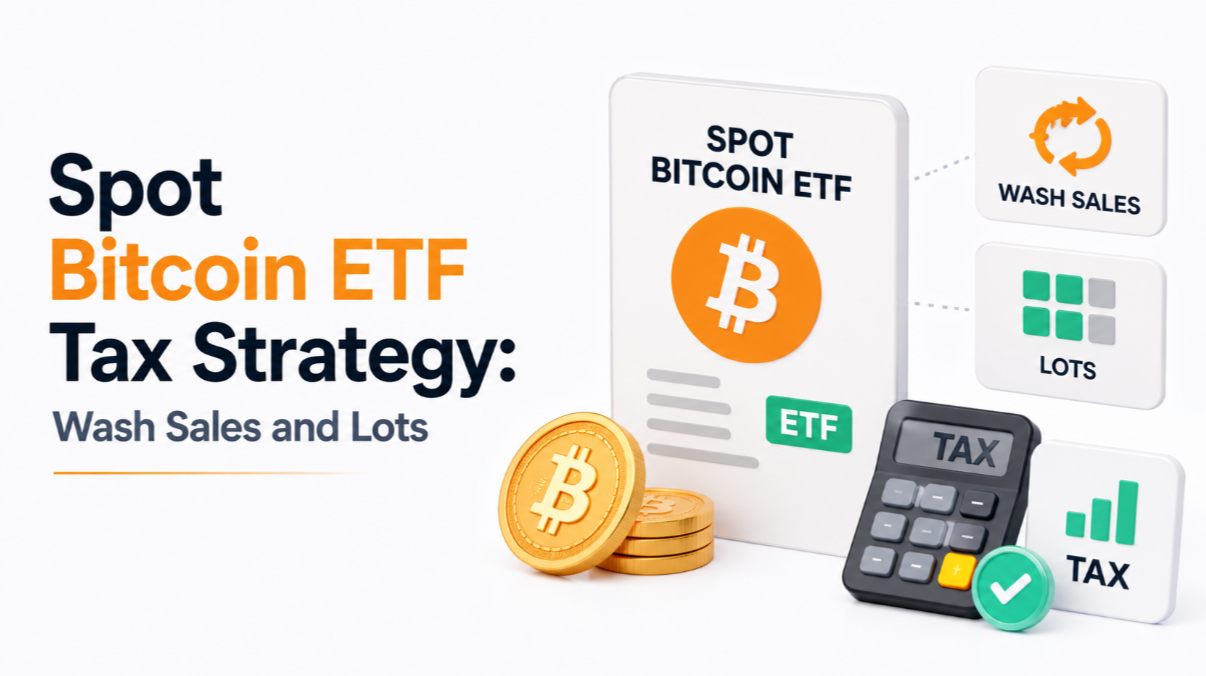
Spot Bitcoin ETFs differ from actual Bitcoin in one underrated way: they are securities, subject to standard equity tax rules. Most notably, the wash sale rule applies. Strategic positioning can save meaningful tax dollars over multiple years.
Wash sale rule on ETFs
Selling an ETF at a loss and rebuying the same ETF within 30 days disallows the loss. Sell IBIT at a loss → buy IBIT back within 30 days → loss is added to the new position's basis (deferred, not lost, but unusable in the current year).
The crypto-vs-ETF arbitrage
Crypto is currently exempt from wash sale rules in the US. ETFs are not. A coordinated strategy: sell IBIT at a loss, simultaneously buy actual BTC. Realise the loss; maintain BTC exposure. This works because BTC and IBIT are not "substantially identical" under IRS doctrine — though tax pros disagree on edge cases.
Lot selection (specific ID)
Brokerages typically default to FIFO. Switch to specific identification (or HIFO automatic selection where supported) to maximise loss harvesting and minimise gain realisation. Schwab, Fidelity, and Vanguard all support specific ID on ETFs.
Long-term vs short-term
ETF gains held over 1 year qualify for long-term capital gains rates (0%, 15%, or 20% in the US). Below 1 year, gains are ordinary income. Mechanical strategy: never realise a gain a few days before the 1-year mark — wait a week, save 7–22 percentage points in tax.
Tax-advantaged accounts
Inside an IRA, none of this matters — gains compound tax-deferred (traditional) or tax-free (Roth). For ETF positions in IRAs, prioritise asset selection over harvesting; in taxable accounts, prioritise harvesting and specific ID.
Inheritance step-up basis
ETFs benefit from step-up basis at death — heirs receive the position with cost basis equal to the date-of-death value. Same applies to BTC, but heirs face the operational challenge of accessing wallets. ETFs simplify inheritance enormously for non-crypto-native families.
See our tax-efficient crypto selling and spot Bitcoin ETF deep-dive.