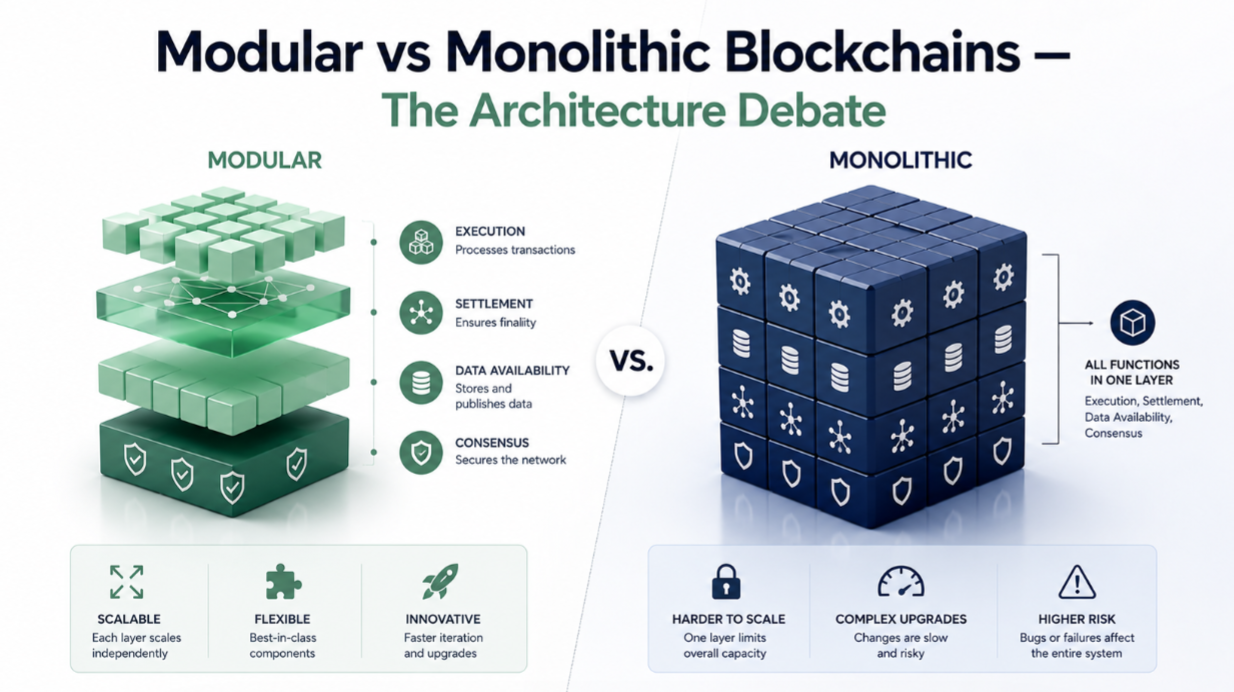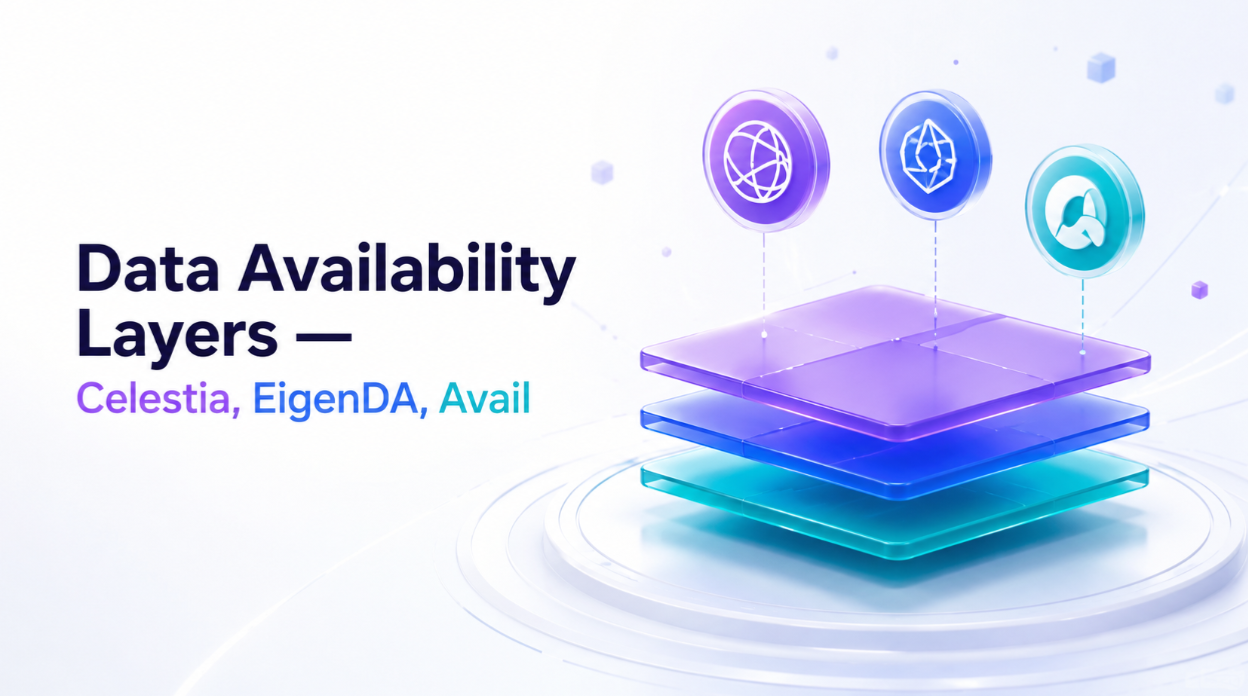
Data availability is the least glamorous but arguably the most important part of the modular blockchain stack. Every rollup needs to make its transaction data available so that anyone can independently verify what happened. Historically, that data went to Ethereum L1, which is secure but expensive. Dedicated DA layers — Celestia, EigenDA, Avail — offer cheaper alternatives with different tradeoffs. Understanding what DA actually is and how these layers differ is required for anyone evaluating rollups and their long-term viability.
Why data availability matters
When a rollup processes transactions, it commits a compressed summary to Ethereum (or another L1). But the compressed summary alone isn't enough to independently verify anything — you need the underlying transaction data.
Consider: an optimistic rollup posts a state commitment saying "after these transactions, the state is X." For this to be verifiable:
1. Anyone must be able to download the transaction data 2. Anyone can then replay the transactions locally 3. If the replayed result doesn't match the committed state, they can submit a fraud proof
Without data availability, none of this works. The rollup could commit any state without revealing what transactions led there, and no one could verify.
DA layers exist to make this data cheap and available.
How Ethereum L1 handled DA (pre-4844)
Before EIP-4844 (activated March 2024), rollups posted their data as normal Ethereum calldata. This was expensive — the same data slot Ethereum uses for smart contract execution.
The result: L2 fees were dominated by L1 data posting costs. During busy periods, an L2 swap might cost $1-5 in fees, most of which was passing through to L1 data.
Blobs (EIP-4844)
EIP-4844 added a new transaction type — blob transactions — with a dedicated pricing lane for rollup data.
Blobs are:
- Larger than calldata (128KB each)
- Priced separately from regular gas
- Only retained for ~18 days on the beacon chain (long enough for fraud proofs)
- Cheaper because they don't compete with regular execution gas
Result: L2 fees dropped 10x for most rollups after 4844 activation. This was the biggest single UX improvement for L2s in Ethereum's history.
But blobs are still Ethereum-based. If a rollup wants even cheaper DA, or wants to avoid Ethereum's specific tradeoffs, dedicated DA layers exist.
Celestia — the DA specialist
Celestia launched in late 2023 as the first dedicated DA layer. It's a purpose-built chain that does nothing except make data available.
Architecture:
- Own PoS consensus (~200 validators)
- Uses data availability sampling (DAS) so light clients can verify data is available without downloading all of it
- Rollups post their data to Celestia rather than to Ethereum
- Ethereum L1 (or another chain) still provides settlement — Celestia just handles DA
Why it works: by specializing, Celestia can handle much more data than Ethereum blobs. Its throughput target is 2MB per block (vs Ethereum's ~1.3MB per slot from blobs).
Trust model: Celestia is a separate chain with its own security. Using Celestia for DA means trusting Celestia validators, not Ethereum validators, for that specific rollup.
Users: Manta Pacific, several small rollups, various Cosmos-native rollups.
Cost: significantly cheaper than Ethereum blobs during high demand. Similar during low demand.
EigenDA — the EigenLayer approach
EigenDA is a DA layer built on top of EigenLayer's restaked ETH security.
Architecture:
- EigenLayer operators (secured by restaked ETH) attest to data availability
- Each operator downloads a portion of the data (not all of it)
- Data is verified through erasure coding
- Settlement anchor is Ethereum via the EigenLayer contracts
Why it works: economic security comes from restaked ETH. Data throughput can be very high because operators specialize in the DA task.
Trust model: hybrid — inherits some of Ethereum's security via the restaked ETH, but adds a separate operator set with its own dynamics.
Users: various EigenLayer-integrated rollups, growing adoption in 2024-2026.
Cost: designed to be cheaper than Ethereum blobs; specific pricing varies by demand.
Avail — Polygon's DA layer
Avail (originally Polygon Avail, now separated) is another dedicated DA chain.
Architecture:
- Own PoS consensus
- Uses KZG commitments and DAS (similar to Celestia)
- Independent of both Ethereum and Cosmos ecosystems
Users: several rollups have integrated, though smaller adoption than Celestia so far.
Trust model: separate validator set with its own economic security.
Cost: competitive with Celestia; specific pricing varies.
Comparing the three
**Celestia**:
- First to market
- Cosmos-native (part of the IBC ecosystem)
- Larger validator set, more distributed
- More mature integration tooling
**EigenDA**:
- Ethereum-adjacent trust model
- Restaked ETH security
- Higher throughput target
- More complex trust structure (EigenLayer + AVS dynamics)
**Avail**:
- More independent
- Less established ecosystem
- Similar technical approach to Celestia
For any given rollup, choosing among these depends on:
- Ecosystem alignment (Ethereum-focused vs Cosmos-focused)
- Trust assumptions preferred (restaking security vs standalone PoS)
- Throughput needs
- Integration maturity
The "ETH DA is Ethereum-secured" argument
A key debate: does using Ethereum L1 for DA make a rollup more secure than using Celestia or EigenDA?
**Yes camp**: Ethereum has the largest validator set, longest track record, and highest economic security. Its DA is inherently more secure.
**No camp** (or "practically no"): Celestia and EigenDA are secure enough for practical purposes. Their independence gives users choice. Being "on Ethereum for DA" is more marketing than substance if the DA is separable from settlement.
Ethereum-purists prefer Ethereum blobs. Modularists argue any well-secured DA is fine. Both positions have merit.
The scaling implication
The DA cost is what determines how cheap a rollup can be.
If DA costs $0.001 per transaction on Celestia and $0.01 on Ethereum blobs, a rollup on Celestia has 10x lower DA costs. Passed through to users, that means 10x cheaper L2 transactions.
At scale, this is huge. Rollups aiming to serve consumer applications (games, social, small payments) need very low per-transaction costs. Alt-DA is often the difference between "possible" and "impossible" for these use cases.
What DA does NOT provide
DA layers only handle... data availability. They don't provide:
- Consensus for the rollup's state (that's still on Ethereum or wherever settlement lives)
- Execution environment (rollup does that)
- Bridging or messaging (separate infrastructure)
A rollup using Celestia for DA still needs to settle to some chain (usually Ethereum). It still runs its own execution. Celestia is just the storage layer for the data.
This is why they're called modular — each piece is separable.
The volitions approach
Some rollups let users choose per transaction: post data to Ethereum (higher security, higher cost) or to alt-DA (lower cost, different trust). This is called a "volition."
Immutable X and StarkEx pioneered this pattern. Users pick their tradeoff per transaction.
Volitions add complexity but provide flexibility. Not widely adopted but architecturally interesting.
The verifiable DA question
For DA to be trustworthy, users need to be able to verify data is actually available without downloading everything.
Data Availability Sampling (DAS) solves this: a light client checks small random samples. If the samples are all available, statistically the whole data is likely available.
DAS is used by Celestia and Avail. It's planned for Ethereum too (full danksharding). Without DAS, only full nodes can verify DA — which limits how much data can practically be handled.
For a rollup builder
Choosing DA:
**Best for maximum ecosystem alignment with Ethereum**: use Ethereum blobs.
**Best for cost minimization**: Celestia or EigenDA.
**Best for restaking-thesis alignment**: EigenDA.
**Best for Cosmos ecosystem integration**: Celestia.
Most new rollups in 2026 use Ethereum blobs by default (accepting the cost for ecosystem integration) with alt-DA as a fallback for cost-sensitive applications.
For a user
You rarely interact with DA directly. But understanding it explains why:
- L2 fees dropped after March 2024 (EIP-4844)
- Different L2s have different fee structures (different DA choices)
- Some emerging rollups (Manta, Mantle) are much cheaper (using alt-DA)
DA is invisible infrastructure that determines cost and security tradeoffs. Understanding it helps you evaluate rollups you're considering using.
The takeaway
Data availability is where most rollup costs live. Dedicated DA layers (Celestia, EigenDA, Avail) offer meaningful cost improvements over Ethereum L1 with different trust models.
The industry has decisively moved toward dedicated DA for cost reasons. Whether Ethereum L1 remains the primary DA (via blobs and eventual full danksharding) or alt-DA takes majority share is an ongoing evolution.
For serious infrastructure understanding: DA is one of the most consequential layers to understand. It's where the modular stack's economics are actually determined.