Almost every professional trader keeps a trading journal. Almost no retail traders do. This is one of the sharpest divides between amateur and professional trading, and the reason is simple: without recorded data, you cannot improve. Memory is unreliable — winners get amplified, losers get rationalized, patterns you should notice remain invisible. A trading journal is the mechanism for turning experience into learning. Setting one up takes an evening. Maintaining it takes a few minutes per trade. The return is compounded improvement over your entire trading career.
Why journaling matters
Without a journal:
- You remember your best trades vividly, your worst ones vaguely
- You attribute success to skill and failure to bad luck
- You repeat mistakes you didn't know you were making
- You cannot identify what specifically works for you
- You cannot demonstrate improvement over time
With a journal:
- You have honest data on your actual results
- You can identify patterns in when you win and lose
- You can measure whether your rules are being followed
- You can compare planned trades to executed trades
- You have material for genuine self-improvement
The pros keep journals because journals work. Same reason applies to serious retail traders.
What to record per trade
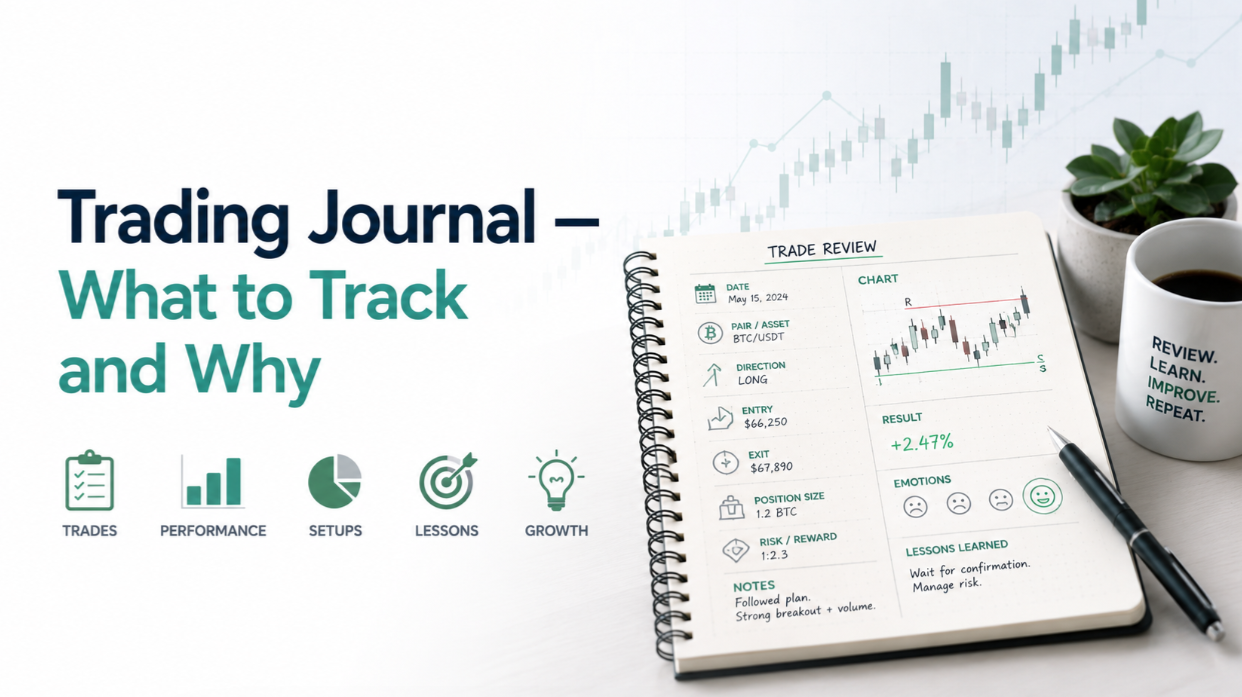
For every trade you take, record:
**Basic data**:
- Date and time of entry
- Asset
- Direction (long/short)
- Entry price
- Position size
- Reason for entry (thesis in 1-2 sentences)
- Predetermined stop loss level
- Predetermined take profit target(s)
**Post-trade data**:
- Exit price(s)
- Exit reason (target hit, stop hit, changed thesis, etc.)
- P&L in USD and %
- Did you follow your plan? (Yes/No)
- What went right / went wrong
**Context**:
- Market regime at time of trade
- Emotional state when entering (calm, FOMO, revenge)
- What news or catalysts influenced the trade
That's 15-20 fields per trade. Sounds like a lot but takes 2-3 minutes to record.
Format options
Different formats work for different traders:
**Spreadsheet**: Google Sheets or Excel. Universal, easy to search and filter, easy to generate summary statistics.
**Notion or similar**: more flexible, allows longer notes. Better for qualitative reflection.
**Dedicated apps** (Edgewonk, TraderVue, Chartlog): purpose-built with analytics. Cost money but reduce friction.
**Simple text file**: works fine. Some prefer plain text for durability.
For most retail traders, a spreadsheet is the sweet spot: enough structure to enable analysis, minimal friction to maintain.
What to review
Regular review is where the value comes from. Journaling without review is just record-keeping.
**Weekly review** (15-30 minutes):
- What trades did I take this week?
- Did I follow my rules?
- Any emotional decisions I regret?
- What patterns am I seeing?
**Monthly review** (30-60 minutes):
- Overall P&L
- Win rate and average win/loss size
- Best trades — why did they work?
- Worst trades — why did they fail?
- Rule violations — what were the circumstances?
- Anything I need to adjust?
**Quarterly review** (1-2 hours):
- Overall performance vs benchmark (holding BTC)
- Are my rules producing the expected results?
- What themes have emerged?
- What should I stop doing?
- What should I do more of?
Key metrics to track
Beyond trade-by-trade data, aggregate metrics:
**Win rate**: percentage of trades that were profitable.
**Average win size vs average loss size**: absolute values.
**Expectancy**: (Win rate × Avg win) - (Loss rate × Avg loss). This is your edge per trade in USD.
**Profit factor**: Total wins / total losses. Should be > 1.5 for consistently profitable trading.
**Maximum drawdown**: largest peak-to-trough decline in your account.
**Rule adherence rate**: percentage of trades where you followed your plan completely.
For most traders, rule adherence is the single most important metric. A trader with 100% rule adherence on a mediocre system usually beats a trader with 60% adherence on a brilliant system.
The emotional dimension
Track emotions, not just numbers.
Every trade entry: how am I feeling right now? Calm and analytical? FOMO-driven? Angry from a recent loss? Confident to the point of overconfidence?
Every trade exit: was this the exit I planned, or an emotional exit? What emotion drove the decision?
Over time, patterns emerge:
- "I lose more when I enter after seeing news"
- "I hold losers too long when I'm defensive from prior losses"
- "My best trades come when I'm calm and following clear setups"
These patterns are invisible without journaling. Once identified, they can be addressed.
What to do with the data
The journal should drive changes in behavior:
**Confirmed pattern**: if analysis shows you consistently lose on FOMO entries, add a rule against them. Then track whether you follow the new rule.
**New hypothesis**: notice something that might be a pattern but you're not sure? Track it explicitly for the next quarter and see if it holds.
**Rule refinement**: existing rules that aren't working can be adjusted. But adjust based on data, not on wishing you'd done something different in the moment.
**Habit reinforcement**: things you're doing well should be acknowledged and continued. The journal is not just for negative feedback.
Common resistance
Reasons traders don't journal:
- "It's too much work" — actually 2-3 minutes per trade.
- "I remember my trades" — you don't. Recency bias makes you remember recent trades and forget older ones.
- "I don't trade enough for it to matter" — the fewer trades you make, the more each one matters, and the more valuable analysis is.
- "I'm not systematic; I trust my intuition" — great, but is your intuition producing results? Only data can answer.
- "I'll start when I'm serious" — you're already trading; you're already serious.
The reality: traders who journal outperform traders who don't, on average, over long enough periods. The advantage compounds.
Journaling for long-term investors
Even non-active traders benefit from journaling major decisions:
- Every purchase: date, amount, price, reason
- Every sale: date, amount, price, reason
- Every rebalancing decision: what triggered, what actions
- Every strategic change: shifted allocation, why?
For long-term investors, journaling helps with:
- Tax record-keeping (essential for cost basis)
- Learning what actually drove your decisions
- Avoiding regret trades in future cycles
- Understanding your risk tolerance in practice vs theory
Even 5-10 minutes per major decision is worthwhile.
Sample entries
Two example entries:
**Trade 1 — Long BTC breakout**
- 2026-03-15 10:30 UTC
- BTC, long, $95,000 entry, $10K position
- Reason: BTC broke above $92K resistance with volume; expecting continuation to $100K+
- Stop: $89K (~6% below entry)
- Target: $105K (~10% above entry)
- Emotional state: calm, following pre-defined setup
- Exit (2026-03-18): $104K, target hit, +$947 P&L, followed plan
- Lessons: setup worked as expected; continue with similar breakout entries
**Trade 2 — Long alt on FOMO**
- 2026-04-02 22:15 UTC
- ARB, long, $1.20 entry, $5K position
- Reason: ARB up 30% today, feels like it's going to keep running
- Stop: none set (red flag)
- Target: "high"
- Emotional state: FOMO, chasing momentum
- Exit (2026-04-04): $0.95, panic sold on reversal, -$1,041 P&L, no plan
- Lessons: this is exactly the entry my rules exist to prevent. FOMO trades without stops are catastrophic. Don't do this again.
Even from just these two entries, patterns start emerging. Multiplied across a hundred trades, patterns become obvious.
The takeaway
Trading journals are the highest-leverage improvement tool available to retail traders. They cost 2-3 minutes per trade, provide compounded learning over your entire trading career, and separate serious traders from amateurs.
Almost every serious trader keeps one. Almost every amateur doesn't. Which side of that divide you're on is entirely up to you.
Start today. Even if your first month of entries is imperfect, you'll have data you didn't have before. In six months, you'll see patterns. In a year, you'll be a genuinely better trader. Compounded over years, the improvement is enormous.