Every crypto trader who lasts more than one cycle has one thing in common: they take risk management seriously. Traders who ignore it might win big for a year or two, then blow up on a single bad trade or a bear market they weren't positioned for. The math of drawdowns, position sizing, and stop-loss discipline determines whether you compound wealth over years or repeatedly rebuild from zero. Master this and you're ahead of 90% of traders regardless of any strategic edge you have.
The compounding math
Small losses are recoverable. Large losses are catastrophic. The math is asymmetric:
- 10% loss requires 11% gain to recover
- 25% loss requires 33% gain
- 50% loss requires 100% gain
- 75% loss requires 300% gain
- 90% loss requires 900% gain
A trader who has a series of 25% drawdowns then recoveries is running to stand still. A trader who has a single 75% drawdown needs multiple full bull cycles to recover — if they ever do.
The goal of risk management isn't to maximize any single year's returns. It's to prevent catastrophic drawdowns while still capturing enough upside to compound long-term.
Maximum drawdown as the metric
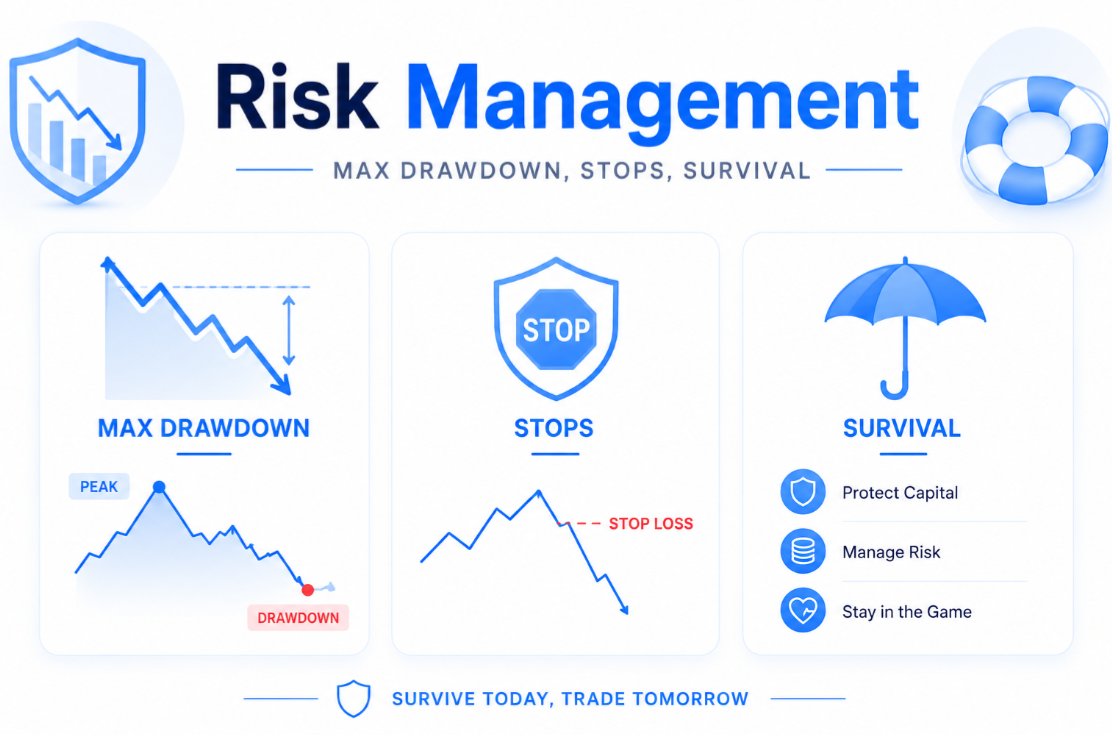
Maximum drawdown is the largest peak-to-trough decline in your portfolio value.
For a trader with $100K starting capital who reached $180K then dropped to $90K before recovering: max drawdown was 50% (from $180K peak).
Why max drawdown matters more than year-end returns:
- It captures the worst pain point you experienced
- It determines whether you can psychologically stick with your strategy
- It shows the tail risk of your approach
Professional traders often target max drawdown limits (e.g., "never more than 20% below high water mark"). Amateur traders often focus on max returns without regard to the drawdowns required to get there.
Setting drawdown limits
For different types of positions:
**Long-term BTC/ETH holds**: expect drawdowns of 50-70% during major bear cycles. This is inherent to crypto's cyclicality. Position size to survive these emotionally and financially.
**Medium-term altcoin positions**: expect drawdowns of 70-90% during bear phases. Only invest what you can afford to see disappear.
**Active trading account**: aim for max drawdown of 20-30%. Anything more suggests position sizing or stop discipline is broken.
**Leveraged trading**: aim for max drawdown of 10-15%. Leverage magnifies losses; tighter limits are essential.
Your drawdown limit should determine your position sizes. If you have a $100K portfolio and can't stomach more than 20% drawdown, your position sizing across all bets must keep aggregate risk below that.
The 2% rule (revisited)
Standard trading rule: never risk more than 2% of your account on any single trade.
"Risk" here = position size × distance to stop loss.
If your account is $50K and you're taking a trade with a 10% stop, max position size is $10K (2% of $50K risked / 10% stop = $10K).
This rule ensures that even a losing streak doesn't take you out of the game. 10 consecutive 2% losses is only 18% total drawdown (compounding). 10 consecutive 5% losses would be 40% drawdown.
Long-term profitable traders often have long stretches of losing trades. Position sizing that survives those stretches is what lets them capture the eventual winners.
Stop-losses
Every trade should have a predetermined exit if it goes against you.
Stop placement principles:
**Technical stops**: below key support levels, above key resistance for shorts. Structure-based; if support breaks, your thesis is likely wrong.
**ATR-based stops**: 2-3x the average true range of the asset. Adjusts for volatility.
**Time-based stops**: if the trade hasn't worked within X days, exit regardless of price.
**Fixed percentage stops**: 5%, 10%, whatever fits the position's risk profile. Simple but might not align with market structure.
Every stop should be:
- Predetermined before entering the trade
- Written down or set as an actual stop order
- Followed without exception
The temptation to "give it a little more time" or "move the stop just a bit" is the single biggest cause of catastrophic losses. Once you start moving stops against you, you've abandoned risk management entirely.
The stop-hunting concern
Some traders resist stops because "market makers hunt them." There's real concern — obvious stop levels (round numbers, prior lows) can attract targeted moves.
The response: place stops slightly beyond obvious levels, not exactly on them. If everyone's stops are at $80K, place yours at $79.5K to avoid the sweep.
But: over-worrying about stop hunts leads to either no stops (catastrophic in real crashes) or stops so wide they defeat the purpose. Some stops will occasionally be hunted; over time, disciplined stopping still outperforms no-stopping.
Position sizing to drawdown
The formula: Max acceptable drawdown / Number of concurrent positions = position size per bet.
If you can accept 20% max drawdown and have 5 concurrent positions with correlated risk, each position should be sized so its worst-case loss is 4% of portfolio.
For less-correlated positions (say, one is a long-term hold and another is a short-term trade in different assets), you can size somewhat larger since concurrent max losses are less likely.
For highly-correlated positions (multiple bets on the same theme), size smaller — a bad thesis takes down all correlated positions simultaneously.
Diversification, real vs fake
Real diversification reduces risk. Fake diversification just spreads exposure while maintaining the same underlying risk.
**Fake diversification**: 5 different altcoins, all L1 competitors, all correlated to BTC at 0.85+. When BTC drops 40%, all 5 drop 50-70%.
**Real diversification**: BTC + a stablecoin position + short exposure via hedges + off-chain assets (equities, bonds).
For most retail crypto investors, real diversification is hard because most crypto correlates during downturns. This is why the ultimate risk-management tool is having assets outside crypto — the non-correlation actually reduces total portfolio risk.
Psychological survival
Risk management isn't just financial. It's psychological.
The traders who blow up are often not those with bad strategies. They're those who couldn't handle drawdowns without breaking their own rules.
Signs you're at psychological risk:
- Checking positions obsessively
- Losing sleep over open positions
- Wanting to average down on losers to "prove yourself right"
- Cancelling or moving stops when triggered feels imminent
- Trading in an emotional state (excited, angry, revenge-trading)
If any of these are happening, your position sizes are too large for your psychology. Reduce sizing until you can stay disciplined.
The bear market survival kit
For crypto specifically, surviving bear markets is where risk management proves its value.
Rules for bear markets:
- Reduce aggressive positioning as prices decline
- Increase stablecoin allocation as opportunities decrease
- Cut positions that go against you rather than doubling down
- Take breaks when trading isn't working
- Preserve capital for the eventual bottom
Traders who buy every dip during the entire bear market often end up out of capital before the actual bottom. Preserving cash for the last 20-30% of decline captures the best entries.
The single most important rule
If a trade or position violates your risk management rules, exit it.
Not "modify the rules to allow it." Not "just this once." Not "the setup is too good to pass up."
If your rule is "no position larger than 10% of portfolio" and you want to take a 15% position, either the position isn't worth taking or your rules need review outside the heat of the moment. Never break a rule in the moment.
Systematic vs discretionary
Some traders use fully systematic risk management (position sizing algorithms, automated stops). Others use discretion within a framework.
Systematic has advantages: removes emotion, is consistently applied, easy to backtest.
Discretionary has advantages: allows for context (a stop just above obvious resistance vs a stop at fixed percentage), adapts to changing conditions.
For most retail traders: rules-based discretion is the sweet spot. Have clear rules that you follow, but allow judgment within them.
The takeaway
Risk management isn't glamorous. It doesn't maximize any single trade's upside. It doesn't provide bragging rights.
What it provides is survival. Traders who survive long enough to see multiple cycles have opportunities amateurs never get. Traders who blow up in year one or year three miss the compounding that makes long-term wealth possible.
The math is unforgiving. The discipline is boring. But the returns to consistent risk management, compounded over a career, are enormous compared to the alternative of great years followed by catastrophic ones.
Every serious trader eventually learns this. Some learn it before they blow up. Others learn it the hard way.