The hardest part of crypto isn't buying — it's knowing when to sell. Investors who bought Bitcoin at $5,000 and rode it to $60,000 often watched it crash back to $15,000 without selling. They had paper gains of 12x that evaporated to 2x. The story repeats every cycle. Having a predetermined exit strategy — a plan for how to convert appreciation into realized profits — separates investors who compound wealth from investors who repeatedly watch it evaporate.
The core problem
Rational decision-making about selling is impossible in real time.
When your position is up 5x, every fiber of your being wants to hold for 10x. When it's up 10x, you want 20x. When it's up 50x, you're convinced this asset is going to change the world and shouldn't be sold.
Then the market turns. Now you're down 30% from the peak. Still up massively from entry — but psychologically anchored on the recent high. You can't sell now because you'd "regret it if it recovers." You hold through more decline. Now you're down 60% from peak. Same problem.
Eventually many "hodlers" ride positions all the way back down to near their entry price without ever taking profits.
The solution: pre-commit to selling rules before you're emotionally invested in specific price levels.
Ladder-based exits
Break your exit into pieces at predefined price levels.
Example: you bought 1 BTC at $80K. Set a ladder:
- Sell 10% at $120K (50% gain locked)
- Sell 15% at $150K (~87% gain)
- Sell 20% at $200K (150% gain)
- Sell 25% at $300K
- Sell 30% at $500K (long-term speculative target)
If Bitcoin runs to $200K then reverses, you've locked in 45% of your position at significantly higher prices. If it runs to $500K, you've locked in 100% at various levels.
The key: pre-commit. Set the levels before you're watching the price. Follow the ladder mechanically.
Downsides:
- If price rockets past your first level, you sell "too early"
- If price doesn't reach your levels, you sell nothing
Both are acceptable outcomes. Ladders capture some gains rather than all-or-nothing.
Percentage-of-position rules
Alternative: sell fixed percentages at each price milestone.
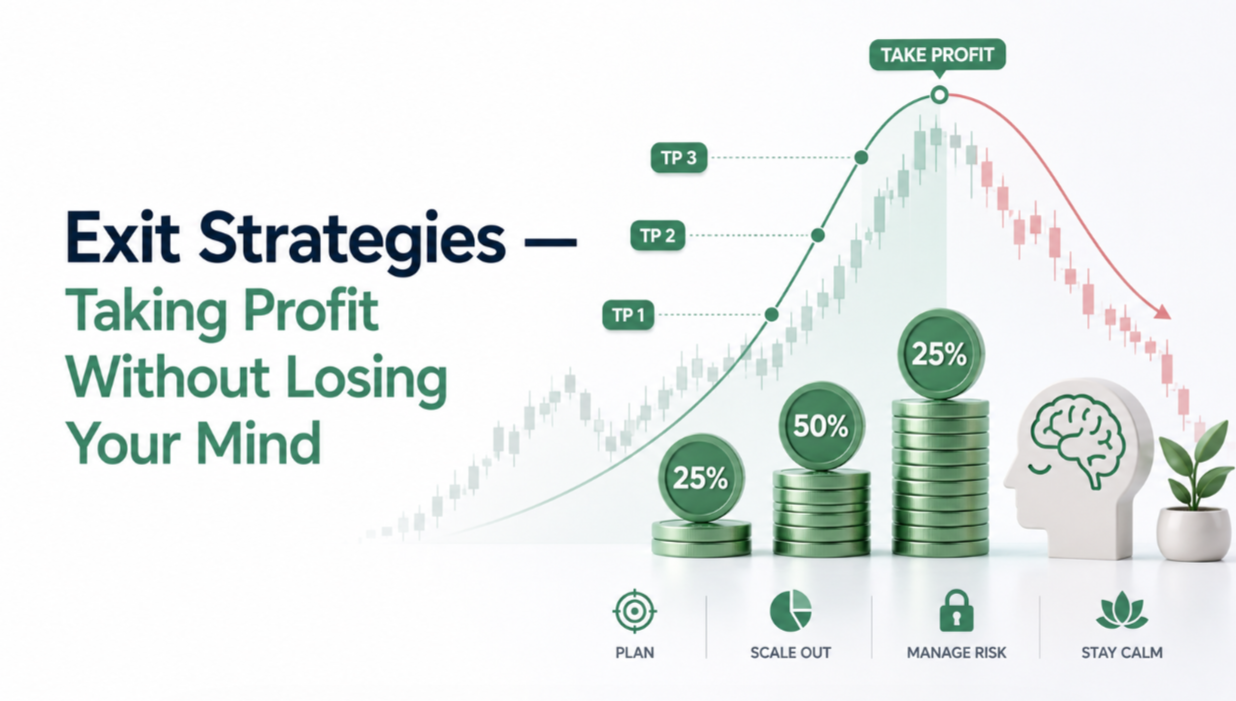
- 25% at 2x initial
- 25% at 5x initial
- 25% at 10x initial
- Hold remaining 25% as long-term "moon bag"
For a position that reaches 10x, you've realized 50% of maximum theoretical gain across three sales while keeping a quarter for further upside.
Simpler than price-based ladders. Adapts to different starting prices automatically.
Cycle-based exits
For long-term positions, using cycle timing rather than price levels:
- Sell 25% during confirmed late-cycle euphoria
- Sell another 25% at major on-chain distribution signals
- Sell another 25% at market-wide extreme greed readings
- Hold 25% for the next cycle
This ties exits to phase recognition rather than specific dollar targets. Useful because prices are uncertain but cycle patterns are somewhat repeatable.
Trailing exits
Use a trailing stop to lock in gains while staying in the position.
Example: position is up 5x. Set a trailing stop at 25% below high water mark. If price drops 25% from any new high, exit.
This lets you ride winners as long as they're moving up but automatically exits when momentum breaks. Sensitive to the trailing percentage — too tight and you're stopped by normal volatility, too wide and you give back significant gains.
Works better for trend followers. Less useful for long-term hold strategies where you accept large drawdowns as normal.
Time-based exits
Sometimes the right exit is time-based rather than price-based.
Example: "I'll hold this alt for 18 months maximum, then evaluate whether to continue."
Prevents indefinite holding of positions that neither pump nor fall. Forces regular re-evaluation.
Useful for speculative positions with clear thesis timelines. Less useful for long-term core holds.
The behavioral hack
The biggest challenge isn't having rules — it's following them.
Techniques that help:
**Write your rules down** before positions get emotional. Post them where you'll see them.
**Automate what you can** via limit sell orders on exchanges. If you've committed to selling at $150K, place the order at $150K now. Removes the "should I really" decision.
**Track your P&L in the currency you care about**. If you're trying to compound USD, watch USD PnL not BTC PnL — otherwise "not selling" feels normal even as USD gains evaporate.
**Set milestone celebrations** — take profits and move some to non-crypto assets. Reduces the psychological loop of "it's just numbers on a screen."
**Peer accountability**: some traders discuss exit plans with trusted peers. Committing publicly increases follow-through.
Full exit vs partial exit
Should you ever fully exit a position?
For long-term core holdings (BTC, ETH): usually not. Complete exits mean paying capital gains on everything and losing the position's ongoing upside.
For speculative positions: yes, especially when the thesis has played out or reversed. If you bought an L2 token expecting it to rally with a specific narrative, and that narrative concludes, exit fully.
For any position: full exit if fundamentals change. If a project's core thesis broke (team change, competitive loss, fundamental breakdown), the size of your position becomes irrelevant — exit.
Cost basis considerations
Selling has tax consequences. Structure exits to minimize tax impact:
- **Prefer long-term holdings** (>1 year) for sales. Lower tax rates.
- **Use specific ID** cost basis to sell higher-basis lots when possible.
- **Harvest losses simultaneously** to offset gains from exits.
- **Time exits across tax years** if you're near a bracket threshold.
For US-based investors, the difference between short-term and long-term rates is often 20 percentage points. That matters for exit timing.
The "moon bag" strategy
A common approach: sell most of the position at various milestones, keep 10-25% as a permanent long-term hold.
Rationale: the small remaining position captures further upside if the asset really does 100x, but you've realized meaningful profits from the majority.
Downside: the moon bag can grow to a significant position if the asset does moon, requiring later rebalancing.
Popular with long-term BTC holders who took profits in each cycle but kept a base holding.
Exit strategies by position type
**Long-term BTC/ETH core**: light selling at cycle tops, mostly hold through cycles.
**Medium-term altcoin positions**: percentage-based ladders. Reduce meaningfully at strong appreciation.
**Trades with defined thesis**: exit when thesis plays out or invalidates.
**Yield-generating positions**: exit when yield opportunity closes or better opportunities exist.
**Speculative bets**: pre-committed to exit at defined targets or defined losses. Never revise upward.
When to abandon your rules
Almost never.
The only legitimate reasons to change an exit plan mid-run:
- Underlying thesis has genuinely changed (asset's fundamentals are different than when you set the plan)
- Life circumstances require different capital allocation
- You realize the plan itself had a flaw that you'd correct in retrospect
None of these are "the market surprised me" or "this feels different now." Those are exactly the emotions the plan was designed to protect you from.
Every trader thinks they'll be disciplined about exits. Very few actually are. The systematic ones do consistently better than the discretionary ones over long horizons.
The takeaway
Predetermined exit strategies convert market opportunities into realized wealth. Ad-hoc exit decisions (or the absence of exits) leave gains on the table cycle after cycle.
The specific strategy — ladders, percentages, cycle-based, trailing — matters less than having one and following it. Pick a framework, apply it consistently, review annually.
The hardest part is emotional. Selling into strength feels wrong. Buying into weakness feels dangerous. Both are exactly what successful long-term investors do.
Your future self, watching you compound realized wealth across multiple cycles, will thank you for the discipline. Your present self, watching apparent gains evaporate because you couldn't bring yourself to sell, will curse the absence of it.
Choose the future self.