Most retail crypto traders use exactly two order types: market and limit. They never touch the other options because they don't understand what they do or when to use them. This is a real handicap — the difference between clicking "market buy" and using a properly-placed stop-limit order is often the difference between a controlled entry and a slippage disaster. Understanding every order type on major exchanges takes an hour and permanently improves your execution.
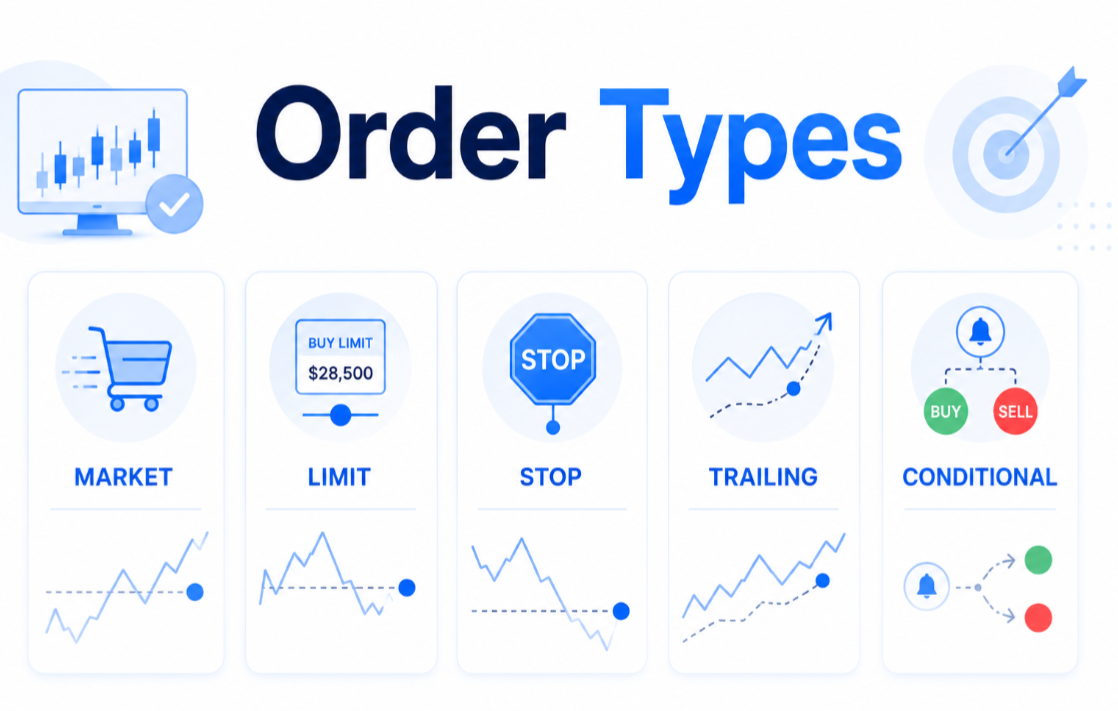
Market order
The simplest: buy or sell at whatever price is currently available.
**How it works**: your order is filled immediately, walking up (for buys) or down (for sells) the order book until your full size is executed.
**Best for**: small trades on liquid markets where speed matters more than exact price. Getting into or out of a position quickly.
**Avoid when**:
- The order book is thin (large trades will slip significantly)
- You have any time flexibility (a limit order at the current bid/ask is usually better)
- During high volatility (price can move significantly during execution)
For most trades, using a limit order at or very near the current market price is nearly as fast but with price protection. Market orders should be the last resort, not the default.
Limit order
Buy or sell only at a specific price or better.
**How it works**: your order sits in the order book at your specified price. It fills when someone else's order matches yours. Doesn't fill if the price never reaches your level.
**Best for**:
- Any trade where price matters (most of them)
- Entering at specific technical levels
- Providing liquidity (limit orders that sit in the book earn "maker" fees on some exchanges)
- Trading in thin markets where market orders would slip
**Downside**: order might not fill if the market moves away from your price.
Limit orders should be your default. Even if you want to trade "immediately," a limit order at the current best bid (for buys) or offer (for sells) usually fills within seconds while protecting you from price movements during execution.
Stop order (stop-market)
An order that becomes a market order when price reaches a trigger level.
**How it works**: you set a trigger price. Once the market reaches that price, your stop order triggers and executes at market.
**Common use**: stop-loss. If you're long BTC at $80K, place a stop at $75K to automatically exit if the position moves against you.
**Best for**:
- Automated stop-loss execution
- Breakout trading (stop above resistance to catch a breakout)
- Set-and-forget risk management
**Danger**: stop-market orders can slip badly in fast-moving markets. If BTC crashes from $75K to $70K in a single block, your stop triggers at $75K but might fill at $71K or lower.
For volatile assets or important stops, use stop-limit instead.
Stop-limit order
An order that becomes a limit order when price reaches a trigger level.
**How it works**: you set two prices — a trigger price and a limit price. Once market reaches the trigger, a limit order is placed at your specified limit price.
**Example**: long BTC at $80K. Place stop-limit with trigger at $75K and limit at $74K. If BTC drops to $75K, a limit sell order is placed at $74K. It fills if BTC goes through $74K; otherwise, no fill.
**Best for**: stop-loss with price protection. You control both the trigger and the maximum acceptable execution price.
**Downside**: if the market gaps below your limit price without touching it, your stop-limit doesn't fill. You're still exposed to the falling price.
The tradeoff: stop-market guarantees execution but at unknown price. Stop-limit guarantees price but might not execute during gaps.
For most stops on major assets: stop-market with a reasonable buffer is usually preferred. For assets prone to flash crashes: stop-limit provides protection against the worst executions.
Trailing stop
A stop that adjusts as price moves in your favor.
**How it works**: you set a percentage or dollar amount below (for longs) or above (for shorts) the current price. As price moves in your favor, the stop moves with it. When price reverses by your trailing amount, the stop triggers.
**Example**: long BTC at $80K with trailing stop of 10%. Initial stop at $72K. If BTC rises to $90K, stop moves to $81K. If BTC then drops 10% to $81K, stop triggers.
**Best for**:
- Locking in profits during trends
- Setting a stop that moves with a winning position
- Set-and-forget position management
**Downside**: sensitive to volatility. A large trailing amount lets big pullbacks trigger the stop. A small trailing amount gets stopped out on normal noise.
Trailing stops work well when there's a clear directional trend. Less useful in ranging markets where price oscillates.
Iceberg order
A large order broken into smaller visible pieces to avoid revealing intent.
**How it works**: you place a large limit order but only a small portion is visible in the order book at any time. As each visible piece fills, another appears.
**Best for**:
- Very large orders (professional traders, institutions)
- Avoiding market impact of showing large size
**Not typically relevant** for retail traders. Included for completeness.
Post-only / Maker-only
A limit order that will only execute as a maker (adding liquidity) not as a taker (removing liquidity).
**How it works**: if your limit price would cross the spread (execute immediately as a taker), the exchange either rejects the order or converts it to a limit at a non-crossing price.
**Best for**:
- Ensuring maker fees (which are often lower or negative) rather than taker fees
- High-frequency and market-making strategies
Useful for cost optimization on high-volume trades. Less relevant for casual retail.
Fill-or-kill (FOK) / Immediate-or-cancel (IOC)
Special order types that specify what happens if the order can't fully execute immediately.
**Fill-or-kill**: the order must fill completely and immediately or be canceled entirely.
**Immediate-or-cancel**: any portion that can fill immediately does; the rest is canceled.
Useful for specific execution requirements (arbitrage that requires simultaneous fills). Not typical for retail.
OCO (One-Cancels-Other)
Two orders linked such that filling one automatically cancels the other.
**Example**: long BTC at $80K. Place OCO with stop-loss at $75K and take-profit limit at $90K. If BTC reaches $90K, the stop is canceled and profit is taken. If BTC drops to $75K, the take-profit is canceled and the stop executes.
**Best for**:
- Automated exit management with both stop and target
- Set-and-forget for defined trades
OCO is useful for pre-defining both sides of a trade's exit. Available on most CEXs. On DEXs, similar functionality often requires third-party keeper services.
Time-based orders
**GTC (Good-Til-Canceled)**: order stays active until you cancel it. Default for most exchanges.
**Day**: order expires at end of trading day (not always applicable to 24/7 crypto).
**GTD (Good-Til-Date)**: order expires at a specified date/time.
Useful for orders you want to auto-expire if not filled within a specific timeframe.
Order types on DEX vs CEX
**CEX**: full range of all above order types.
**Spot DEX (Uniswap, Curve)**: essentially just market orders (swap at current price). Limit orders exist as third-party services (UniswapX, 1inch limit) but aren't native.
**Order-book DEX (Hyperliquid, dYdX)**: most order types available natively, including stop-loss and trailing stops.
**Perp DEX (GMX)**: usually market only, with stops as separate protocol features.
For traders who rely on advanced order types, CEXs and order-book DEXs are typically better than AMM-style DEXs.
Practical usage patterns
For different trading styles:
**Long-term investor accumulating**: DCA (limit orders slightly below market) plus occasional big-drop limit orders.
**Swing trader**: OCO with stop-loss and take-profit for every trade.
**Trend follower**: entries via limit near key levels; trailing stops to ride winners.
**Range trader**: limit orders at range boundaries; tight stops just outside.
**Panic seller**: market order (please don't; use a limit at the current bid).
The mistake most retail traders make
Using market orders for everything.
Market orders have real costs:
- Slippage on any non-trivial size
- Higher fees on many exchanges (taker fees > maker fees)
- No price protection against sudden moves
A limit order at the current best bid/ask fills nearly as fast on liquid markets, avoids slippage, and often gets lower fees. There's almost no reason to use market orders on liquid major pairs.
Building the habit: even when you want to "buy now," place a limit order at the current ask price. It fills within seconds while giving you price control.
The takeaway
Order types are tools. Knowing them lets you execute strategies precisely. Not knowing them limits you to blunt-instrument market orders that cost real money over time.
Every serious trader should be comfortable with: market, limit, stop-market, stop-limit, trailing stop, and OCO. That covers 95% of practical trading needs.
The rest (post-only, iceberg, FOK/IOC) are professional tools that most retail don't need. But understanding they exist prevents confusion when you encounter them.
The single-highest-value habit: use limit orders as your default. Reserve market orders for genuine emergencies. Your execution costs drop meaningfully.