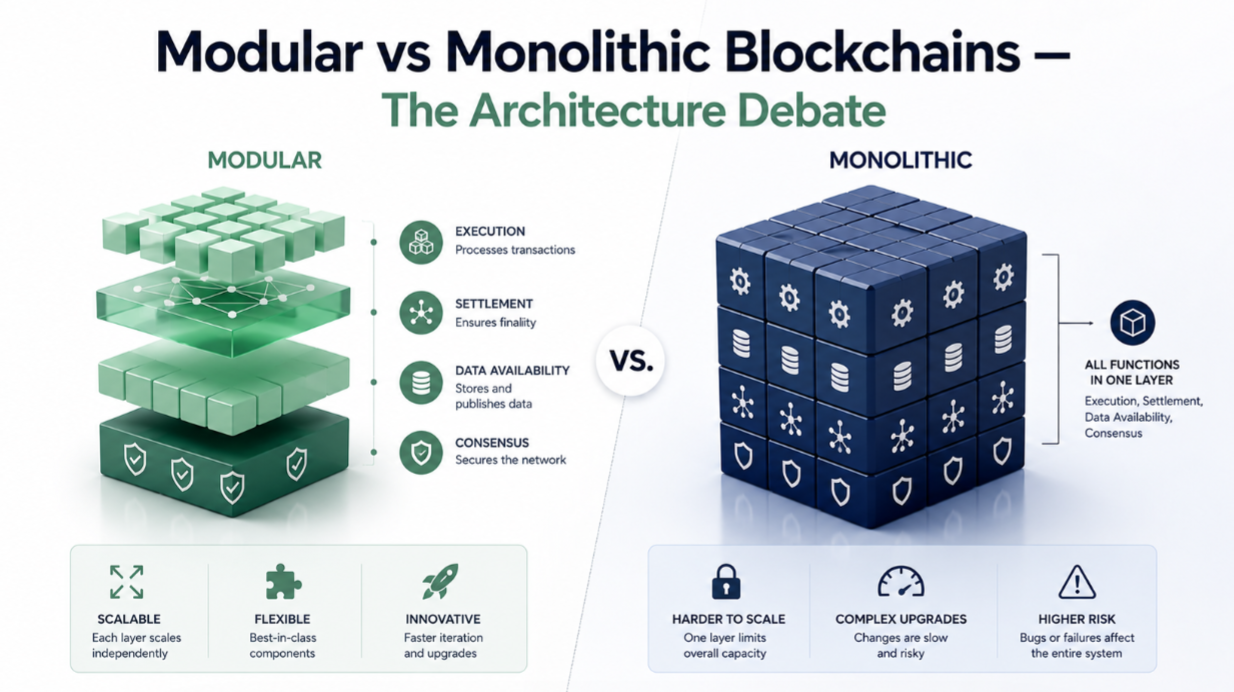
The most consequential architectural debate in blockchain infrastructure is whether to build everything as one integrated system (monolithic) or split responsibilities across multiple specialized layers (modular). Ethereum has committed to the modular thesis with its rollup-centric roadmap. Solana has committed to the monolithic thesis with a single high-performance execution environment. Both approaches have real merits and real limitations. Understanding the tradeoffs is required for anyone evaluating where blockchain infrastructure is heading.
The functions a blockchain must perform
Every blockchain does four things:
**Execution**: running the transactions and state transitions. When you swap ETH for USDC, execution is what computes the new balances.
**Settlement**: providing final authoritative record of what happened. When you have a dispute, settlement is where you go.
**Consensus**: agreeing on the order of transactions. Without consensus, execution can't proceed.
**Data availability**: making transaction data available so anyone can verify what happened. Without DA, execution can't be independently verified.
A monolithic blockchain does all four in a single integrated system. A modular blockchain splits them across specialized layers.
The monolithic approach (Solana)
Solana runs execution, settlement, consensus, and DA all together in a single high-performance chain. Every node runs the full stack.
The bet: hardware improves faster than software abstractions can compensate for. If you can build a very fast integrated system, you can serve every use case with high throughput and low latency.
Solana's architecture:
- Extreme hardware requirements for validators (10Gbps networking, high-end CPUs, lots of memory)
- Parallel execution (transactions that don't touch the same state can execute simultaneously)
- Custom consensus (Proof of History + Tower BFT) designed for speed
- Single execution environment (SVM — Solana Virtual Machine)
Results (in 2026): thousands of transactions per second, sub-second finality, fees typically under a cent.
The modular approach (Ethereum)
Ethereum decomposes the stack:
**Execution**: happens on rollups (Arbitrum, Optimism, Base, zkSync, etc.). Each rollup is its own execution environment.
**Settlement + Consensus**: Ethereum L1 handles final settlement and consensus over rollup state commitments.
**Data Availability**: L1 (via blobs post-EIP-4844) or dedicated DA layers (Celestia, EigenDA, Avail).
The bet: specialization wins over integration. Each layer can be optimized independently for its specific role. Innovation can happen in parallel on different layers.
Ethereum's architecture:
- Modest hardware requirements for L1 validators (anyone can run a full node)
- L1 acts as the trust anchor
- Rollups provide execution scale
- DA layers provide cheap data storage
- Users interact with rollups, benefits flow to Ethereum
Results (in 2026): L1 processes ~15 TPS but rollups collectively handle 200-500+ TPS, with more capacity coming from DA improvements.
The tradeoffs
**Composability**: monolithic wins. Every dApp on Solana can call every other dApp atomically. On modular, dApps on different rollups can't compose synchronously — they need bridges and messaging that add latency and cost.
**Sovereignty**: modular wins for app chains. A rollup can customize its own execution environment, fee token, governance. A Solana dApp must fit within Solana's single environment.
**Simplicity for users**: monolithic wins for now. Solana users have one chain, one wallet, one experience. Modular users have many rollups to choose between, and moving between them requires bridging.
**Decentralization at scale**: modular wins in principle. L1 stays lightweight and decentralized while heavy execution moves elsewhere. Solana requires expensive hardware, concentrating validation to fewer entities.
**Innovation velocity**: modular wins. New execution environments can be launched as new rollups. Solana can only evolve by upgrading its single system, which requires coordination.
**Latency**: monolithic wins currently. Solana's finality is faster than Ethereum L1 + rollup latency in most cases. Rollup latency improves with preconfirmations but hasn't caught up.
The interoperability problem
Modular's biggest weakness: fragmentation.
Ethereum has dozens of rollups. Assets and users are spread across them. Sending assets from Arbitrum to Optimism requires either the canonical bridge (slow) or a third-party bridge (risky). A user with positions on multiple rollups has fragmented liquidity.
Solana has one chain. No fragmentation. Everyone uses the same USDC, the same ETH-equivalent (as an SPL token), the same set of protocols.
The modular ecosystem is working on this via cross-rollup messaging, intent-based execution, and shared sequencing. But as of 2026, fragmentation is a real UX problem for Ethereum modular that Solana monolithic doesn't have.
The maximalist positions
**Solana maximalists**: "monolithic wins because integration beats decomposition. Modular systems have too much complexity. Users don't want to think about rollups. Hardware will keep improving so monolithic systems can serve every use case."
**Ethereum maximalists**: "modular wins because it's the only way to scale without concentrating validation. Monolithic chains inevitably centralize to a few high-hardware operators. Modular preserves decentralization while scaling execution horizontally."
The reality: both approaches are working. Both have real users, real applications, real value. Neither has definitively won.
Where each excels
Concrete applications where each architecture fits better:
**Monolithic (Solana) advantages**:
- High-frequency trading (perp DEXs, order books)
- Consumer apps where UX simplicity matters (payment, NFTs for casual users)
- Applications requiring synchronous composability across many contracts
- Real-time games and social
**Modular (Ethereum) advantages**:
- Custom execution environments (privacy-focused, ZK-based, alt-VM chains)
- Applications requiring maximum decentralization and censorship resistance
- Applications benefiting from Ethereum's vast existing ecosystem
- Institutional use cases valuing the L1 security anchor
Both ecosystems have use cases that work well in the other, and both have use cases that work poorly. The maximalist framing "one architecture is objectively better" doesn't hold up to real applications.
The empirical scoreboard
Metrics as of 2026:
**TVL** (total value locked in DeFi):
- Ethereum + rollups: ~$150B+
- Solana: ~$15-20B
- Solana grew faster in 2024-2025 but Ethereum ecosystem larger
**Daily active users**:
- Ethereum + rollups combined: ~1-2M
- Solana: ~500K-1M
- Comparable magnitude
**Developer activity**:
- Ethereum: largest developer ecosystem
- Solana: growing rapidly, second largest
**Institutional adoption**:
- Ethereum: dominates institutional DeFi
- Solana: growing institutional adoption
Both ecosystems are meaningful; neither is dominant across all measures.
The future direction
Both approaches continue evolving:
**Ethereum improvements**: preconfirmations, based rollups, shared sequencing, danksharding, single-slot finality — all designed to fix modular's UX and fragmentation issues.
**Solana improvements**: Firedancer (new validator client) for performance, MEV improvements, hardware requirement optimization, potential adoption of some modular concepts (state compression as a proto-DA layer).
The interesting middle: both approaches are borrowing from each other. Solana adopting some data layer separation. Ethereum working on preconfirmations that provide monolithic-like UX. The categorical distinction blurs over time.
Other approaches
Beyond Ethereum-modular and Solana-monolithic:
**Cosmos**: app-chain thesis. Each app runs its own chain, connected via IBC. Between modular and monolithic — each chain is monolithic but the ecosystem is modular.
**Aptos, Sui (Move-based)**: monolithic like Solana but with different execution models (parallel via Move's object model).
**BNB Chain**: monolithic EVM chain with faster block times and lower fees than Ethereum L1.
**Ton**: monolithic with sharding built in.
None of these has definitively won either. The landscape is diverse and evolving.
For a builder or user
Practical guidance:
- If you're building a consumer app where UX and speed matter most, Solana is often the right choice.
- If you're building DeFi that benefits from Ethereum's ecosystem and security, Ethereum rollups.
- If you need custom execution environment (privacy, alt-VM), modular rollups.
- If you're a user, use both — different apps thrive on different chains.
The tribal debate ("Ethereum vs Solana") misses the point. These are complementary architectures with different strengths. Both will exist and grow. The interesting question isn't which wins, but which serves your specific need best.
The takeaway
Modular and monolithic are two coherent architectural approaches to the same problem — how to scale blockchain infrastructure while maintaining decentralization. Each makes different tradeoffs. Neither is objectively better.
Ethereum + rollups + DA is a bet on specialization and decentralization at the cost of UX complexity. Solana is a bet on integration and simplicity at the cost of hardware requirements. Both bets are proving out different things.
Understanding both architectures is basic literacy for anyone working in this space. Being locked into maximalist positions on either side misses the reality that both are here to stay and both have real value.