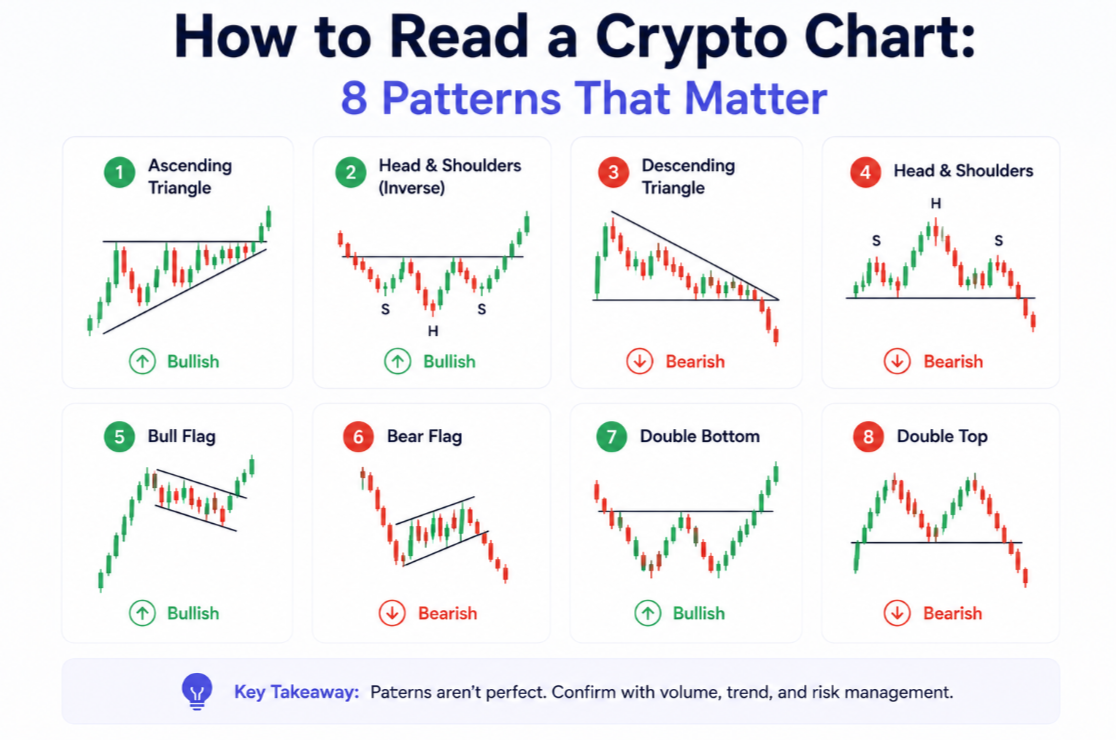
There are hundreds of indicators on TradingView. Most are noise. The eight patterns below cover the situations that actually repeat — and that experienced traders use to decide when to act and when to wait.
1. Support and resistance
Horizontal lines where price has reversed multiple times. Three or more touches make a level meaningful. A break above resistance often becomes new support; a break below support often becomes new resistance.
2. Trend lines and channels
Diagonal lines connecting at least three highs (downtrend) or lows (uptrend). A clean break of a trend line on volume is one of the most reliable early signals.
3. Moving averages
- 20 EMA — short-term momentum.
- 50 SMA — medium-term trend.
- 200 SMA — long-term regime. Above it = bull market, below it = bear market in most markets.
4. Volume
Price moves on low volume are noise. Price moves on rising volume are the signal. Breakouts without volume usually fail.
5. The double top / double bottom
Two failed attempts to break the same level. A confirmed double top is a strong reversal signal in uptrends; double bottoms work the same way in downtrends.
6. The head and shoulders
A peak (head) between two lower peaks (shoulders), with a neckline connecting the lows. A close below the neckline is the trigger; the projected target equals the height of the head.
7. Candlestick reversals
Hammer, bullish/bearish engulfing, and morning/evening star patterns flag exhaustion and potential reversals. They matter most at major support or resistance — in the middle of a range they mean little.
8. Funding rates (for perpetuals)
On Binance Futures and Hyperliquid, positive funding means longs are paying shorts — a sign of crowded long positioning. Extreme funding often precedes flushes.
What does not work
Reading patterns on 1-minute charts during low-volume hours. Following influencer signals without understanding entry, stop, and target. Trading every breakout — most fail. Three patterns confirmed across multiple timeframes are worth fifty random scribbles.
Bring it together with our crypto trading strategies guide or jump into reading on-chain data.