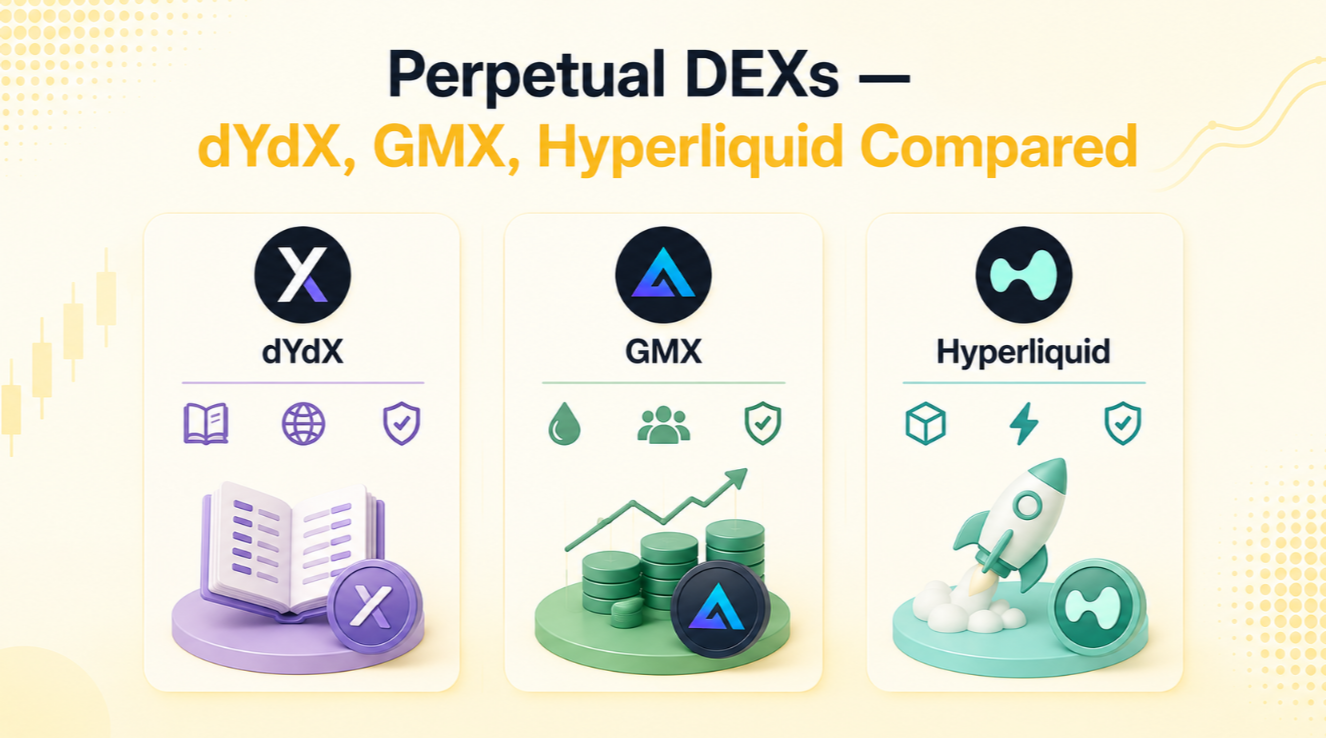
Perpetual futures dominate crypto trading volume — CEX perp volume has consistently exceeded spot volume for years. Bringing perpetuals fully on-chain has been one of DeFi's longest-standing challenges, because the mechanic (leverage, funding rates, oracle-based settlement) is fundamentally harder to execute trustlessly than spot trading. Three protocols have taken meaningfully different approaches: dYdX (order book), GMX (pool-based), and Hyperliquid (app-chain). Understanding the tradeoffs teaches you what "decentralized perpetuals" actually means at each design point.
What a perpetual is
A perpetual future is a contract that:
- Tracks the price of an underlying asset (BTC, ETH, etc.)
- Has no expiration date (unlike traditional futures)
- Uses funding rates to keep its price aligned with spot
- Allows leverage (typically 10-50x on major assets)
When you go long BTC-PERP with 10x leverage using $1,000 of collateral, you have $10,000 of BTC exposure. If BTC goes up 5%, you gain $500 (50% of your collateral). If BTC goes down 5%, you lose $500. If BTC goes down 10% (which would put your position underwater), you get liquidated.
Funding rate mechanic: every 1-8 hours, longs and shorts exchange payments based on the perpetual's price vs spot. If perp trades above spot (longs are demanded), longs pay shorts. This incentivizes people to short and drives the perp back toward spot.
dYdX — the order book approach
dYdX (V4, launched 2023) uses a traditional order book model. Users place limit orders or market orders; the exchange matches them. Feels like a CEX.
Architecture: dYdX V4 runs on a dedicated Cosmos app-chain (not on Ethereum or another shared chain). This gives them full control over matching logic, ordering, and fees.
Key features:
- Order book with limit orders
- Deep liquidity from market makers
- Low latency (app-chain-native)
- ~1-3 bps trading fees (very low)
- Perpetuals on ~50+ major assets
Where it dominates: professional trading with tight spreads on major assets. If you want to place limit orders at specific prices, dYdX is the best on-chain venue.
Weaknesses: less flexibility for exotic assets (limited to whatever's listed), depends on market maker participation for liquidity, complex user onboarding (Cosmos chain instead of Ethereum-native).
GMX — the pool-based approach
GMX (on Arbitrum, now on other chains too) took a different approach: instead of an order book, users trade against a shared liquidity pool (called GLP or GM in different versions).
Mechanism: LPs deposit into GMX's pool. The pool holds a basket of assets (BTC, ETH, USDC, USDT, etc.). Traders open positions against the pool. Traders pay a small opening fee, plus ongoing "borrow rate" while position is open. LPs earn these fees plus any losses traders take.
Key features:
- Zero slippage on major assets (up to pool depth)
- No order book, no market makers
- LPs bear counterparty risk (trader wins = LP loses)
- Simple UX (no order types beyond market)
- Fair funding rate mechanism
Where it dominates: retail-friendly trading on major assets. Users who don't want to worry about limit orders or bid-ask spreads.
Weaknesses: LPs can lose during sustained trader wins (which has happened at times), pool composition biases can create adverse selection, less capital efficient than order books for large trades.
Hyperliquid — the fully on-chain order book
Hyperliquid (launched 2023) runs on its own custom L1 designed specifically for perpetual trading. It offers a fully on-chain order book with performance comparable to CEXs.
Architecture: custom L1 with novel consensus, single-block finality, extreme latency optimization for trading. Every order and match is on-chain — no off-chain matching engine.
Key features:
- On-chain order book with sub-second matching
- Deep liquidity across many pairs
- Low fees (~0.35 bps for taker, negative for maker)
- Growing derivatives selection
- Simple deposit/withdrawal via bridges from other chains
Where it dominates: has been eating market share from both dYdX and GMX since 2024. Combines the order book advantages of dYdX with the on-chain purity of GMX. As of 2026, one of the largest perp DEXs by volume.
Weaknesses: single-chain concentration risk (all your perps on Hyperliquid depend on Hyperliquid's chain being up), less integrated with other DeFi than Ethereum-native venues.
Comparing the three
Design tradeoffs:
**Capital efficiency**: dYdX and Hyperliquid (order book) > GMX (pool). Order books enable tighter spreads because market makers compete on price.
**Latency**: Hyperliquid > dYdX > GMX. Custom infrastructure wins for speed.
**Simplicity for users**: GMX > dYdX ~ Hyperliquid. Pool trading has fewer UX surprises for newcomers.
**LP economics**: GMX and Hyperliquid offer LP roles; dYdX doesn't need LPs in the same way (market makers fill that role).
**Asset breadth**: Hyperliquid > dYdX > GMX. Order books can list more assets more easily.
**Composability with Ethereum DeFi**: GMX (originally Arbitrum, so Ethereum-adjacent) > dYdX (Cosmos chain) ~ Hyperliquid (own chain). Being on Ethereum makes DeFi composability easier.
Funding rate mechanics
All three use funding rates but with slightly different implementations:
- dYdX: standard perpetual funding, updated hourly.
- GMX: funding rate influenced by pool asset weights, updated continuously.
- Hyperliquid: standard perpetual funding, updated hourly.
Funding rates vary widely by asset and market conditions. During bull runs on Bitcoin, funding rates for BTC perps can hit 100%+ annualized (longs paying shorts significantly). During bear phases, funding can go negative.
Fees compared
For a $10K position:
- dYdX: opening fee ~$1-3, low ongoing.
- GMX: opening fee ~$8-10 (0.08-0.10% of position), plus borrow fee accrued over time.
- Hyperliquid: opening fee ~$0.35, low ongoing.
Hyperliquid and dYdX are cheaper for pure trading. GMX's fees are higher but its LP incentives redistribute them.
Risks by protocol
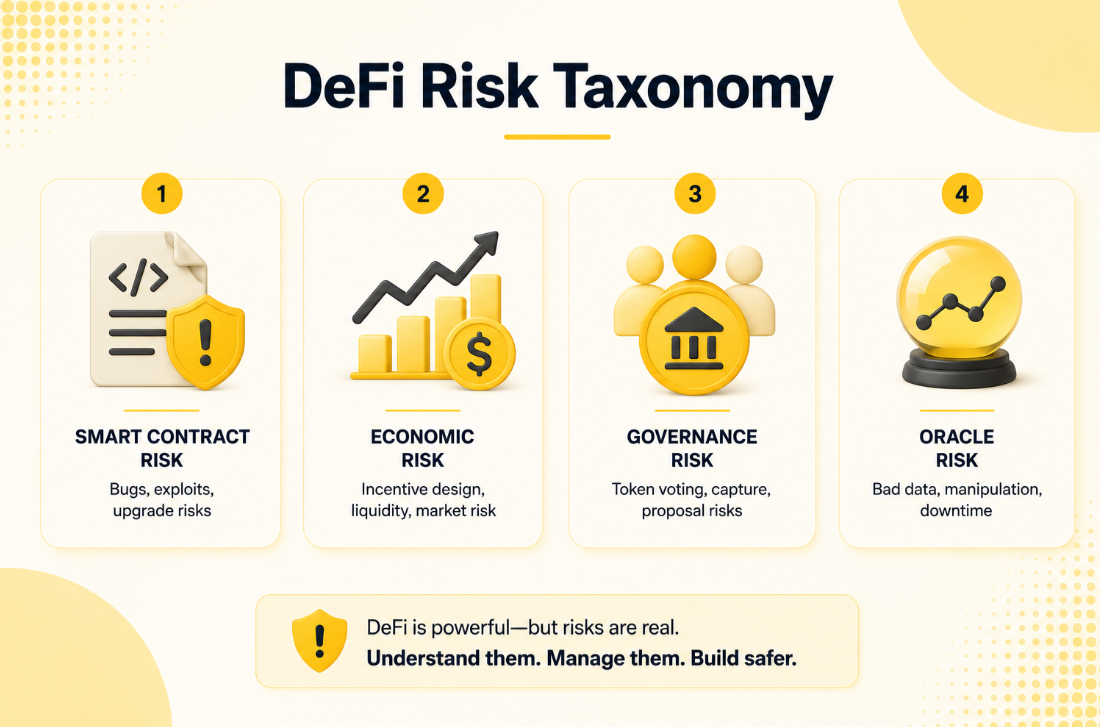
**dYdX V4**: Cosmos chain risk (whole chain must stay operational), governance risk (dYdX DAO decisions), oracle risk (uses Chainlink and other feeds).
**GMX**: LP risk (LPs can lose to traders in adverse conditions, though has been profitable long-term), oracle manipulation risk (has been exploited via manipulated oracle prices in one incident, fixed subsequently), pool composition risk.
**Hyperliquid**: custom L1 risk (unproven infrastructure at scale), oracle risk, concentration risk (much of the traffic is on a single chain).
None have suffered catastrophic failures, but each has had incidents worth studying.
For a trader choosing
Practical guidance:
- For serious active trading with order types: dYdX or Hyperliquid.
- For simple long/short exposure without thinking about spreads: GMX.
- For lowest fees: Hyperliquid.
- For deepest liquidity on major pairs: currently Hyperliquid or dYdX.
- For DeFi composability (use perp as part of another strategy): GMX or Hyperliquid.
The perp DEX landscape has been consolidating. In 2022-2023 there were dozens of small perp DEXs; by 2026 volume is concentrated in these three plus a small tail. Choosing among the top three based on your specific needs is the pragmatic approach.
The larger picture
Perpetual DEXs have arguably been the biggest success story of DeFi in 2024-2026. Volume has grown to be comparable to major CEX perpetual volume. This represents genuine substitution of TradFi/CEX activity by DeFi infrastructure.
The design lessons: order books can work on-chain if you're willing to use custom infrastructure (Hyperliquid). Pool-based approaches are simpler but leave value on the table. And getting perp DEX design right is much harder than getting spot DEX design right — the multi-year gap between Uniswap dominating spot and perp DEXs reaching maturity reflects that complexity.