The Solana vs Ethereum debate has matured. Both ecosystems have grown; both have shown weaknesses; both have committed users. The 2026 comparison is no longer "which is better" but "which fits what."
Architecture in one paragraph each
- Ethereum — Monolithic execution on L1; scales through rollups (L2s). Finality ~12 minutes on L1; rollup finality varies. Conservative consensus, slow but predictable.
- Solana — Monolithic execution on L1; scales by adding hardware. ~400 ms blocks, ~12 second probabilistic finality. Single-chain throughput optimised; tighter coupling between validators.
Real numbers in 2026
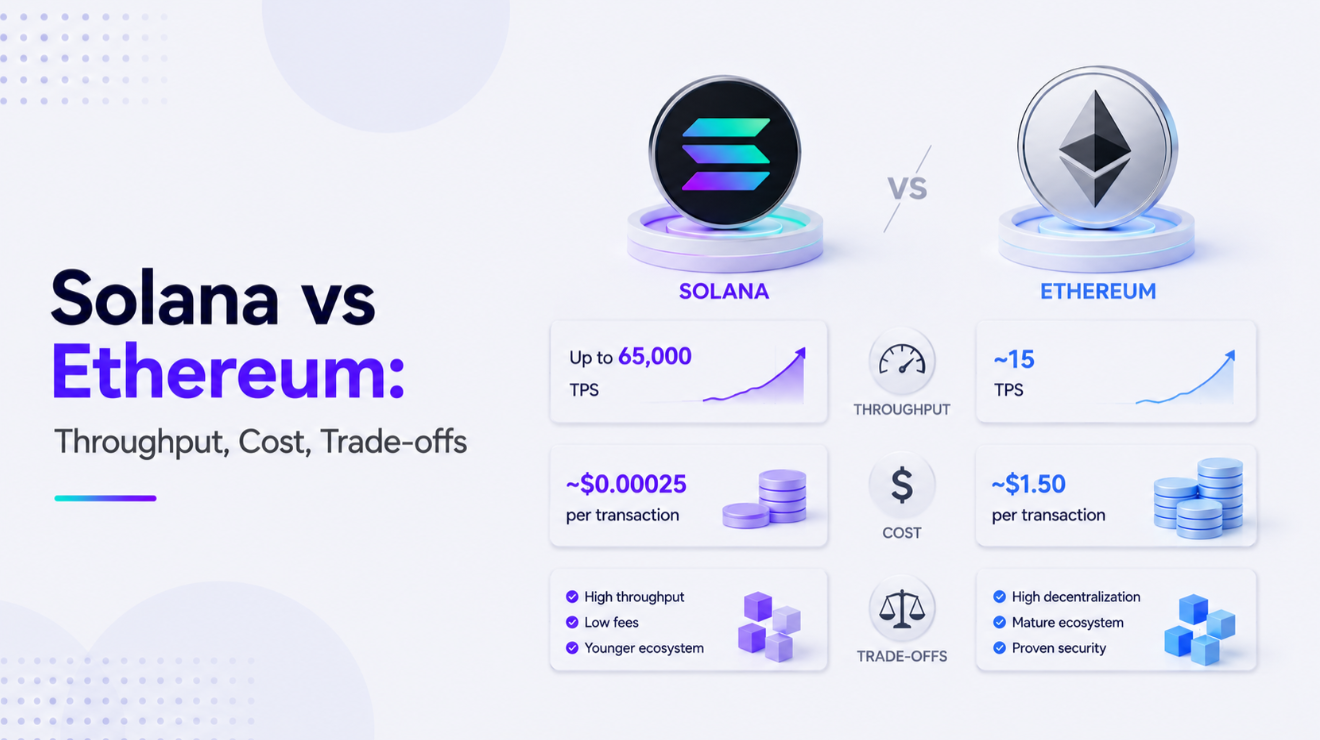
- TPS (real) — Ethereum L1: ~15. All L2s combined: ~150–300. Solana L1: 2,500–4,000 during normal hours, lower at peak.
- Fees — Ethereum L1 swap: $5–20. L2 swap: $0.05–0.50. Solana swap: ~$0.001.
- Validator count — Ethereum: ~1M+ validators (operated by ~100k+ entities). Solana: ~1,400 validators with ~200 in the top supply quartile.
- Geographic distribution — Both are well-distributed; Solana validators concentrate in Frankfurt/Amsterdam/Tokyo data centers.
- Outage history — Solana: significant outages 2022–2023, rare in 2024–2026 after Firedancer client launch. Ethereum L1: zero outages since launch.
Where each one wins
- Solana wins — Consumer applications needing instant UX, high-frequency DeFi (perps, DEX trading), memecoins, NFTs at scale.
- Ethereum wins — Maximum-decentralisation use cases, large-scale institutional capital (BUIDL and most RWAs), DeFi composability across diverse protocols, settlement layer for L2s.
The Firedancer factor
Jump Trading's independent Solana client launched mainnet in 2024–2025. Two implementations (Agave + Firedancer) reduce single-client failure risk substantially. Outages — Solana's long-time weakness — have become rare. The 2026 reliability gap with Ethereum has narrowed considerably.
Long-term thesis differences
Ethereum bets on a rollup-centric future where L1 is settlement and L2s are execution. Solana bets on monolithic scaling — Moore's Law plus engineering — within a single chain. Both can be right; they target different design points.
See our Solana DeFi 2026 and our L2 networks compared.