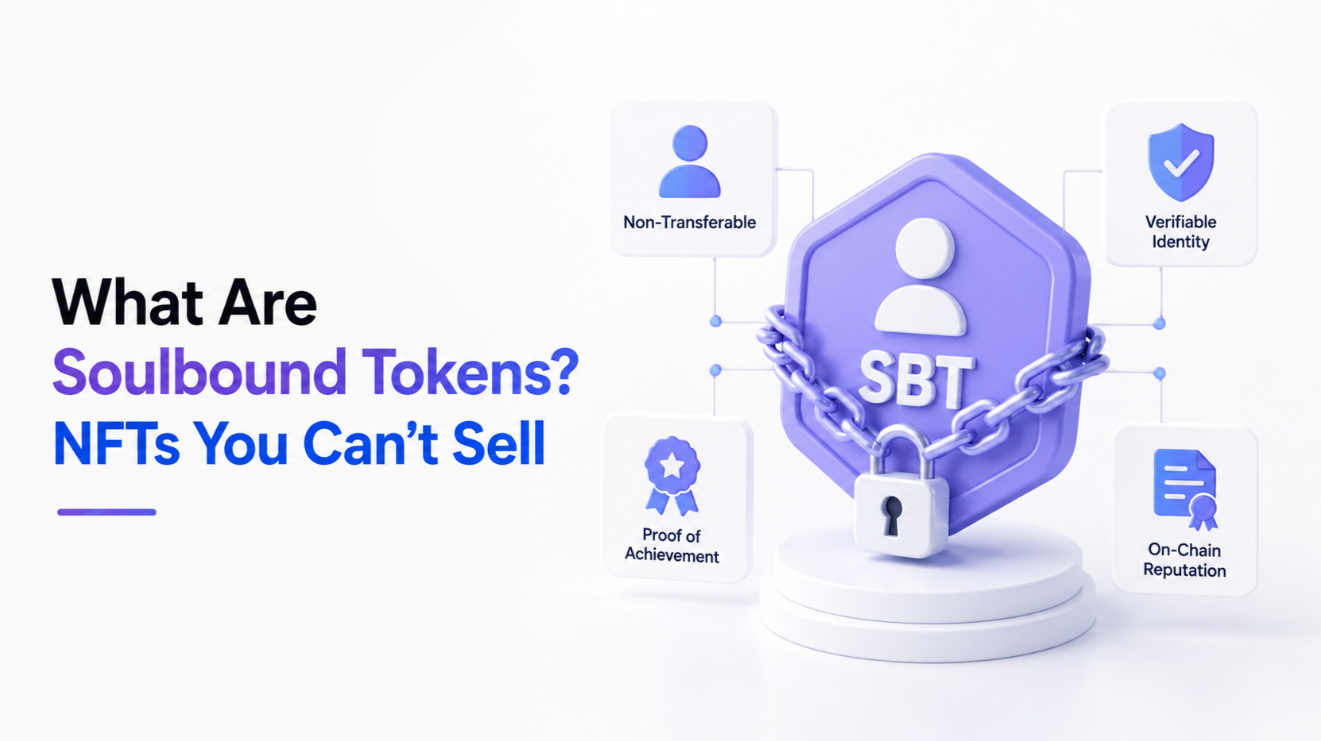
A soulbound token (SBT) is an NFT that cannot be transferred. Once you receive one, it belongs to your wallet forever (or until the issuer revokes it). The concept came from a 2022 Vitalik Buterin paper; the 2026 reality is finally catching up.
What SBTs are used for
- Credentials — University degrees, professional certifications, course completions.
- Reputation — DAO participation, governance votes, contribution history.
- Memberships — Conference attendance, community access, voting eligibility.
- Sybil resistance — One-per-person tokens that prevent gaming airdrops or DAO votes.
- Compliance — KYC verification proofs that travel with your wallet.
How they differ from regular NFTs
A regular NFT can be sold, transferred, or stolen. A soulbound NFT cannot — the smart contract simply rejects any transfer attempt. This makes them useful for things where ownership should mean "this address earned or was assigned this thing," not "this address bought it on a marketplace."
Real-world examples in 2026
- Optimism Citizen NFTs — Used in OP's governance system for individual voting.
- Gitcoin Passport stamps — Each credential is a non-transferable proof.
- Layer3 quest badges — Show task completion across many protocols.
- Sismo / Holonym credentials — ZK-based identity attestations.
- EthCC and Devcon attendance — Conference POAPs evolved into proper SBTs.
Limitations
A non-transferable token is awkward when wallets get lost — you cannot move credentials to a new wallet. Solutions like recovery contracts and credential portability protocols (Sismo, Verax) are emerging but not universal. Privacy is another challenge: an SBT in a public wallet is visible to anyone.
Should you collect SBTs?
If they are tied to real participation (attended an event, completed a real course, contributed to a DAO), yes — they form a portable on-chain CV. If they are pure airdrop-farming tokens with no real meaning, they clutter your wallet without value.
See our Web3 identity guide for how SBTs fit the broader picture.