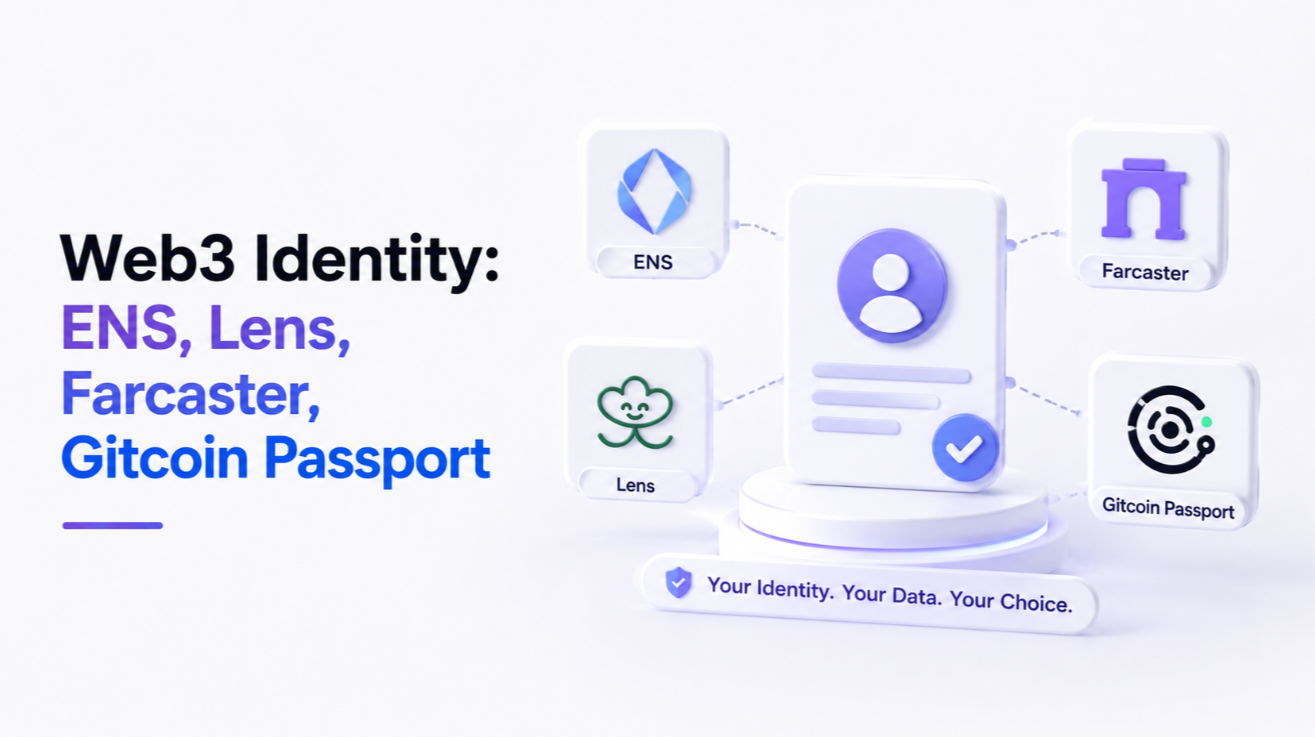
Web3 identity used to be theoretical. In 2026 it is operational — millions of ENS names, real social graphs on Farcaster, sybil scoring via Gitcoin Passport, and account abstraction connecting them. Here is how it actually fits together.
ENS: the username layer
Ethereum Name Service maps human-readable names (vitalik.eth) to wallet addresses, records, and metadata. 3M+ registrations in 2026, deep integration with wallets, dApps, and even some traditional services. Subdomains (gm.alex.eth) extend ENS to scale.
Lens Protocol: the social graph as an NFT
Lens stores profiles, follows, and posts as on-chain assets. Migrated to Lens Chain (a dedicated rollup) in 2024–2025 for scale. Multiple front-ends (Hey, Orb, Buttrfly) read the same underlying graph. Best traction with creator economy use cases.
Farcaster: the protocol-native social network
Farcaster grew from a few thousand to 500k+ DAU in 2024–2026. Hybrid architecture (off-chain Hubs + on-chain Optimism registrations). Frames — interactive in-cast apps — turned Farcaster into a real consumer platform.
Gitcoin Passport: sybil resistance
Aggregates verified credentials (BrightID, holonym, ENS holdings, Lens activity, Coinbase verification, even Twitter and LinkedIn) into a Passport score. Used by airdrops, governance votes, and grants to filter sybils. Imperfect but the leading tool.
How they connect
A user with an ENS name maps to a wallet; that wallet has a Farcaster registration and a Lens profile; their Passport score signals their authenticity to airdrops and DAOs. Account abstraction (ERC-4337) ties them under a single smart account that can pay gas in any token.
Where Web3 identity actually works
- Airdrop eligibility — Passport scores filter farmers.
- DAO voting — limit influence per-person rather than per-token.
- Social proof — verified ENS + Farcaster history matters in DeFi credit and lending.
- Portability — same identity moves across multiple dApps without re-onboarding.
Where it does not (yet)
Mainstream consumer identity. KYC compliance. Privacy-preserving credentials. ZK-based identity (Anon Aadhaar, World ID) is maturing but adoption remains niche. The decentralised-identity dream of replacing OAuth-style sign-in everywhere is still a long way off.
See our DAOs in 2026 and decentralized social postmortem.