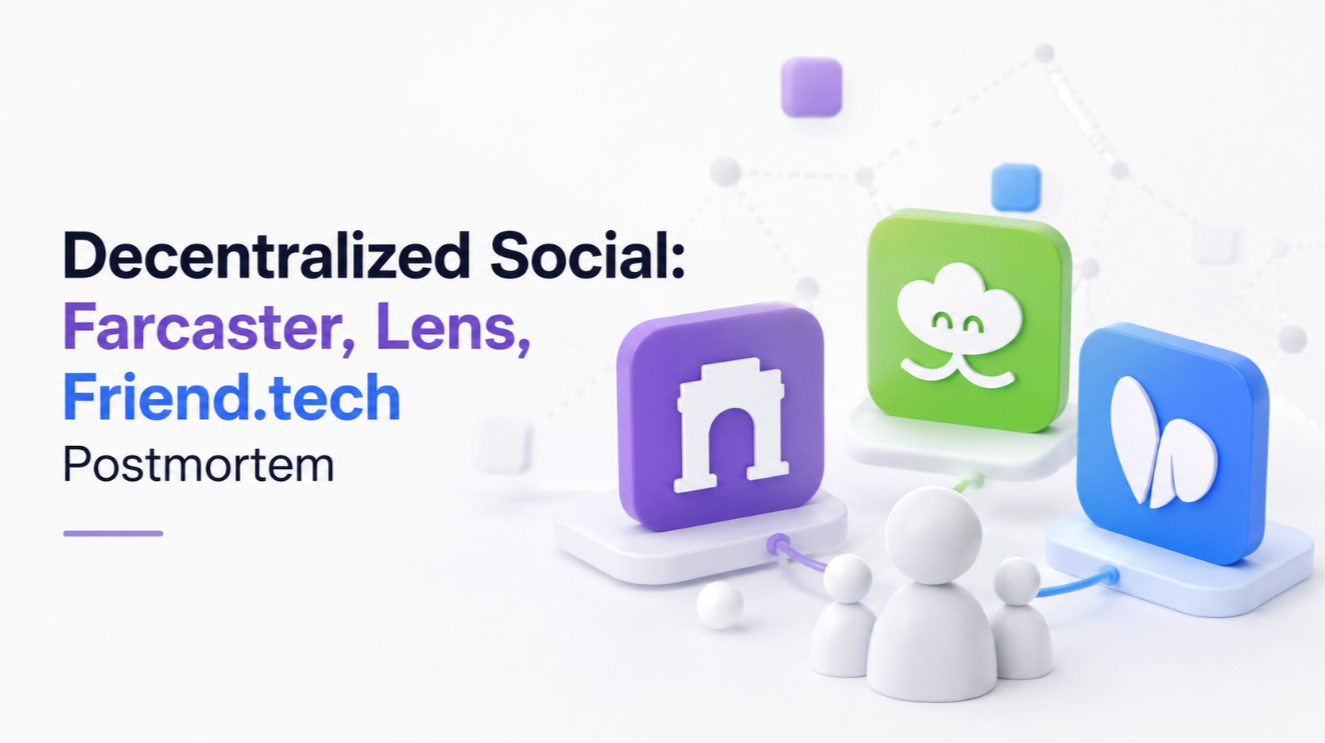
Decentralised social has been the most-attempted, most-failed category in crypto. In 2026 there is one genuine breakout (Farcaster), one slow rebuild (Lens), and a graveyard of viral-but-fleeting experiments. The patterns are now clear.
Farcaster: protocol-first, slowly mainstream
Farcaster grew from ~10k DAU in early 2023 to 500k+ DAU by 2025–2026. The 2024 "Frames" launch (interactive in-cast apps) was the unlock — turned passive social into a platform for everything from minting NFTs to running polls. Multiple front-ends (Warpcast, Supercast, Privy-powered apps) reuse the same data. Real protocol, real users.
Lens: the second-chance protocol
Lens v1 (Polygon, 2022) attracted attention but limited usage. The 2024 migration to Lens Chain (a dedicated rollup) plus relaunched front-ends (Hey, Orb, Buttrfly) brought real usage. Smaller than Farcaster, with a creator-economy angle. The lesson: technical platform-building beats viral incentives.
Friend.tech: the cautionary tale
Launched mid-2023, hit $50M weekly volume, then collapsed. The mechanic — buy "keys" to access influencer chats — was viral but lacked retention. By late 2024 the team had moved on; the protocol was effectively dead. Lessons: viral mechanics without product depth do not survive; bonded curves are extraction not coordination; and token incentives can pull forward demand that does not exist organically.
What worked across the survivors
- Protocol-first architecture — Multiple clients reading the same data create resilience.
- Real social graph, not just tokens — Follows, casts, replies stored as primary data.
- Gradual, sustained growth — No "go viral overnight" — both Farcaster and Lens grew over years.
- Crypto-native communities — Both serve audiences who already had wallets and on-chain expertise.
What still does not work
- Mainstream non-crypto adoption — still missing.
- Monetisation beyond crypto tipping — limited.
- Algorithmic curation at scale — hard without centralised feeds.
- Moderation — open protocols make hate speech and spam harder to police.
What might come next
The next round of attempts will likely combine the Farcaster protocol with AI agent activity (already happening), zero-knowledge identity for sybil resistance, and tokenised attention markets that distribute value to content creators differently than incumbent platforms. The unsolved problem remains crossing from crypto-native niches to broader audiences.
See our Web3 identity guide and AI agents on-chain deep-dive.