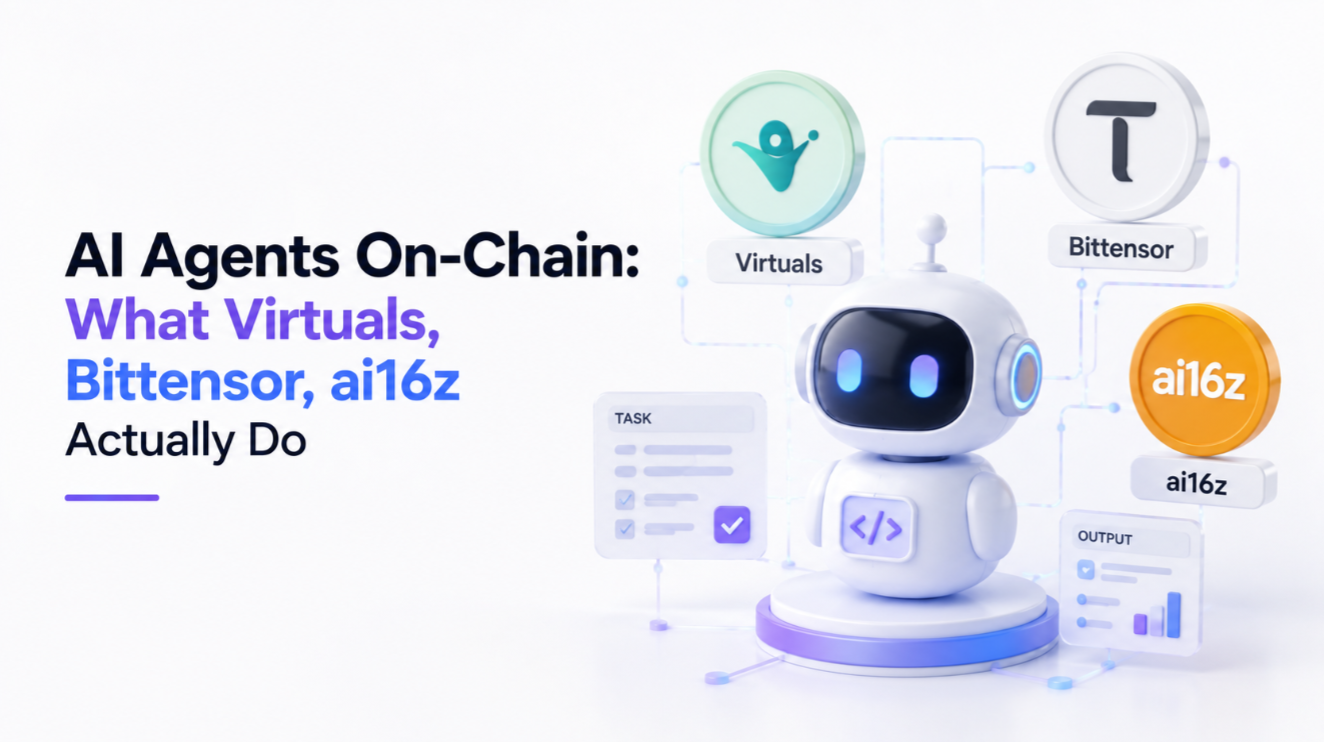
AI agents on chain went from concept to bubble to consolidation in 12 months. The 2026 landscape has a handful of frameworks with real activity, a much larger graveyard of token-only "agents," and an open question about whether any of this is durable.
Virtuals Protocol: agent issuance and trading
Virtuals is the largest agent platform by market cap and activity. Creators launch agents as tokens; tokens can be traded; agents post on Twitter, interact with other agents, and execute simple on-chain actions. Most agents are entertainment characters; a smaller group of "productive" agents actually transact.
Bittensor: subnet-based AI competition
Bittensor coordinates ML-model competitions across subnets. Each subnet rewards models based on output quality (judged by validators). The most productive subnets generate real AI services — text completion, image generation, retrieval. TAO emissions reward both miners (model operators) and validators.
ai16z (Eliza Framework)
Open-source agent framework with significant developer adoption. Powers many of the productive agents on Virtuals and elsewhere. AI16Z token captures protocol activity but is also the most prominent example of "AI fund" cult dynamics that overshot fundamentals in 2024.
What agents actually do today
- Post on social media (Twitter, Farcaster) — most common, lowest economic value.
- Manage simple on-chain positions (trades, treasury rebalancing) — real but small in scale.
- Run prediction markets or coordinate other agents — niche but growing.
- Provide AI services (model inference, data retrieval) — handled mostly through Bittensor and similar.
Why most agents will not survive
The 2024 surge produced thousands of "agents" that were really branded tokens. Most have no users, no revenue, and no clear function beyond price speculation. As speculative attention rotates, these collapse. The frameworks underneath — Virtuals, Bittensor, Eliza — should outlast the hype around individual agents.
How to evaluate an agent or framework
- Does the agent / protocol do something real, or is the "agent" just marketing?
- Who pays for the output? Real users, or token emissions?
- How much of token supply is held by insiders?
- Does the framework have meaningful third-party developer adoption?
See our AI crypto tokens map and AI tokenomics deep-dive.