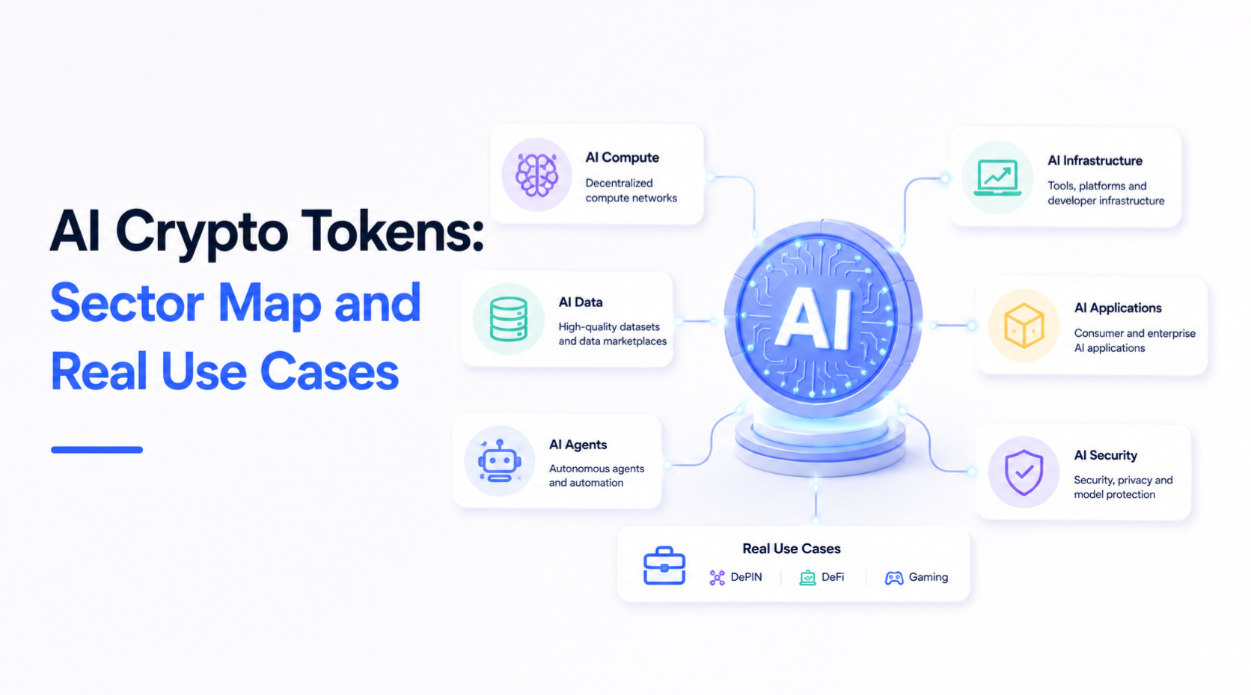
AI crypto in 2026 is no longer just a meta — it is a $30B+ sector with several distinct categories, each with its own thesis. Most projects still lack revenue. The handful that do have it command outsized attention.
Category 1: Compute marketplaces
Networks that match GPU supply to AI demand: Akash, io.net, Render, Aethir, Gensyn, Zero Gravity. Demand from AI labs is real and growing — typically 60–80% cheaper than AWS, with the trade-off of less reliability and uneven QoS. Akash and io.net lead by paying revenue.
Category 2: Decentralised AI infrastructure
Bittensor runs a network of subnets where models compete for emissions based on user value. Fetch.ai focuses on autonomous agents. Sentient (launched 2026) introduces constitutional AI to crypto agents. These are bets on AI as a multi-actor coordination problem, not a single-vendor service.
Category 3: AI agents on chain
Virtuals Protocol, ai16z, Wayfinder, Olas — frameworks for AI agents that hold wallets, transact, and interact with DeFi. The sector exploded in late 2024 then consolidated into a handful of survivors. Real on-chain agent activity remains modest but growing.
Category 4: Data and inference markets
Networks for verifiable model inference, dataset rights, and on-chain ML primitives. Bittensor subnets, Ora Protocol, Allora, Ritual. Genuinely novel architectures — the open question is whether AI developers actually want to coordinate this way.
How to think about valuation
- Real fiat-paying customers (Akash GPU rentals) > token-paying customers > emissions-funded usage.
- Token-revenue capture ratio: how much of the network's economic activity flows to token holders?
- Network effects: does adding the 100th provider add value, or just dilute existing ones?
- Token supply schedule: are emissions outpacing demand growth?
The bear case
AI crypto often markets itself as decentralised AI when it is really just AI subsidised by crypto emissions. If the token incentives stopped, would users stay? For most projects, the honest answer is no. The survivors will be the ones whose underlying utility justifies their tokenomics.
See our AI tokenomics deep-dive and the DePIN guide for adjacent context.