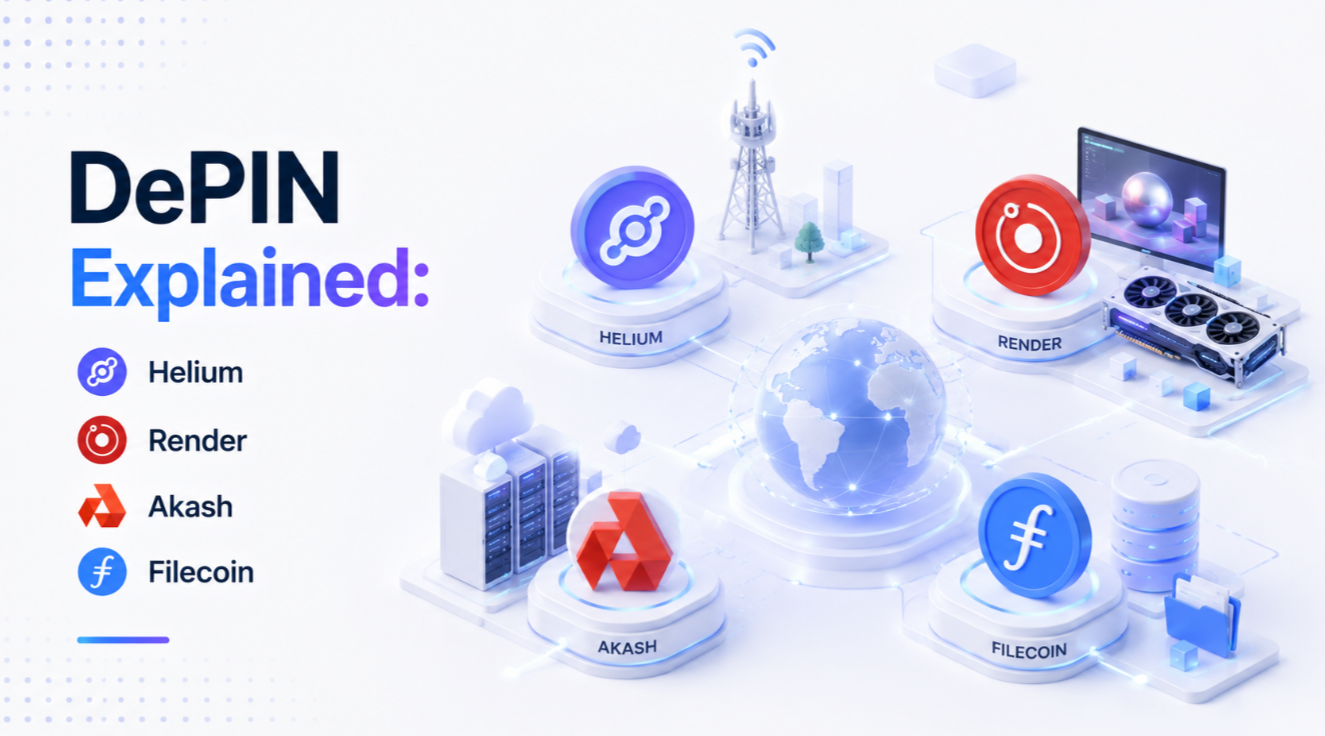
DePIN — decentralized physical infrastructure networks — pay token rewards to people who plug hardware into a coordinated network. Wi-Fi hotspots, GPU compute, storage, mapping cars. In 2026, the strongest networks have actual revenue from non-crypto buyers.
The DePIN flywheel
A project issues a token. Operators buy hardware and earn tokens for providing service. Buyers pay (often in fiat) for the service. The token captures fees, governance, or buyback. The model works when real demand pays operators enough to keep the hardware deployed.
Helium: decentralized wireless
Originally a LoRaWAN network, now dominated by Helium Mobile (CBRS-band 5G). 250k+ subscribers in the US pay $20/month for unlimited data. Hotspot owners earn MOBILE token. The Sprint/T-Mobile MVNO fallback gives users always-on coverage.
Render: GPU rendering and now compute
Render coordinates GPU owners (originally for 3D rendering, now for AI training too). Migrated from Ethereum to Solana in 2024 for performance. RNDR token is burned by buyers and emitted to providers. Real revenue from studios and AI labs has grown into the eight figures annually.
Akash: decentralized cloud compute
Akash is a Cosmos-based marketplace for renting compute capacity — including H100 GPUs and A100s. Buyers pay AKT or stablecoins for compute that is typically 70–80% cheaper than AWS. AI workloads dominated 2025–2026 revenue growth.
Filecoin: decentralized storage
The original storage DePIN, still the largest by capacity (~25 EiB stored). Saturn CDN and the FVM (Filecoin Virtual Machine) extended Filecoin into application use cases beyond raw storage. Adoption by Internet Archive and major researchers anchors real demand.
How operators earn
- Helium Mobile — passive income if you live in a city with paying subscribers; modest in most rural areas.
- Render / Akash — economics depend on your GPU model and electricity costs.
- Filecoin — capital-intensive; mostly run by large storage providers, not retail.
- Hivemapper / Roam / Geodnet — niche networks paying for specific data (mapping, GPS, weather).
How to evaluate a DePIN project
- Look for non-token revenue (real fiat paying customers).
- Check unit economics — does the hardware ROI make sense without speculative token upside?
- Verify the supply schedule and emissions — most DePIN tokens are heavily inflationary.
- Read the buy-back or burn mechanism — that is the long-term link between usage and token value.
See our how to earn from DePIN guide and the Render Network deep-dive.