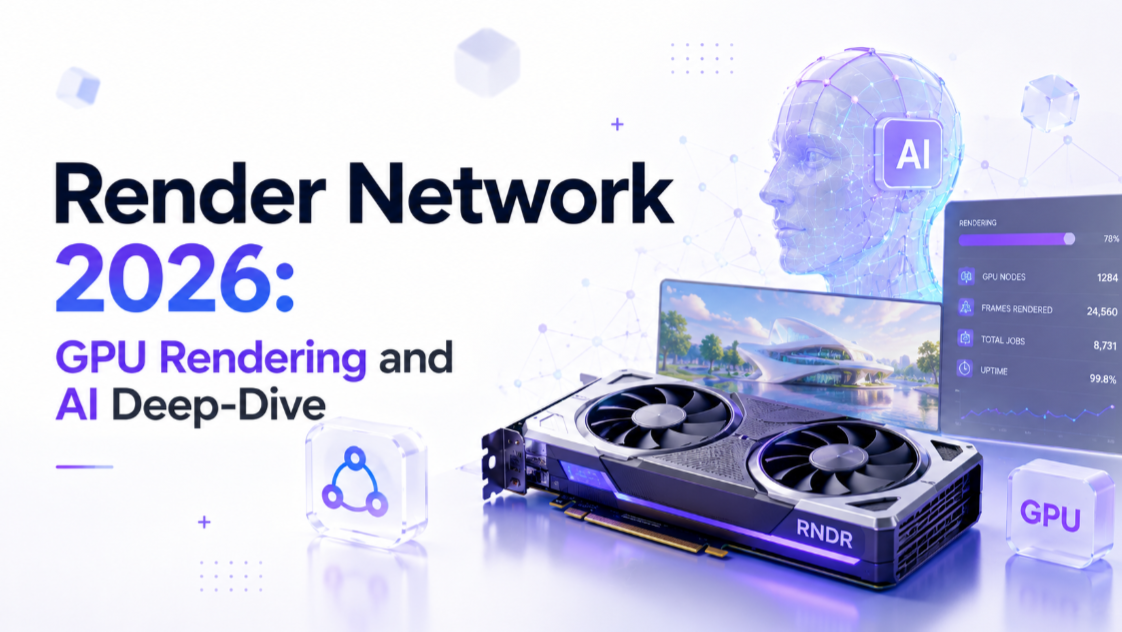
Render started as a decentralised GPU rendering network in 2017. The 2024 migration from Ethereum to Solana plus the rise of AI workloads turned it into one of the few DePIN networks with credible, growing real revenue.
How Render works
Artists submit rendering jobs (typically 3D scenes from Cinema 4D, Blender, Maya). Render routes jobs to operators with idle GPU capacity. Operators earn RNDR tokens; the buyer pays in RNDR (which is burned). The mechanism creates direct demand for the token whenever rendering jobs run.
The AI expansion
The same GPU capacity originally used for rendering is now repurposed for AI inference and training. ML workloads (Stable Diffusion fine-tunes, LLM inference, video generation) regularly run on Render. The network attracts both art studios and AI startups.
Real customer base
- Animation studios for film and TV.
- Architects rendering large building visualisations.
- AI startups generating training data and running inference batches.
- Independent artists for personal projects.
RNDR tokenomics
RNDR is burned when jobs are paid for, creating deflationary pressure tied directly to usage. Operators earn newly issued tokens (controlled emission). The balance — burn vs emission — has trended slightly deflationary during high-usage periods. Migration to Solana cut transaction fees and improved settlement times.
How to use Render
- As an artist / buyer — Submit jobs via OctaneRender, Cinema4D plugins, or direct API. Pay in RNDR.
- As an operator — Run RNDR Node client on a workstation with an RTX 4090 or H100. Earnings depend on uptime, demand, and operator tier.
Risks and limitations
- Demand sensitivity — AI workload growth has driven recent revenue; a slowdown would hit revenue.
- Competition — Akash and io.net target similar markets.
- Operator concentration — Top operators handle disproportionate workloads.
See our Akash & io.net deep-dive and DePIN explained.