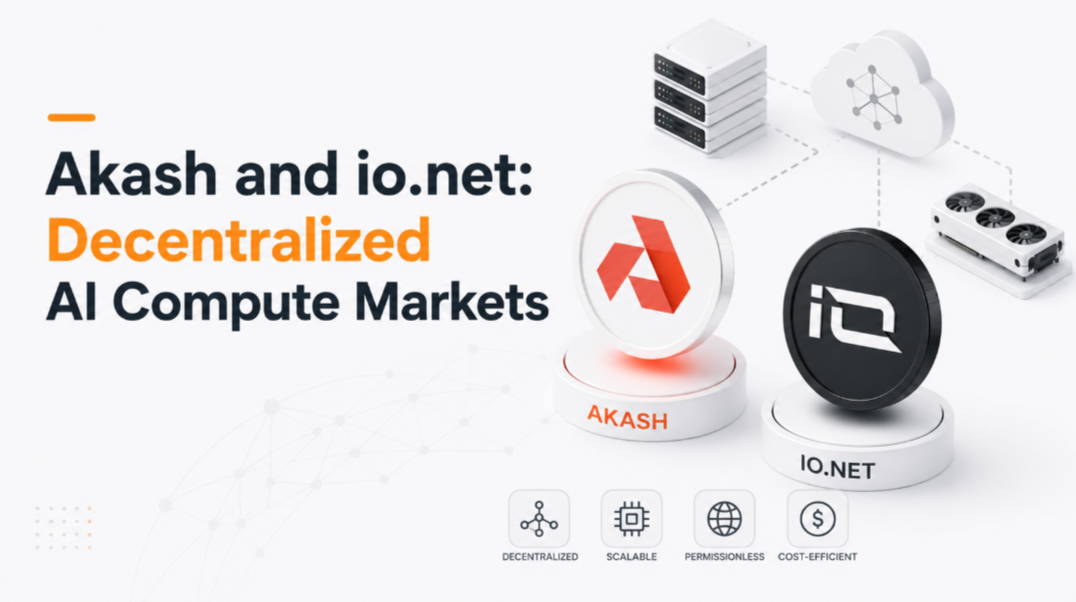
AI compute is one of the few DePIN sectors with verifiable, large-scale revenue. Akash and io.net dominate the decentralised side of the market, providing GPU capacity at a fraction of AWS prices.
Akash Network
A Cosmos-based marketplace where providers offer compute (CPU, GPU, storage) at user-set prices. Buyers pay in AKT or stablecoins. The protocol matches workloads to providers; deployments run on standard Kubernetes-compatible workloads. As of 2026, Akash hosts thousands of GPUs (H100, A100, RTX 4090, RTX 3090).
io.net
A Solana-native decentralised GPU network, optimised for AI workloads. Aggregates GPUs from data centres, crypto miners (now-idle ASIC infrastructure), and individual operators. Strong UX for ML workflows; raised major institutional funding in 2024.
How they compete with AWS
- Price — H100 hourly: AWS ~$3–4. Akash/io.net: ~$1.50–2.50.
- Availability — Decentralised networks have less consistent uptime than AWS but more aggregate GPU supply during demand spikes.
- Tooling — AWS has years of mature MLOps tooling. Akash/io.net are catching up but still less polished.
- Trust — AWS has SLAs and enterprise contracts. Decentralised compute has reputation-based systems and crypto-native dispute mechanisms.
Where decentralised AI compute fits
- AI research labs running fine-tuning jobs cost-sensitively.
- Startups validating models before committing to enterprise AWS contracts.
- Workloads that can tolerate occasional interruptions (training, batch inference).
What does not work
Latency-sensitive production inference, enterprise customers requiring SOC 2 / HIPAA, workloads requiring tightly-coupled multi-GPU clusters. AWS still wins those use cases for now.
Tokenomics
AKT (Akash) is used to pay for compute and stake to secure the network. IO token (io.net) similar function. Both tokens face the standard DePIN tension: real revenue exists, but token emissions can outpace fee-driven demand.
See our DePIN explained and AI crypto tokens map.