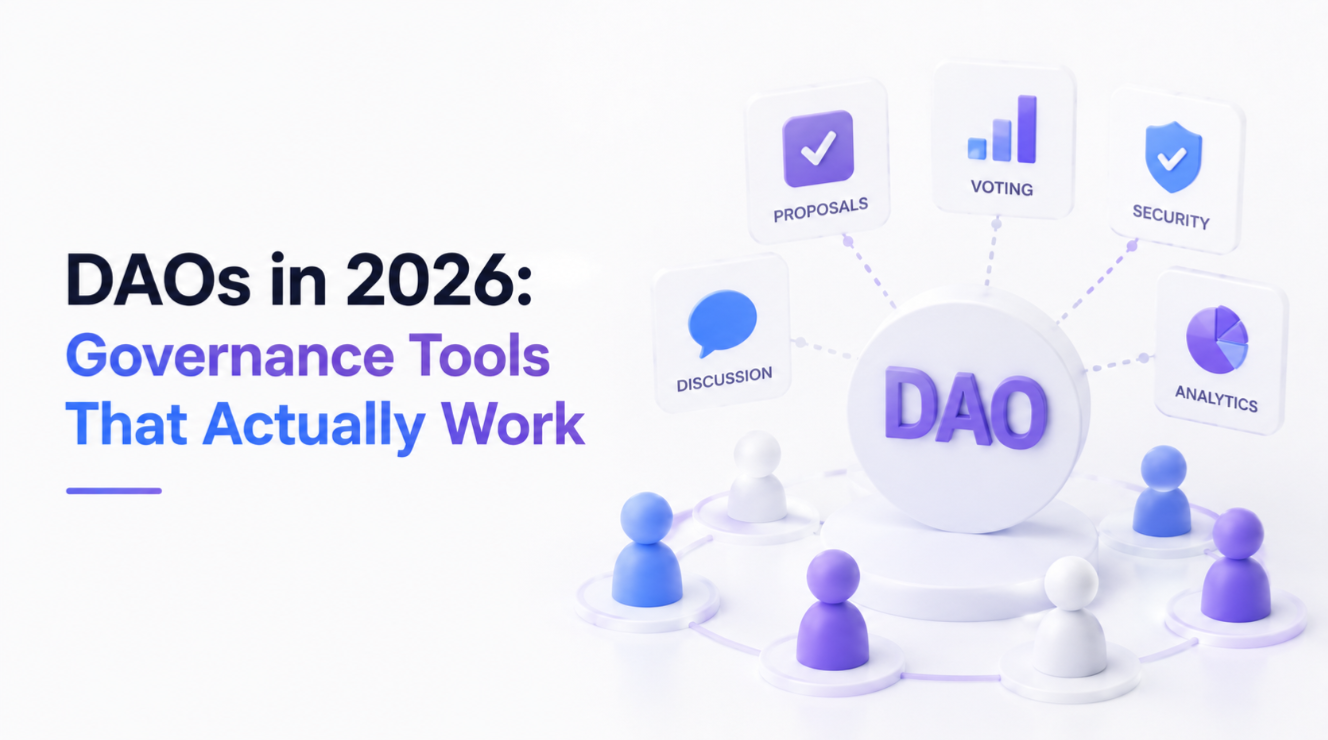
DAOs in 2026 are quieter than in 2021 but more functional. The early "tokens = governance" model has been refined by years of voter apathy, governance attacks, and legal scrutiny. The leading DAOs (Maker, Uniswap, Lido, Optimism, Arbitrum) have working — if imperfect — systems.
How modern DAO governance is structured
- Token voting — Still the base layer for most decisions.
- Delegation — Token holders delegate votes to active delegates (recognised on Tally, Karma, Agora).
- Forum discussion → Snapshot signal → on-chain execution — A staged process that prevents impulse decisions.
- Multisig executors — A small group executes on-chain after the DAO approves the parameters.
- Subdomains and councils — DeFi DAOs (Aave, Uniswap) increasingly delegate specific functions to specialised subDAOs.
Tools that actually get used
- Snapshot — Off-chain signalling votes. Free, fast.
- Tally — On-chain governance and delegate management. The dominant interface for execution.
- Aragon — Multi-purpose DAO infrastructure, popular for new launches.
- Llama — Treasury management, risk parameters, financial reporting.
- Discourse / Commonwealth — Long-form discussion forums.
Why most DAO experiments failed
Voter apathy (most token holders never vote). Whale dominance (a few addresses control outcomes). Governance attacks (Beanstalk's $182M loss in 2022). Legal ambiguity (DAOs as unincorporated entities face liability questions). The "everyone votes on everything" model did not survive contact with reality.
What works in 2026
- Active delegation — Voters delegate to public delegates with publishing requirements.
- Time-locked execution — Multi-day delays between approval and execution let the community react to malicious proposals.
- Limited scope — DAOs vote on direction; operations are executed by paid teams.
- Legal wrappers — Foundations (Cayman, Marshall Islands, Wyoming DAO LLCs) provide entity structure.
Regulatory pressure in 2026
The SEC's 2023–2024 enforcement actions (notably against Ooki DAO) established that DAOs can be legal persons subject to securities and CFTC oversight. The 2025 FIT21 Act partly clarified the framework. EU MiCA explicitly carves out some DAO governance activity. Compliance is now a feature most major DAOs invest in.
See our DePIN tokenomics and crypto regulation 2026.