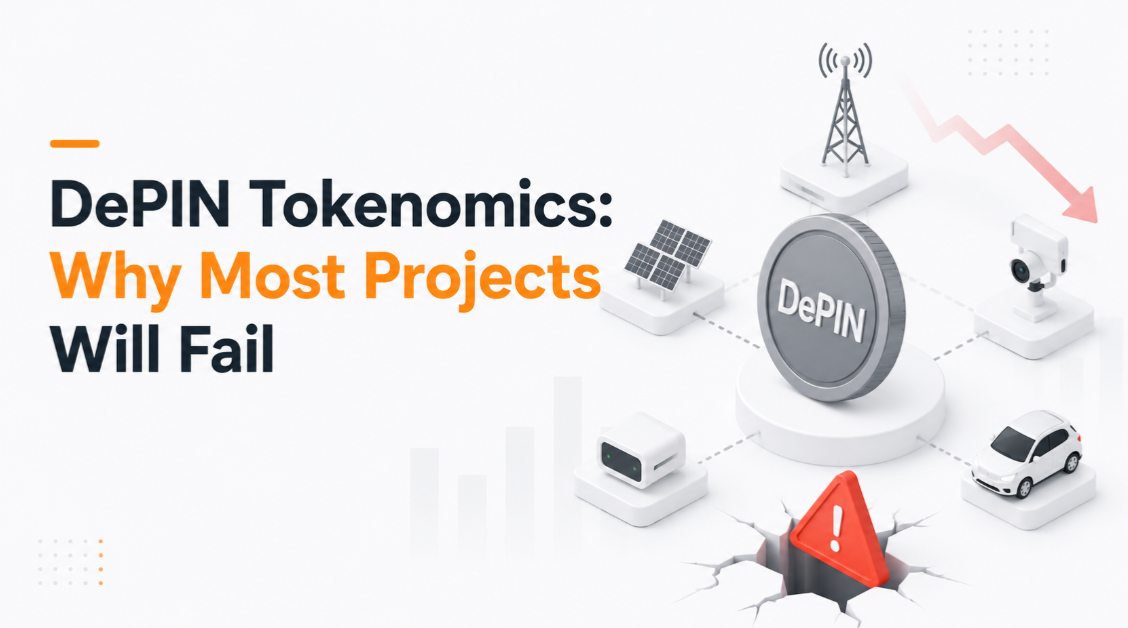
DePIN promises a flywheel: tokens pay providers, providers expand the network, users pay for service, fees flow back to the token. Most projects break the cycle at the third step. Here is what actually makes the model work — or fail.
The core tokenomic challenge
A DePIN must mint tokens fast enough to attract providers but slowly enough that token value supports those rewards. Early on, emissions exceed fee revenue (subsidising network growth). Eventually, fee revenue must catch up or the token spirals. Most networks die in the gap.
What separates survivors
- Real, growing, non-token revenue — Helium Mobile subscribers, Akash GPU rentals, Render rendering jobs. Fee revenue measured in real currency, not tokens.
- Burn or buyback mechanisms — Render burns RNDR on rendering jobs. Helium burns DC for hotspot rewards. These create direct demand for the token.
- Reasonable emission curves — Front-loaded emissions die fastest; multi-year tail emissions allow demand to catch up.
- Operator economics that survive bear markets — Operators only stay if hardware ROI works at low token prices, not just at peak prices.
Patterns that signal failure
- Token emissions paying 5× current fee revenue.
- Heavy insider / team allocations with short vesting.
- No clear burn / buyback / fee-share mechanism.
- Operators churning out within 6 months of joining.
- Marketing-first launches with hardware shipped before software works.
Case studies
- Helium (LoRaWAN) — The original DePIN. Initial token economics did not match real demand; pivoted to Helium Mobile (5G) with stronger fee revenue. Lesson: pivoting tokenomics is possible but painful.
- Filecoin — Real storage demand exists but operator concentration and emissions schedule make the token a long-term challenge. Decoupled storage utility from token speculation.
- Render — Migration from Ethereum to Solana plus burn mechanism aligned with rendering revenue. Tokenomics now reasonably tight.
- Many failed DePIN attempts — Tokens that paid operators handsomely until the next attention rotation; then collapsed.
The honest investor framing
Most DePIN tokens are bets that the network reaches sustainable fee flywheel before emissions collapse the token. Some will. Many will not. Size positions accordingly. The hardware investment is more recoverable than the token bet.
See our DePIN explained and how to read tokenomics.