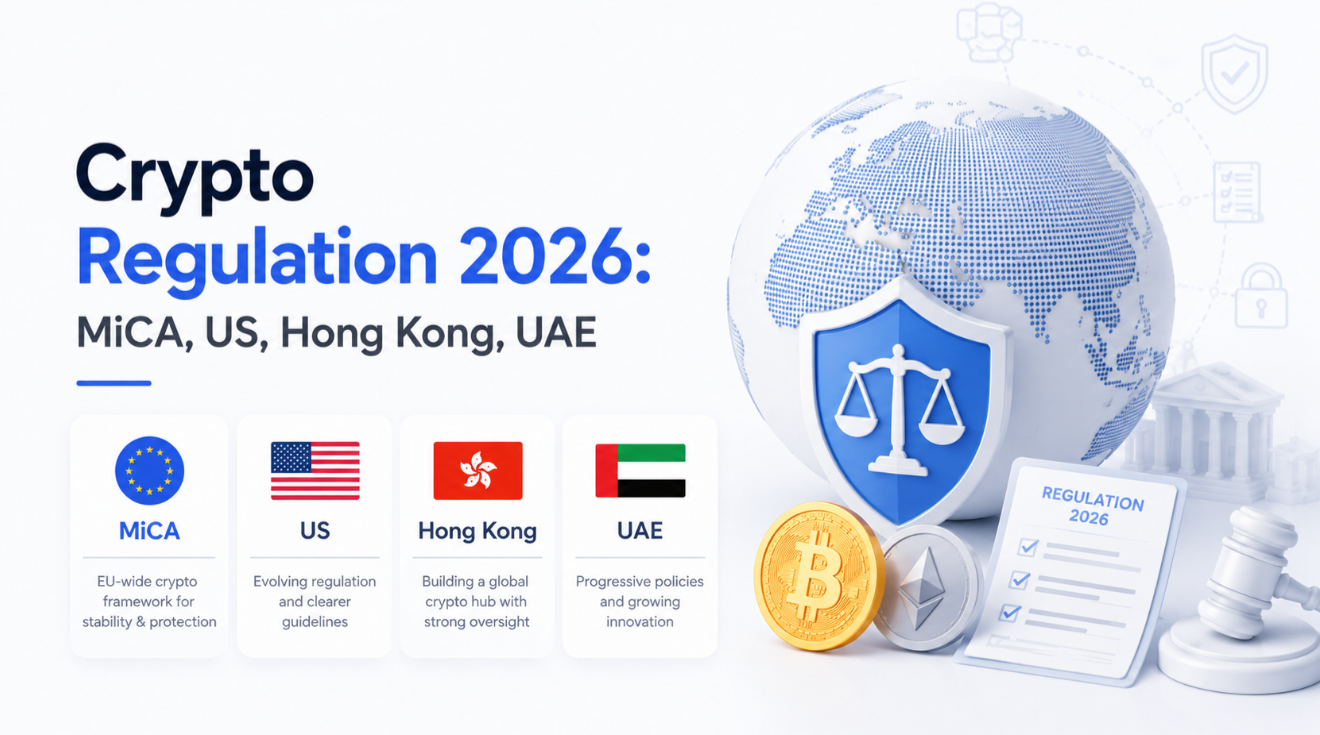
2024–2025 marked the regulatory inflection point for crypto. MiCA went fully live in the EU. The US shifted from enforcement to legislation. Hong Kong opened its stablecoin licensing regime. The UAE doubled down as the most permissive major hub. Here is how the four major regimes look in 2026.
European Union: MiCA in full effect
The Markets in Crypto-Assets Regulation took full force in December 2024 for service providers and June 2024 for stablecoins. Every CASP (exchange, custodian, broker) operating in the EU needs authorisation from a national regulator (BaFin, AMF, CNMV, etc.). Stablecoin issuers face reserve, redemption, and disclosure requirements that USDT does not fully meet — leading to USDT delistings on EU-licensed exchanges in 2024.
United States: from enforcement to legislation
The 2024 election shift produced the GENIUS Act (stablecoin legislation, signed 2025) and FIT21 (market structure, signed late 2025) — replacing piecemeal SEC and CFTC enforcement with a clearer dividing line: SEC oversees security tokens, CFTC oversees commodity tokens (BTC, ETH, and most majors). State-level licensing remains a parallel layer; New York's BitLicense still binds.
Hong Kong: stablecoin licensing first mover
Hong Kong opened its stablecoin licensing regime in 2026 — the first major Asian jurisdiction to do so. Combined with the existing Type 1 license for VATPs (virtual asset trading platforms) and the 2024 spot Bitcoin and Ethereum ETFs, Hong Kong has positioned itself as a regulated alternative to Singapore. Ethereum staking ETFs followed.
United Arab Emirates: the global permissive hub
Dubai's VARA (Virtual Assets Regulatory Authority) issues licenses to a wide range of activities. Abu Dhabi's ADGM offers a separate Tier 1 framework. Lower tax burdens, English-language regulators, and a clear path for both retail and institutional service providers have made the UAE the destination of choice for many founders.
What this means for users in 2026
- EU users — Use MiCA-authorised exchanges; expect stricter KYC and more limited stablecoin choice.
- US users — Spot BTC and ETH ETFs now mainstream; staking remains regulated. Most major exchanges work but with state-by-state nuances.
- Hong Kong users — Spot BTC, ETH, ETH-staking ETFs all available; licensed local exchanges (HashKey, OSL) and global ones with HK approval.
- UAE users — Broadest set of legal products; minimal tax friction; healthy supervisory framework.
What is still unsettled
DeFi regulation is the open question in every jurisdiction. The EU may extend MiCA scope; the US debates whether self-custodied DeFi falls under broker rules; Asia still figures out where the line sits. Most users in 2026 still access DeFi freely, but expect more clarity (and more constraints) in the next 12–18 months.
See our crypto tax software guide for the practical compliance angle.