The optimistic vs ZK rollup debate has matured. In 2026, both production models work; both have meaningful user bases; both have real trade-offs. Here is the technical and practical comparison.
Optimistic rollups: post and challenge
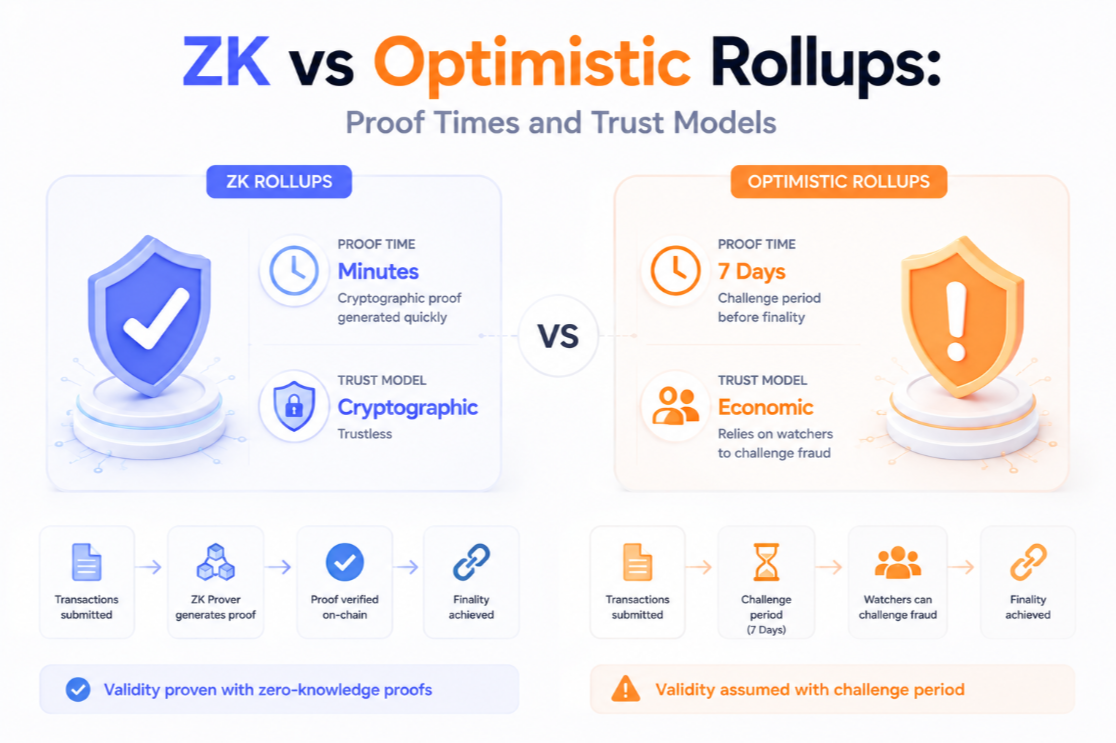
Arbitrum, Optimism, Base, and the Superchain family use optimistic rollup designs. Transactions are posted to L1 with an assertion of correctness. Anyone can challenge during a fraud window (~7 days). If no challenge succeeds, the state is final. Trade-off: 7-day withdrawal delay; fast and cheap during normal operation.
ZK rollups: prove and verify
zkSync, Linea, Scroll, StarkNet, and Polygon zkEVM generate zero-knowledge proofs that mathematically guarantee transaction validity. L1 verifies the proof in seconds. Finality on L1: minutes to ~1 hour. No challenge window required. Trade-off: proof generation is computationally expensive and historically slower; recent hardware and prover improvements have closed the gap considerably.
Key 2026 numbers
- Proof time (ZK) — 5–30 minutes for major ZK rollups in production.
- Finality on L1 — ZK: <1 hour. Optimistic: 7 days (or instant via fast bridges).
- Per-transaction cost — Both under $0.10 for swaps. ZK rollup compute cost is amortised across batch size.
- EVM compatibility — Optimistic ≈ identical to Ethereum. ZK is improving rapidly (Type 1 zkEVMs, e.g., Polygon zkEVM Type 1, in late stages).
Trust assumptions
- Optimistic — Assumes at least one honest validator will challenge fraud during the window.
- ZK — Trusts cryptography. No challenge window needed.
Where each one wins
- Optimistic — Largest ecosystems (Arbitrum, Base), best EVM compatibility, more developer mindshare.
- ZK — Faster L2 → L1 finality, stronger trust-minimisation story, native account abstraction (zkSync).
The convergence
Optimistic rollups are exploring ZK proofs for faster finality. ZK rollups are catching up on EVM-equivalence. The end state — in some years — may be hybrid systems where the line between the two blurs. For 2026 users, the practical difference is mostly which apps are deployed where.
See our Layer 2 networks compared.