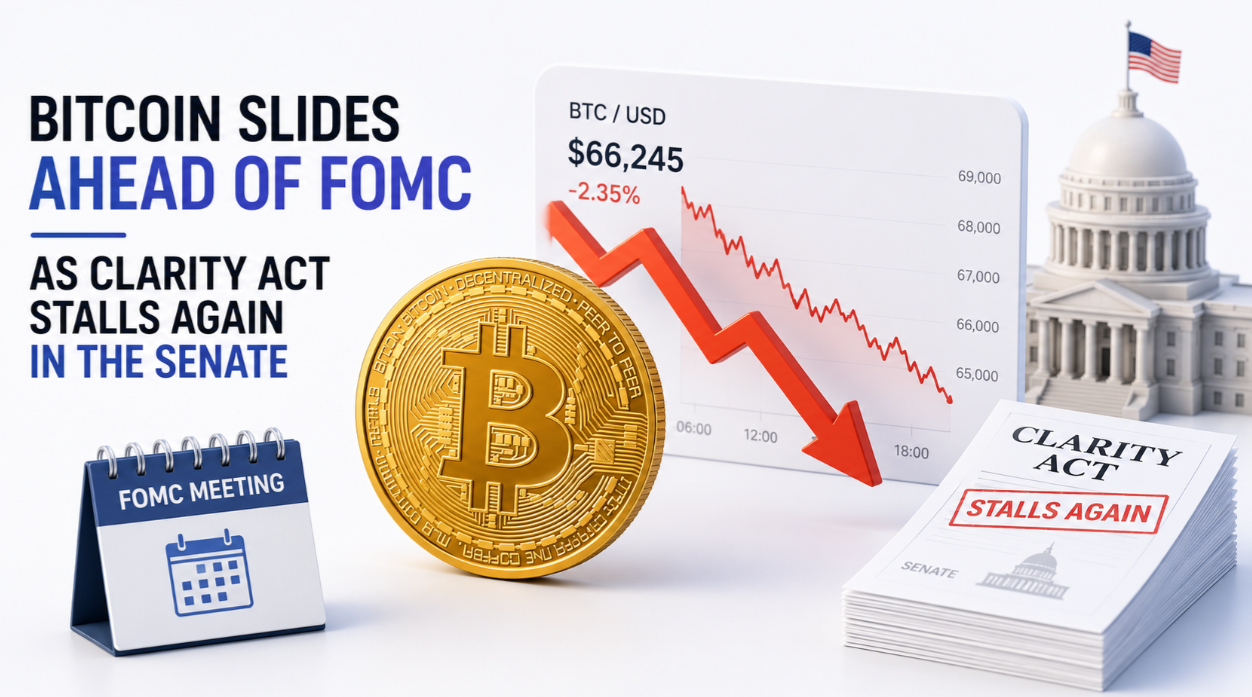
Two Deadlines, One Week
trDigital asset markets spent the first half of September pricing in two separate risks that happened to land on consecutive days. The first was legislative: a procedural vote in the United States Senate that would decide whether comprehensive crypto market-structure rules had any path to law before the midterm elections. The second was monetary: a Federal Open Market Committee decision arriving into an inflation backdrop that had already pushed traders to abandon expectations of easier policy.
By Tuesday afternoon, the first of those questions had an answer — and it was not the one the industry had spent years and considerable money lobbying for.
The Senate Vote: 49–50 and the End of the 2026 Path
The Senate failed to advance the CLARITY Act, falling short in a 49–50 vote. The cloture motion required 60 votes in the 100-member chamber to close debate on the motion to proceed to H.R. 3633, the Digital Asset Market Clarity Act. The procedural vote leaves the bill stalled on Capitol Hill after months of negotiations aimed at building bipartisan support.
The framework itself was not exotic. The bill splits oversight of digital assets between the SEC, which keeps securities, and the CFTC, which would gain exclusive jurisdiction over digital commodity spot markets. That division had already cleared the lower chamber: the House passed the CLARITY Act 294–134 in July 2025, with all 216 voting Republicans supporting the bill, joined by 78 Democrats. The Senate Banking Committee approved its portion 15–9 in May 2026.
What killed it was the final stretch. Republican leaders released a revised version on Sunday, adding new ethics restrictions to address Democratic concerns about public officials profiting from crypto ventures — changes that were not enough to resolve the remaining opposition. Senator Cynthia Lummis, who co-authored the text, told reporters before the vote that a failure would effectively end the effort: the negotiating team had conceded more than 120 Democratic requests, and that, in her view, was enough.
The practical consequence is a calendar problem rather than a policy one. The failure essentially ends market-structure legislative work in the Senate for 2026, which means the SEC and CFTC continue defining the perimeter through enforcement and rulemaking rather than statute.
How Prices Absorbed It
The market reaction was immediate but orderly. Bitcoin fell roughly 4% toward $75,000 as expectations of CLARITY Act passage this year collapsed. Ether, Solana and XRP declined by similar margins, while crypto-linked equities including Circle, Bullish and Coinbase extended earlier losses. Prediction markets had already done much of the repricing in advance, with implied odds of the bill becoming law in 2026 sitting at just 14% on Tuesday morning.
Options positioning told the same story before the vote. Bitcoin put options had become marginally more expensive than calls, with the 7-day skew swinging notably bearish and the 30-day measure following — a shift that deliberately covered the Senate vote, the Fed decision and the Bank of Japan meeting all in the same window.
The Fed Half of the Equation
The second event carries a different structure of risk, because the headline is already known. The FOMC concludes its two-day meeting with a decision at 2:00 p.m. ET on Wednesday, September 16, followed by a press conference at 2:30 p.m. The current federal funds target range is 3.50%–3.75%, unchanged since the July 29 meeting; a 25-basis-point hike would move the band to 3.75%–4.00%.
That would be a genuine regime change rather than a routine adjustment. The range has been held at its current level since December 2025, after three consecutive quarter-point cuts in September, October and December of that year. The July meeting produced a 9–3 vote to hold, with three officials already pushing for an increase — and market pricing for a September hike had climbed to roughly 86%–90% following the August inflation release, up from around 70% the day before. By Tuesday, that probability had risen further to about 92%.
When an outcome is that fully discounted, the decision itself is rarely the market-moving event. What tends to matter is the vote count, the updated rate projections, and how Chair Kevin Warsh handles questions thirty minutes later. This meeting carries an updated Summary of Economic Projections, including the dot plot of where policymakers expect rates to go, so it communicates considerably more than a bare hike or hold. Futures markets were pricing a path toward roughly 4.2% by December as of the most recent close.
What the Two Events Mean Together
Taken separately, each is manageable. Taken together, they remove both of the supports the crypto market had been leaning on into the fourth quarter: a regulatory catalyst and the prospect of looser policy.
The structural picture underneath is less alarming than the headlines. On-chain data shows selling pressure metrics have eased noticeably from their August peak, and long-term holders accounted for a much smaller share of realised profits than they did a month earlier — a sign that older coins are not moving. The missing ingredient is new capital, not holder conviction.
Technically, traders are watching a narrow band: demand support sits around $75,000–$76,000, with overhead resistance near $78,000, $79,500 and $80,500, while $82,500 remains the wider upside target on the daily chart.
The Takeaway
The CLARITY Act's defeat does not change any existing rule; it removes a deadline. US market structure now stays where it has been since 2024 — defined case by case by two agencies rather than by statute — and the debate realistically resumes in 2027 with a differently composed Congress.
The Fed decision, by contrast, changes the cost of capital directly. If the hike lands as priced, the signal to watch is not the number but the dot plot: a projection path implying further tightening into 2027 would matter far more to digital asset valuations than a single quarter-point move that markets have been absorbing for two weeks.