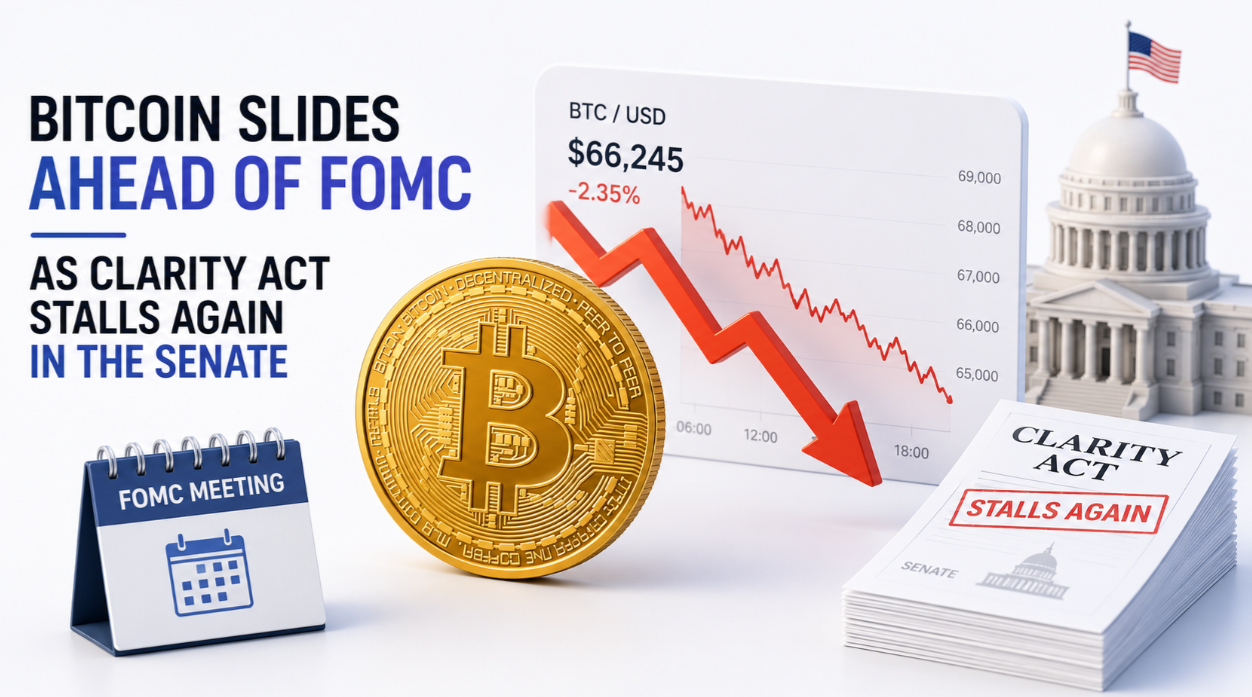
U.S. crypto markets rarely get two defining events in the same 48 hours. This week they do. On Tuesday afternoon the Senate takes its first real measurement of support for the Digital Asset Market CLARITY Act, and on Wednesday afternoon the Federal Reserve delivers a rate decision that money markets have spent the past week violently repricing. One event decides who writes the rules for American crypto companies. The other decides how expensive the dollars funding them will be. Traders have been positioning for both, and the tape shows it.
The Senate Vote That Only Opens the Door
The Senate is scheduled to hold a cloture vote on the CLARITY Act at 2:15 p.m. ET on Tuesday, September 15. The threshold is 60 votes, and the ceiling on what it achieves is narrow: cloture ends debate on the motion to proceed. It does not pass the bill. Success would simply let the chamber begin formal consideration, amendments and an eventual up-or-down vote.
The arithmetic is the story. Republicans hold 53 Senate seats, so with full attendance at least seven Democrats would have to cross over. That is why Senate Republicans spent the weekend rewriting the text, releasing a new draft late Sunday aimed at the three fights that have stalled the bill for months: the President's personal crypto conflicts of interest, the long-running dispute between banks and crypto firms over stablecoin rewards, and legal protections for software developers.
Those concessions did not buy quiet. Banking groups have argued that yield-bearing stablecoins would siphon deposits away from community banks. On September 14, New York Attorney General Letitia James led 18 state attorneys general in urging Congress to reject the bill, arguing it would erode states' ability to pursue crypto fraud. Democrats sent Republicans a counteroffer on the provisions as late as Tuesday morning. Senator Cynthia Lummis, one of the bill's principal negotiators, pressed her colleagues publicly to advance it, framing the moment as one that will not return for years.
What the Bill Would Actually Change
The CLARITY Act is Congress's broadest attempt yet to divide oversight of digital assets between the Securities and Exchange Commission and the Commodity Futures Trading Commission. Today that boundary is drawn mostly by enforcement actions, agency interpretations and court rulings rather than by a single federal statute. The House passed its version, H.R. 3633, in July 2025 by 294-134 with 78 Democrats in favor. The Senate Banking Committee reported an amended version in 2026, and Majority Leader John Thune filed cloture on the motion to proceed in early August, before the chamber left for recess.
Why a Failed Vote Is Not Necessarily a Collapse
Failure would leave little runway. The Senate has roughly two working weeks before the midterm campaign calendar takes over, which is why many analysts treat Tuesday as a decision point for 2026 rather than a procedural footnote.
The market consequences may still be smaller than the headlines suggest. SEC Chair Paul Atkins has said the agency intends to keep advancing crypto rulemaking under its existing authority regardless of the legislative outcome, and CFTC Chair Michael Selig has made a similar point about his own agency's limits and reach. Brian Vieten, senior research analyst at Siebert Financial, told CoinDesk the market is overweighting the binary outcome; in his reading, a failure would leave firms operating under the current SEC and CFTC approach, pulling product launches and tokenization work into 2027 and 2028 rather than shelving them. Adam Morgan McCarthy of LO:TECH added that crypto equities, with their higher beta, would likely give back more than bitcoin if the vote stalls.
The structural difference matters for anyone modeling risk: legislation is durable, while agency rulemaking can be reversed by the next administration.
The Fed Meeting Nobody Expected to Be a Hike Debate
Twenty-four hours later, the macro variable lands. The FOMC meets September 15-16, with the decision due Wednesday at 2:00 p.m. ET alongside the press conference and updated projections.
The unusual part is the direction. Rate markets are pricing a 25 basis point increase, not a cut. CME FedWatch showed roughly 86.5% odds of a hike early in the week, up from 69.4% the previous Friday; Polymarket priced a 25bp increase at about 81.5% on Monday afternoon UTC, with a 50bp move at well under 1%. A quarter-point move would lift the target range to 3.75%-4.00%.
The repricing traces back to inflation data. August producer prices rose 5.4% year over year against a 5.3% consensus, with core PPI at 4.6%, and July's figures were revised higher. That print, layered on the CPI release, pushed a market that had been close to a coin flip into near-consensus for tightening — and set up a political collision, since President Trump has been pushing publicly for cuts while Fed Chair Kevin Warsh is expected to follow the data.
For crypto, the transmission channel is liquidity. Higher policy rates firm the dollar, lift Treasury yields and compress appetite for long-duration risk. A hike that is already 86% priced is not itself the risk; the dot plot and the guidance around it are.
What the Tape Is Already Saying
Positioning has visibly de-risked into both events. Bitcoin traded near $77,400 during European hours Tuesday, roughly flat on the day but about 3% below the $79,530 it touched overnight and more than 1% lower on the week. XRP was the outlier among majors at about $1.41, up more than 2%, with zcash near $1,149. Ether, BNB, TRON, HYPE and dogecoin were all slightly lower, and solana held just above $101. Over seven days, dogecoin was down 7%, HYPE 5% and BNB 3%.
Institutional flows have moved in the same direction. U.S. spot bitcoin ETFs recorded roughly $462.7 million of net outflows over the four sessions from September 8 to September 11, per Farside Investors data, ending a three-week inflow streak and marking the heaviest weekly withdrawal since July 2026. The worst single session was about $282.7 million on September 10. Spot ether products behaved differently, taking in around $216 million on September 11, with BlackRock's ETHA accounting for roughly $149 million of that — a hint that some allocators rotated rather than exited.
How to Read the Rest of the Week
Three checkpoints are worth watching in order.
The first is the raw vote count Tuesday afternoon. Sixty or more and the bill moves into floor debate with amendments still live. A narrow miss in the high 50s signals a text that is close enough to revive with changes. A count in the low 50s says the bipartisan coalition never existed.
The second is Wednesday's projections rather than the rate itself. A hike paired with a hawkish path for 2027 would force markets to reprice liquidity well beyond this month.
The third is ETF flows in the sessions after both events. Renewed inflows would suggest the outflows were event hedging; continued withdrawals would point to something more structural in institutional demand.
Bitcoin's technical picture sits between well-defined levels, with support in the $76,500-$76,800 zone and resistance clustered just under $78,400 before the $80,000 line that has capped the market. Both catalysts have the capacity to resolve that range in either direction — and they arrive one day apart.